
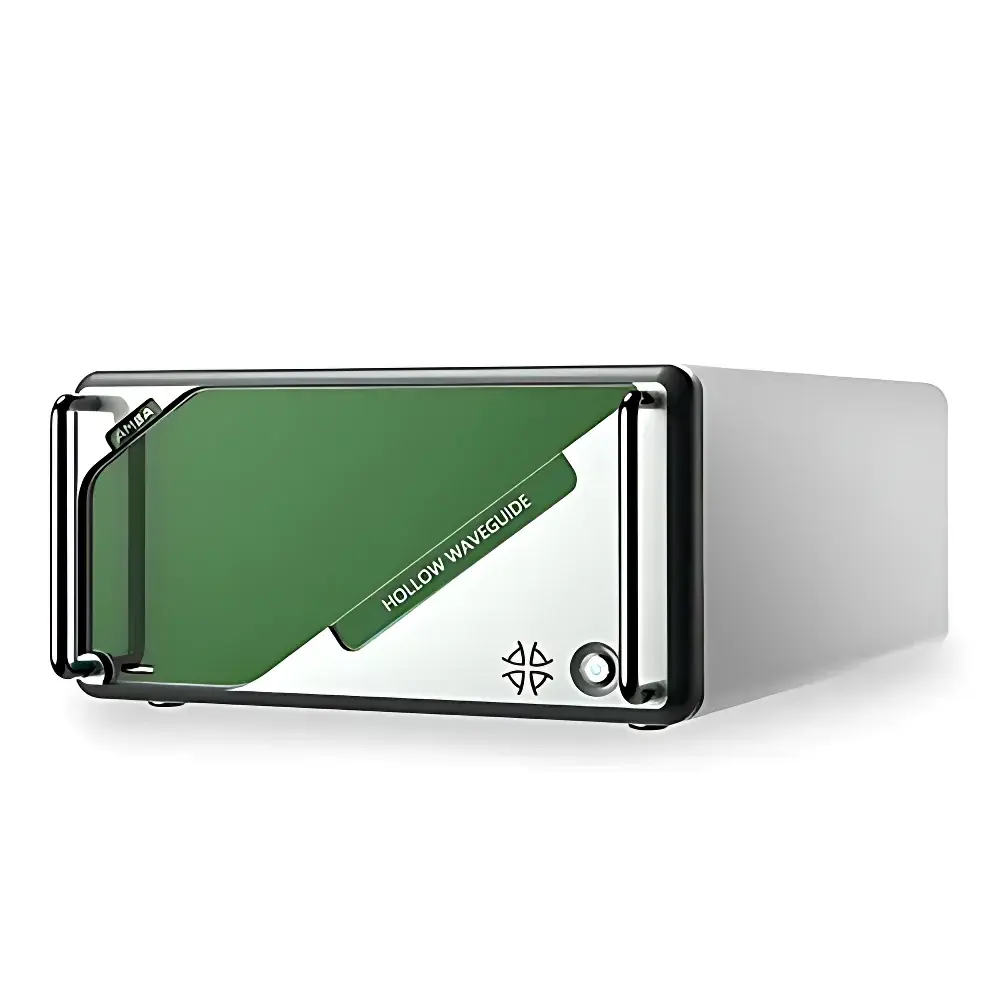
AMBA i3121 Ultra-High-Precision Liquid Water and Water Vapor Isotope Analyzer
| Origin | Netherlands |
|---|---|
| Manufacturer Type | Authorized Distributor |
| Origin Category | Imported |
| Model | i3121 |
| Pricing | Available Upon Request |
Overview
The AMBA i3121 Ultra-High-Precision Liquid Water and Water Vapor Isotope Analyzer is an advanced cavity-enhanced laser absorption spectrometer engineered for simultaneous, high-accuracy measurement of stable hydrogen (δD) and oxygen (δ18O) isotope ratios in both liquid water and ambient water vapor. It employs Linear Cavity Ring-Down Spectroscopy (CRDS), a highly sensitive optical technique leveraging long effective pathlengths (>20 km) within a linearly folded optical cavity to resolve minute isotopic absorption features near 1.39 µm and 1.47 µm. This principle enables sub-permil precision without reliance on offline equilibration or cryogenic trapping—delivering direct, real-time isotopic quantification with minimal sample preparation. Designed for hydrological tracing, paleoclimate reconstruction, ecohydrology, and atmospheric process studies, the i3121 meets the stringent analytical demands of ISO/IEC 17025-accredited laboratories and supports method validation per ASTM D8255 and USP for isotopic reference material traceability.
Key Features
- Dual-channel inlet architecture with physically isolated vapor and liquid pathways—reducing carryover and memory effects to ≤1.5% for δD and ≤1.0% for δ18O across sequential injections.
- Integrated dual-phase capability: seamless switching between vapor-phase analysis (1000–50,000 ppm H2O) and direct liquid injection via heated nebulizer or automated syringe pump.
- Compact industrial chassis (43 × 18 × 40 cm) with shock-damped optical bench, conforming to IEC 60529 IP20 rating for laboratory and field-deployable operation.
- Thermally stabilized cavity (±0.01 °C) and pressure-regulated sampling (<±0.1 Torr) ensure long-term baseline stability and reproducibility over 24-hour continuous runs.
- Low-power design: main unit consumes <180 W at steady state; optional vaporization module adds <80 W—compatible with uninterruptible power supplies for remote station deployment.
Sample Compatibility & Compliance
The i3121 accepts native liquid water samples (0.5–2 mL volume, pH 2–12, TDS <50 g/L) and ambient or humidified gas streams (300–1000 Torr, 35 mL/min at 760 Torr). It complies with GLP data integrity requirements through hardware-enforced audit trails, electronic signatures, and time-stamped raw absorbance logs. All firmware and calibration routines adhere to FDA 21 CFR Part 11 principles for regulated environments. Measurement uncertainty budgets are traceable to NIST SRM 1983 (δ18O) and VSMOW2/SLAP2 scale anchors, with linearity verified per ISO 11843-7 for detection limit estimation.
Software & Data Management
Controlled via AMBA Analyze v4.x—a Windows-based application supporting automated calibration sequences (two-point or multi-point), real-time spectral fitting, and δ-value calculation using iterative least-squares regression against user-defined reference standards. Data export formats include CSV, HDF5, and XML for integration into LIMS platforms. Software enforces version-controlled method templates, automatic QC flagging (e.g., cavity loss >1.2%, residual RMS >0.005 AU), and encrypted local storage compliant with GDPR Article 32 technical safeguards. Optional cloud sync enables secure remote monitoring and collaborative data review across distributed research networks.
Applications
- High-resolution evapotranspiration partitioning in watershed-scale ecohydrological modeling.
- Source attribution of atmospheric moisture in tropical cyclone genesis studies.
- Diagenetic fluid history reconstruction from porewater extracted from sediment cores.
- Validation of isotopic output from regional climate models (RCMs) and general circulation models (GCMs).
- Routine QA/QC of certified reference materials (CRMs) for inter-laboratory comparison exercises coordinated by IAEA/WMO.
FAQ
What sample volumes are required for liquid water analysis?
For standard operation: 0.8–1.5 mL per injection. With the optional 130-position autosampler, sample throughput reaches up to 200 analyses per unattended 24-hour cycle.
Does the system require external calibration gases or standards?
No—calibration is performed using liquid reference waters (e.g., VSMOW2, GISP) introduced via the same inlet path as unknowns, ensuring identical matrix effects and minimizing systematic bias.
Can the i3121 operate unattended in a field trailer or mobile lab?
Yes—its wide operating temperature range (−10 to +45 °C for vapor mode), low power draw, and vibration-resistant optics support deployment in Class II environmental enclosures meeting MIL-STD-810G shock/vibration criteria.
How is memory effect quantified and validated?
Memory is measured as residual signal amplitude after sequential injection of high/low isotopic standards (e.g., −300‰ vs. +100‰ δD), reported as % carryover in the instrument’s built-in diagnostic report per ISO 17034 Annex D.
Is firmware update capability available remotely?
Yes—secure SSH-enabled updates are supported via Ethernet connection; all patches undergo FIPS 140-2 validated cryptographic signing prior to installation.





