
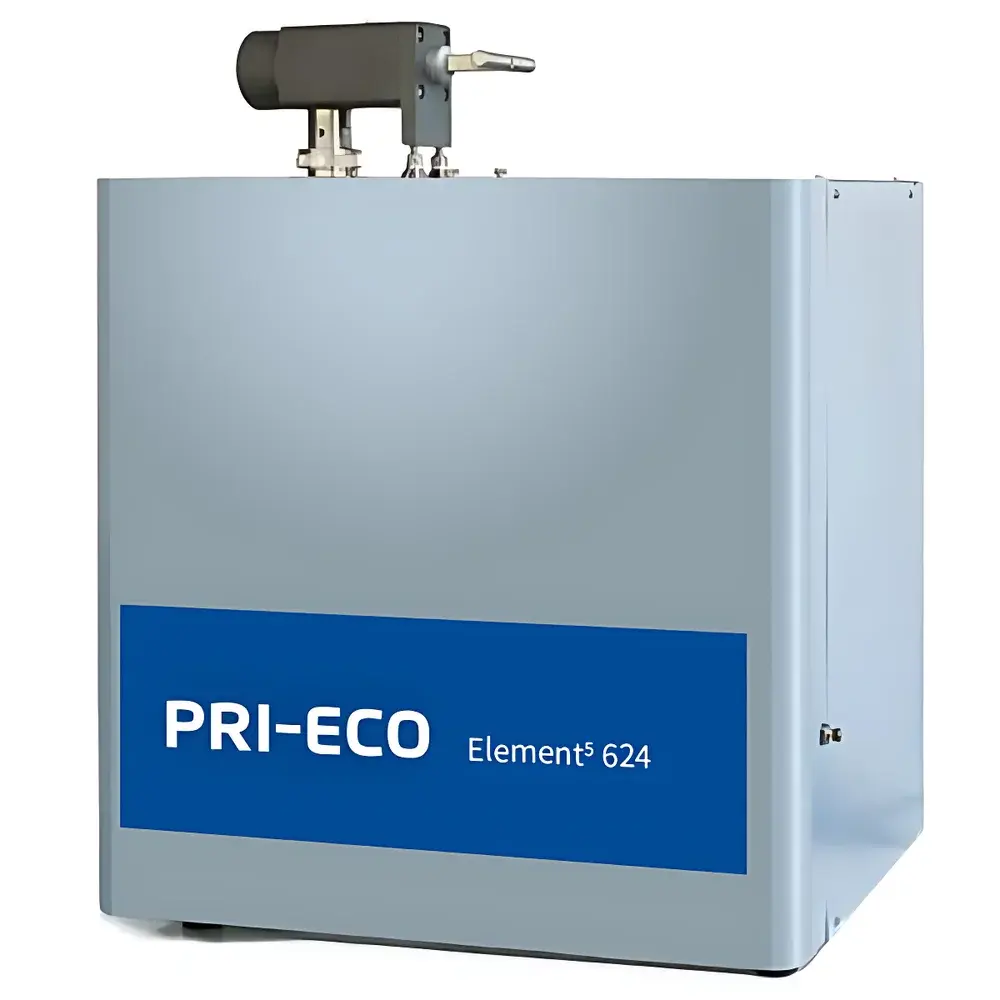
Pri-eco Element5 624 CHNSO Organic Elemental Analyzer
| Brand | Pri-eco |
|---|---|
| Origin | Beijing, China |
| Manufacturer Type | Manufacturer |
| Model | Element5 624 |
| Detection Elements | C, H, N, S, O |
| Principle | Dumas flash combustion coupled with gas chromatographic separation |
| 炉 Design | Single-furnace (oxidation and reduction in one furnace) |
| Detector | TCD with auto-calibration |
| Sample Mass Range | 0.01–100 mg |
| Detection Range | 200 ppm – 100% |
| Accuracy | < 0.2% (vs. certified reference materials) |
| Precision | < 0.1% RSD (vs. certified reference materials) |
| LOD | 1–5 µg |
| Combustion/Reduction Temperature | 800–1100 °C |
| Analysis Time (CHNS) | ~15 min |
| GC Column Length | 2 m |
| Calibration Models | Linear, quadratic, cubic |
| Software | EAS CLARITY |
| Carrier Gas | Helium (99.999%, 3–5 bar) |
| Oxidant | Oxygen (99.999%, 3–5 bar) |
| Power Supply | 230 VAC ±10%, 1–10 A |
| Dimensions (L×W×H) | 760 × 350 × 700 mm |
Overview
The Pri-eco Element5 624 CHNSO Organic Elemental Analyzer is a high-performance, single-furnace combustion-based instrument engineered for precise quantification of carbon, hydrogen, nitrogen, sulfur, and oxygen in organic matrices. It implements the Dumas flash combustion principle—where samples are rapidly oxidized at controlled high temperatures (800–1100 °C) in an oxygen-rich environment—followed by selective separation of evolved gases (CO₂, H₂O, NOₓ, SO₂, CO) via dedicated gas chromatographic columns. Oxygen determination is achieved through high-temperature pyrolytic reduction in the same furnace, eliminating inter-furnace transfer variability. This integrated thermal architecture ensures exceptional reproducibility and minimizes system complexity without compromising analytical rigor. Designed for laboratories requiring robust, cost-effective elemental analysis across diverse sample types—from soil and plant tissue to pharmaceutical intermediates and petrochemical feedstocks—the Element5 624 meets core requirements for method validation under ISO 17025, ASTM D5291, ASTM D7359, and USP , supporting GLP-compliant workflows.
Key Features
- Single-furnace configuration enabling both oxidative (CHNS) and reductive (O) reactions within one thermally stable zone, reducing calibration drift and maintenance overhead
- Thermal conductivity detector (TCD) with built-in auto-calibration routine—no external reference gas required, ensuring long-term baseline stability and operational continuity
- Modular reaction tube system: interchangeable oxidation/reduction tubes (multiple diameters available) optimized for sample mass (0.01–100 mg), matrix volatility, and carbon content (ppm to 100%)
- Flexible gas flow management: programmable O₂ dosing per analysis to conserve high-purity oxygen and extend consumable life
- Multi-tier sample introduction options: manual single-sample holder or motorized rotary autosamplers (32-, 50-, or 100-position); pneumatic stackable trays support up to 147 samples with minimal operator intervention
- Integrated combustion monitoring via standard top-view inspection port, allowing real-time visual verification of sample ignition and ash residue formation
- Compact footprint (760 × 350 × 700 mm) suitable for benchtop deployment in regulated QC labs or field-deployable research units
Sample Compatibility & Compliance
The Element5 624 accommodates solid powders, pressed pellets, filter papers, cryo-milled tissues, and homogenized liquids—provided they are non-volatile under ambient handling conditions. Its wide dynamic range (200 ppm to 100% w/w) supports applications from trace nutrient profiling in agricultural soils (ISO 14254) to bulk carbon quantification in polymer additives (ASTM D6348). All hardware and software components comply with CE marking directives and electromagnetic compatibility (EMC) standards IEC 61326-1. The EAS CLARITY software architecture supports audit-trail logging, user-access controls, and electronic signature capability—facilitating alignment with FDA 21 CFR Part 11 requirements when configured with appropriate IT governance policies. Routine performance verification follows certified reference materials (e.g., sulfanilamide, benzoic acid, acetanilide) traceable to NIST SRMs.
Software & Data Management
EAS CLARITY is a Windows-based acquisition and evaluation platform offering full method scripting, multi-point calibration (linear, quadratic, cubic), and adaptive curve fitting. It provides real-time chromatogram visualization, peak integration with manual override, and automated reporting compliant with ISO/IEC 17025 clause 7.8. Raw data files (.raw) are stored in vendor-neutral binary format with embedded metadata (operator ID, timestamp, furnace temperature profile, gas pressures). Export options include CSV, PDF, and XML for LIMS integration. The software supports batch processing of up to 147 sequential runs, with automatic pass/fail flagging against user-defined specification limits. Audit trails record all parameter modifications, calibration events, and report generation actions—retained for ≥36 months unless purged under documented data retention policy.
Applications
- Environmental science: Total organic carbon (TOC), C/N ratios, and sulfur speciation in sediments, composts, and atmospheric particulates
- Agricultural research: Protein estimation (N × 6.25), fertilizer efficiency studies, and isotopic tracer coupling (via optional IRMS interface)
- Pharmaceutical QA/QC: Assay verification of active pharmaceutical ingredients (APIs), excipient purity screening, and residual solvent quantification (when coupled with GC-MS)
- Food & feed analysis: Crude protein content (AOAC 992.15), adulteration detection, and nutritional labeling compliance (EU Regulation 1169/2011)
- Petrochemical testing: Hydrocarbon composition profiling, sulfur content in fuels (ASTM D5453), and catalyst poisoning assessment
- Academic & method development labs: Method transfer validation, inter-laboratory comparison studies, and reference material certification
FAQ
What sample forms are compatible with the Element5 624?
Solid powders, pressed pellets (using micro-press), filter papers loaded with digested extracts, and low-volatility liquid residues (e.g., evaporated aqueous extracts) are routinely analyzed. Highly volatile or halogenated organics require pre-treatment or alternative instrumentation.
Does the system support oxygen analysis without hardware modification?
Yes—oxygen quantification is performed in the same furnace using a separate reduction step; no additional reactor module or gas line is required.
Can the Element5 624 be integrated with isotope ratio mass spectrometry (IRMS)?
Yes—its standardized GC effluent outlet and helium carrier compatibility enable seamless coupling to IRMS systems for δ¹³C, δ¹⁵N, δ³⁴S, and δ¹⁸O measurements.
Is routine maintenance limited to consumables only?
Primary maintenance involves periodic replacement of quartz reaction tubes, NiO catalyst, and Mg(ClO₄)₂ water trap; furnace insulation and TCD filament integrity are verified annually during IQ/OQ protocol execution.
How is data integrity ensured during extended unattended operation?
EAS CLARITY enforces write-once file locking, cyclic redundancy checksums on raw data blocks, and synchronized system clock logging—meeting ALCOA+ principles for raw data preservation.
Related Products






