
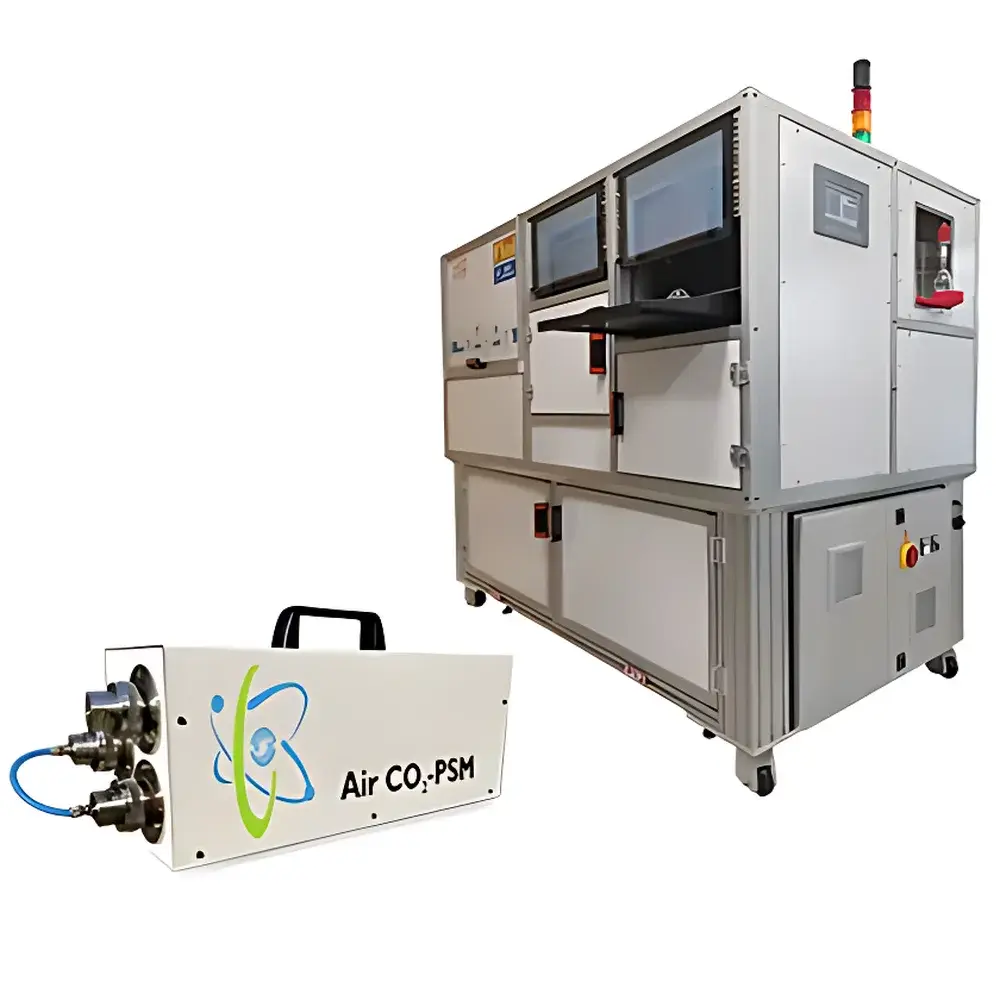
Pri-eco EA-SCAR 14CO₂ Isotope Ratio Analyzer for Online Atmospheric Radiocarbon Monitoring
| Brand | Pri-eco |
|---|---|
| Origin | Beijing, China |
| Manufacturer Type | Original Equipment Manufacturer (OEM) |
| Regional Classification | Domestic (China) |
| Model | EA-SCAR 14CO₂ |
| Quotation | Upon Request |
| Measurement Precision | 1–1.5 pMC @ 10 min |
| Isotope Measured | ¹⁴C in CO₂ |
Overview
The Pri-eco EA-SCAR 14CO₂ Isotope Ratio Analyzer is a high-sensitivity, laser-based analytical system engineered for continuous, real-time quantification of atmospheric radiocarbon (¹⁴C) in carbon dioxide. Unlike conventional accelerator mass spectrometry (AMS), which requires extensive sample preparation and offline analysis, the EA-SCAR platform implements saturated-absorption cavity ring-down (SCAR) spectroscopy in the mid-infrared region (≈4.5 µm) to achieve direct, calibration-free detection of ¹⁴CO₂ at parts-per-quadrillion (ppq) sensitivity. The instrument integrates a front-end CO₂ purification module—comprising Zeoquantum adsorption/desorption and integrated H₂O removal—to deliver ultra-pure, dry CO₂ gas to the optical measurement cell. This architecture ensures minimal isotopic fractionation and high reproducibility across extended operation cycles. Designed for long-term unattended deployment, the EA-SCAR supports the establishment of regional ¹⁴CO₂ observation networks aligned with national carbon accounting frameworks, including verification of fossil fuel CO₂ contributions under ISO 14064-2 and support for GHG inventory reporting per IPCC Tier 3 methodologies.
Key Features
- Mid-infrared SCAR spectroscopy using distributed-feedback quantum cascade lasers (DFB-QCLs) operating near 2200 cm⁻¹ for selective ¹⁴CO₂ absorption line probing
- Dual-cavity differential configuration enabling common-mode noise rejection and enhanced signal stability
- Online, high-frequency measurement capability: configurable integration times from 10 minutes to 4 hours, with precision scaling inversely with square root of averaging time
- Modular interface supporting optional coupling to isotope ratio mass spectrometry (IRMS) for cross-validation or dual-isotope (e.g., δ¹³C + Δ¹⁴C) workflows
- Automated leak-checking, electronic flow control, and helium/oxygen/air gas management compliant with EN 61000-6-3 for electromagnetic compatibility in laboratory environments
- Integrated reaction furnace system (dual-zone, up to 1100 °C) compatible with elemental analyzers (e.g., ECS 8070 CN) for on-site conversion of organic carbon to CO₂ prior to SCAR analysis
Sample Compatibility & Compliance
The EA-SCAR accepts gaseous CO₂ samples ranging from ambient air (≈400 ppm CO₂) to enriched standards (up to 10⁴ pMC). It accommodates input from both fixed-site inlet systems and portable field capture units (e.g., C-Quantum device, 3 kg, rechargeable battery-powered, 20-sample capacity per charge). The system meets GLP-compliant data integrity requirements through timestamped, audit-trail-enabled acquisition software. All hardware components conform to IEC 61010-1 safety standards for laboratory equipment. While not FDA 21 CFR Part 11-certified out-of-the-box, the software architecture supports qualified electronic signature implementation and full traceability of raw decay curves, calibration logs, and environmental metadata (temperature, pressure, flow rate)—essential for ISO/IEC 17025-accredited laboratories conducting radiocarbon source attribution studies.
Software & Data Management
Acquisition and processing are managed via Pri-eco’s proprietary SCAR-Analyzer Suite, a Windows-based application built on Qt framework with HDF5-native data storage. Each measurement session generates a self-contained .h5 file containing raw cavity ring-down time series, spectral fitting residuals, background-subtracted absorbance spectra, and derived ¹⁴C activity expressed in percent modern carbon (pMC). Batch processing supports automated baseline correction, pressure/temperature normalization (using ideal gas law), and drift compensation against reference gas injections. Export formats include CSV (for Excel or R integration), NetCDF (for climate modeling pipelines), and XML (for LIMS interoperability). Raw data files retain full instrumental metadata required for third-party reprocessing—critical for inter-laboratory comparison studies referenced in PNAS and Advanced Photonics Research publications.
Applications
- Atmospheric monitoring of fossil-derived CO₂ in urban and industrial zones for emission verification under national “dual-carbon” strategies
- Biogenic fraction determination in blended transportation fuels (e.g., ethanol-gasoline, biodiesel-diesel) per ASTM D6866-22 Annex A3
- Radiocarbon dating support for low-mass environmental samples (soil CO₂ fluxes, tree-ring CO₂, ice-core air bubbles) where AMS access is limited
- Nuclear waste characterization via ¹⁴C inventory assessment in graphite moderators or spent fuel reprocessing off-gases
- Calibration and validation of regional atmospheric transport models (e.g., WRF-Chem, STILT) using high-temporal-resolution ¹⁴CO₂ time series
FAQ
What is the minimum detectable ¹⁴CO₂ activity level?
The system achieves a lower limit of quantification (LLOQ) of 1–1.5 pMC at 10-minute integration, improving to 0.2–0.3 pMC at 240 minutes under stable environmental conditions.
Can the EA-SCAR be deployed outdoors or in mobile laboratories?
Yes—the main analyzer unit (200 × 110 × 160 cm, 78 kg) is rack-mountable and vibration-isolated; it is routinely operated in containerized labs. The companion C-Quantum field sampler enables autonomous CO₂ collection under ambient conditions (10–60 min per sample, stored in replaceable glass tubes).
Is helium the only carrier gas required?
Helium (99.999% purity, 3–5 bar) is mandatory for optical path purging and CO₂ transport; oxygen (99.999%) and oil-free compressed air are required only when interfaced with combustion-based elemental analyzers.
How does SCAR compare to IRMS for ¹⁴C analysis?
SCAR offers higher throughput and lower operational cost than IRMS but does not provide simultaneous δ¹³C data unless coupled to an external IRMS. Its strength lies in continuous, non-destructive monitoring rather than high-precision single-sample isotope ratio determination.
Are calibration standards traceable to international references?
Yes—system calibration uses NIST-traceable ¹⁴C reference gases (e.g., IAEA-C6, OxII) and follows procedures documented in ISO 18311:2016 for radiocarbon measurement uncertainty estimation.
Related Products




