
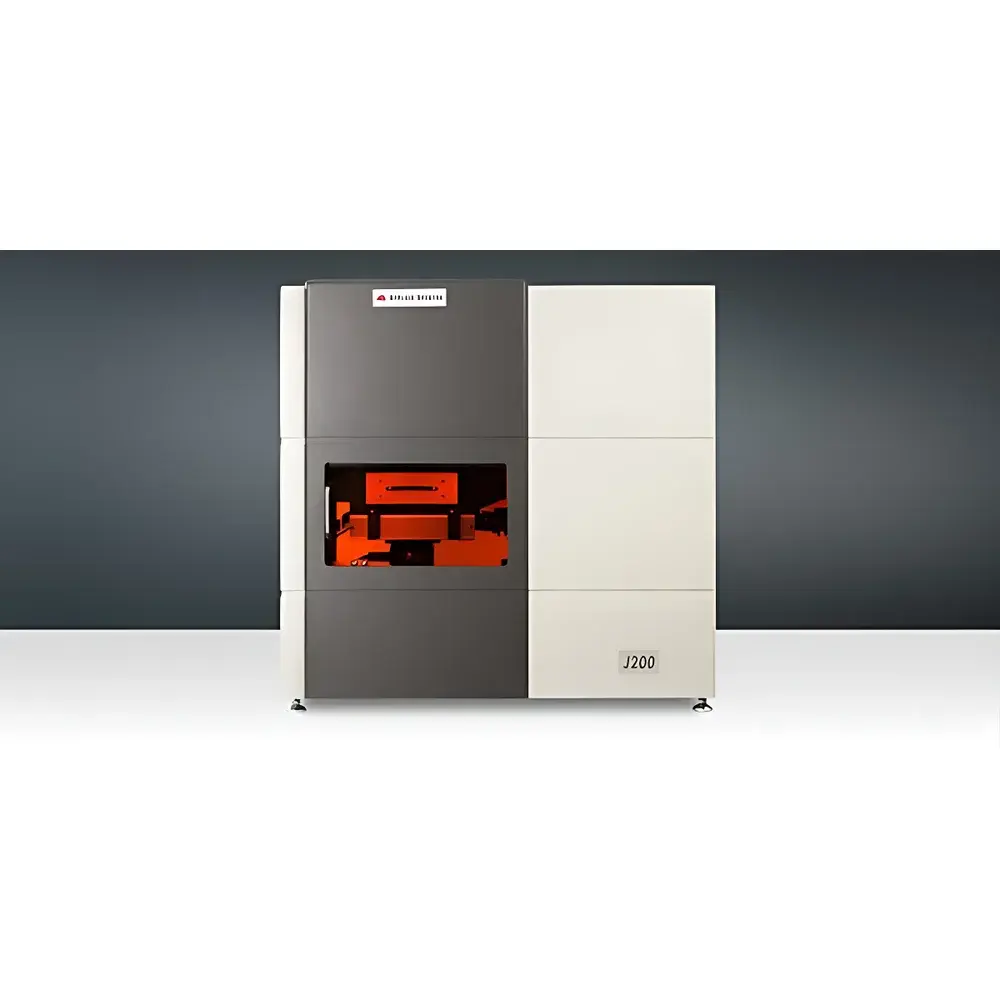
ASI J200 LA-LIBS Hybrid Laser Ablation and Laser-Induced Breakdown Spectroscopy System
| Origin | USA |
|---|---|
| Supplier Type | Authorized Distributor |
| Import Status | Imported |
| Model | LA-LIBS |
| Pricing | Available Upon Request |
Overview
The ASI J200 LA-LIBS Hybrid System integrates two complementary laser-based elemental analysis techniques—Laser Ablation (LA) and Laser-Induced Breakdown Spectroscopy (LIBS)—into a single, synchronized platform engineered for spatially resolved, multi-elemental characterization of solid, liquid, and gaseous samples. At its core, the system employs a high-stability, nanosecond-pulsed Nd:YAG laser (266 nm, ≤25 mJ, 20 Hz, <6 ns FWHM) to generate transient micro-plasmas on sample surfaces; emitted atomic/ionic line spectra are collected by a high-resolution Czerny–Turner spectrometer (190–1040 nm spectral range) with λ/Δλ up to 6000 and spectral accuracy better than ±0.05 nm. Simultaneously, ablated particles are transported via inert gas flow (He or Ar) to an external ICP-MS for ultra-trace quantification at sub-ppt (ppq) levels. This dual-path architecture enables both rapid qualitative screening (LIBS) and high-sensitivity quantitative depth profiling (LA–ICP-MS), supporting comprehensive elemental coverage across the entire periodic table—including light elements (H, C, N, O, F) under controlled He-atmosphere conditions.
Key Features
- Hybrid operational modes: standalone LIBS, standalone LA, or fully synchronized LA–LIBS acquisition with real-time correlation of optical emission and aerosol transport signals.
- Flexible laser configuration: ns-laser standard (266 nm); optional fs-laser integration for reduced thermal effects and improved spatial resolution.
- Automated sample handling: motorized XYZ stage (100 × 100 × 35 mm travel, 0.2 µm step resolution and repeatability), auto-focus via 670 nm assist laser, and dual-CMOS imaging (wide-field overview + high-magnification ablation monitoring).
- Precise beam control: continuously variable spot size (35–250 µm at sample surface), optical attenuator for 0–100% energy adjustment, dual automatic laser shutters for stable signal gating and energy management.
- Environmental control: sealed, gas-purged sample chamber compatible with He or Ar atmospheres; integrated air filtration and desiccant modules for moisture/oxygen-sensitive analyses (e.g., hydride-forming elements).
- Laser safety compliance: Class I enclosure with interlocked access ports, optical filters in viewing path, and hardware-enforced laser lockout during maintenance.
Sample Compatibility & Compliance
The J200 accommodates heterogeneous materials without dissolution or matrix-matching requirements—enabling direct analysis of metals, alloys, geological specimens, polymers, biological tissues, thin films, and forensic trace evidence (e.g., glass fragments, paint layers). Sample preparation is minimized: minimal polishing required; no conductive coating needed. The system meets ISO/IEC 17025 documentation standards for laboratory accreditation and supports GLP/GMP workflows through audit-trail-enabled software logging. For regulated environments (pharmaceutical QC, environmental testing), data integrity complies with FDA 21 CFR Part 11 requirements via electronic signatures, user access controls, and immutable raw-data archiving. All spectral calibrations reference NIST-traceable LIBS databases (NIST Atomic Spectra Database) and ASI’s proprietary TruLIBS™ library (84 elements, including isotopic variants).
Software & Data Management
ASI’s unified TRU-ANALYZE™ software provides end-to-end control—from experimental design to multivariate interpretation. It supports customizable acquisition protocols (single-spot, line scans, raster mapping, depth profiling) and integrates real-time plasma diagnostics (electron temperature, excitation temperature). Spectral processing includes automatic peak identification, background subtraction, self-absorption correction, and intensity normalization against internal standards or plasma parameters. Quantitative analysis leverages univariate and multivariate calibration (PLS-R, PCA), with built-in uncertainty propagation. Elemental distribution maps (2D/3D) are generated with pixel-level metadata (ablation time, laser energy, plasma delay), exportable in HDF5, CSV, or vendor-neutral .spc formats. Raw spectra and processed results are stored in a relational database with version-controlled project histories.
Applications
- Geochemical provenance studies: zircon U–Pb dating support, mineral phase mapping, rare-earth element (REE) fractionation analysis.
- Pharmaceutical QA/QC: elemental impurity screening per ICH Q3D guidelines; tablet coating uniformity assessment.
- Electronics & photovoltaics: dopant distribution in Si wafers, interfacial contamination detection in thin-film stacks.
- Forensic science: glass refractive index correlation via Mg/Ca/Sr ratios; gunshot residue (GSR) particle composition (Pb, Ba, Sb).
- Materials research: oxidation state mapping (e.g., Fe²⁺/Fe³⁺ via 404.5 nm vs. 407.2 nm lines), hydrogen depth profiling in metal hydrides.
- Environmental monitoring: bioaccumulation studies in plant tissues, heavy metal speciation in soil micromorphologies.
FAQ
Can the J200 analyze light elements such as hydrogen, carbon, nitrogen, and oxygen?
Yes—when operated in a helium-purged chamber to minimize atmospheric N₂/O₂ interference and enhance UV line transmission (e.g., H I 656.3 nm, C I 247.9 nm, N I 337.1 nm, O I 777.2 nm).
Is the system compatible with third-party ICP-MS instruments?
Yes—the LA module features standardized gas-tight interface fittings (Swagelok® 1/4″ VCR) and adjustable aerosol transport parameters (flow rate, carrier gas composition, residence time) optimized for coupling with Thermo Fisher, Agilent, and Nu Instruments ICP-MS platforms.
Does the software support automated calibration curve generation?
Yes—TRU-ANALYZE™ includes guided workflows for single- and multi-element calibration using certified reference materials (CRMs), with automatic outlier rejection and error-weighted regression.
What is the minimum detectable mass for trace elements in solid samples?
Under optimal LA–ICP-MS coupling, detection limits reach 0.01–0.1 pg for most elements; LIBS-only detection limits range from 1–100 ppm depending on matrix and emission line intensity.
How is data integrity ensured during long-duration mapping experiments?
The system logs timestamped metadata (laser energy, focus position, ambient pressure, detector gain) for every spectrum; all raw data are written directly to disk in non-proprietary binary format with checksum validation.





