
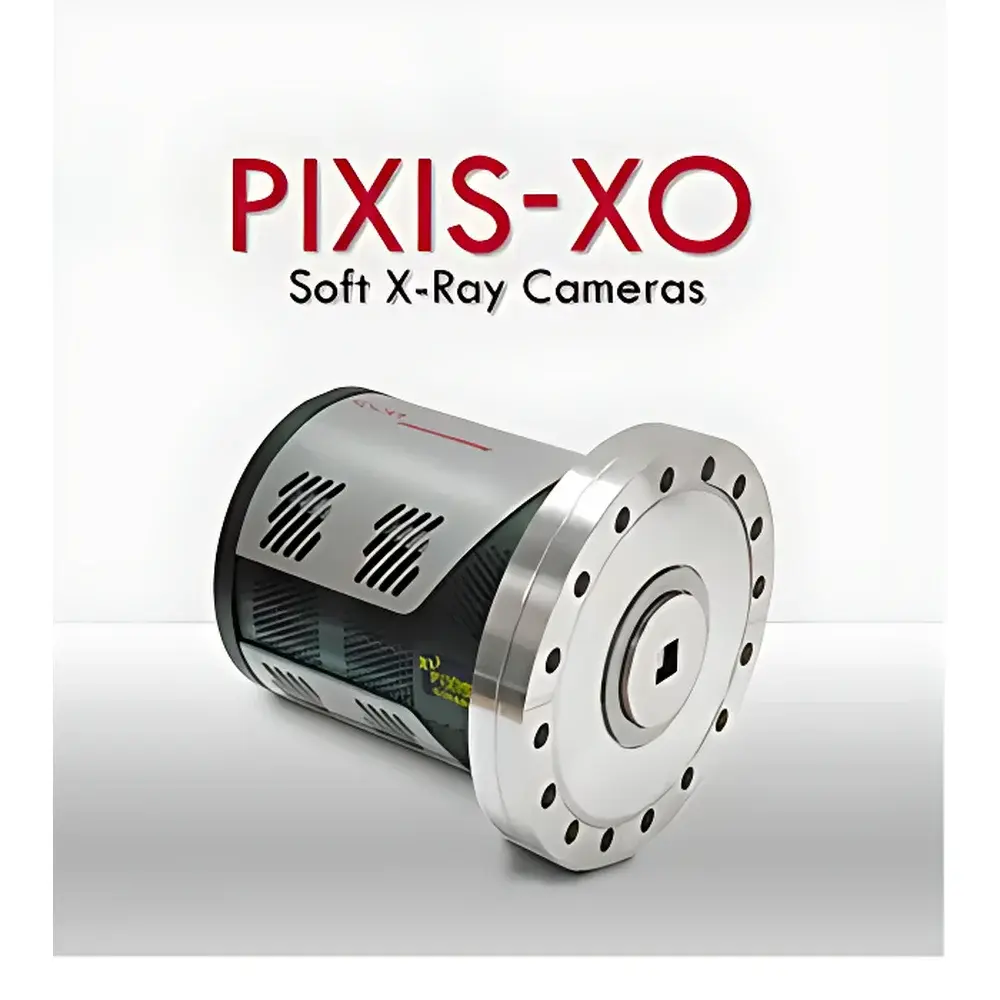
Princeton Instruments PIXIS-XO Soft X-ray Camera
| Brand | Teledyne Princeton Instruments |
|---|---|
| Origin | USA |
| Model Variants | PIXIS-XO-100B, PIXIS-XO-100BR, PIXIS-XO-400B, PIXIS-XO-400BR, PIXIS-XO-1024B, PIXIS-XO-1024BR, PIXIS-XO-1300B, PIXIS-XO-2KB, PIXIS-XO-2048B |
| Pixel Sizes | 13 × 13 µm, 13.5 × 13.5 µm, 20 × 20 µm |
| Detection Range | <30 eV to ~20 keV |
| Cooling | Thermoelectric (–70 °C to –90 °C) |
| Readout Interface | High-speed USB 2.0 |
| ADC Resolution | 16-bit |
| Readout Speed | Up to 2 MHz |
| Sensor Architecture | Back-illuminated, deep-depletion CCD options available |
| Vacuum Interface | Rotatable ConFlat (CF) flange |
Overview
The Princeton Instruments PIXIS-XO Soft X-ray Camera is a scientific-grade, direct-detection imaging system engineered for high-sensitivity, low-noise detection of photons across the extreme ultraviolet (EUV) and soft X-ray spectral regions. Utilizing back-illuminated, deep-depletion charge-coupled device (CCD) sensors, the PIXIS-XO operates on the principle of photoelectron generation within silicon—where incident photons with energies from 80% at 1–2 keV for optimized deep-depletion variants—critical for applications requiring photon-starved signal capture. The camera’s thermoelectric cooling architecture achieves stable sensor temperatures between –70 °C and –90 °C, suppressing dark current to sub-0.001 e⁻/pixel/s levels and enabling long integration times without thermal noise degradation. Its ultra-high vacuum (UHV)-compatible rotatable ConFlat flange ensures seamless integration into beamlines, plasma chambers, and synchrotron endstations while maintaining optical alignment flexibility during setup and calibration.
Key Features
- Back-illuminated CCD sensors with optional deep-depletion architecture for enhanced QE in the soft X-ray/EUV range (30 eV–20 keV)
- Multiple array configurations: from 1340 × 100 to 2048 × 2048 pixels, supporting application-specific field-of-view and resolution trade-offs
- Precision pixel geometries: 13 × 13 µm, 13.5 × 13.5 µm, and 20 × 20 µm—optimized for spatial resolution, full-well capacity, and read noise performance
- Dual-output, selectable-gain amplifier architecture enabling simultaneous optimization of speed and noise floor
- True 16-bit analog-to-digital conversion with ≤3 e⁻ rms read noise (low-gain mode) and dynamic range exceeding 80 dB
- High-speed USB 2.0 interface providing plug-and-play connectivity without proprietary frame grabbers or PCIe cards
- LightField 64-bit acquisition software with real-time background subtraction, flat-field correction, and non-uniformity compensation
- Fully programmable PICAM API (64-bit) supporting LabVIEW, MATLAB, Python, and C/C++ integration for OEM and automated workflows
Sample Compatibility & Compliance
The PIXIS-XO is designed for direct detection of photons—not scintillator-coupled indirect imaging—making it ideal for vacuum-compatible experiments where optical transmission losses must be minimized. All models comply with ISO 14644-1 Class 5 cleanroom assembly protocols and meet RoHS 3 and REACH material restrictions. The CF-63 or CF-100 vacuum feedthroughs conform to ASTM F2517-17 standards for UHV sealing integrity. For regulated environments—including GLP/GMP-compliant plasma diagnostics or EUV lithography process monitoring—the LightField software supports audit-trail logging, user access controls, and 21 CFR Part 11–compliant electronic signatures when deployed with validated configuration management.
Software & Data Management
LightField serves as the unified control and analysis environment for the PIXIS-XO, offering hardware-synchronized triggering, multi-region-of-interest (ROI) binning, and real-time histogram statistics. Its embedded firmware implements on-the-fly pedestal correction and correlated double sampling (CDS) to minimize kTC noise and reset anomalies. Raw data are saved in vendor-neutral TIFF or HDF5 formats with embedded metadata (exposure time, gain setting, temperature, timestamp), ensuring FAIR (Findable, Accessible, Interoperable, Reusable) data principles. Batch processing pipelines support automated calibration application (e.g., energy-scale mapping via known line spectra), and export modules integrate natively with Igor Pro, OriginLab, and Python-based analysis stacks (NumPy, SciPy, scikit-image).
Applications
- X-ray plasma diagnostics: Time-resolved imaging and spectroscopy of tokamak, Z-pinch, and laser-produced plasmas—enabling electron temperature and density reconstruction via continuum slope and line-ratio analysis
- Soft X-ray microscopy: Zone-plate-based full-field imaging of hydrated biological specimens at ~10–50 nm resolution, leveraging water-window contrast (284–543 eV)
- EUV lithography metrology: In-situ mask inspection and source stability monitoring at 13.5 nm using calibrated reflectivity and dose uniformity analysis
- X-ray absorption spectroscopy (XAS): Quick-EXAFS and XANES measurements at bending-magnet or insertion-device beamlines, where high QE and linearity ensure accurate edge-jump quantification
- High-harmonic generation (HHG) characterization: Single-shot spectral and spatial profiling of attosecond pulse trains in vacuum UV and soft X-ray regimes
FAQ
What vacuum level is required for optimal PIXIS-XO operation?
The camera is rated for continuous operation at pressures ≤1 × 10⁻⁶ Torr; for extended exposure below 100 eV, pressures ≤1 × 10⁻⁸ Torr are recommended to minimize hydrocarbon contamination on the sensor surface.
Can the PIXIS-XO be used with phosphor screens for indirect detection?
No—it is optimized for direct illumination only; coupling to scintillators introduces significant point-spread degradation and QE loss unsuitable for quantitative soft X-ray work.
Is radiometric calibration traceable to NIST standards available?
Yes—Teledyne Princeton Instruments offers optional NIST-traceable absolute QE calibration across the 30 eV–20 keV range, delivered with uncertainty budgets per ISO/IEC 17025 requirements.
How does the dual-amplifier architecture improve experimental flexibility?
One amplifier is optimized for speed (up to 2 MHz), the other for ultra-low noise (<3 e⁻ rms); users select based on whether temporal resolution or SNR dominates the measurement objective.
Does LightField support synchronized multi-camera acquisition?
Yes—via hardware TTL triggering and shared clock distribution, enabling precise temporal registration across multiple PIXIS-XO units or hybrid detector arrays (e.g., combined X-ray/visible-light imaging).



