
Pri-eco PRI-8800 Automated Temperature-Programmed Soil Incubation System for Online Greenhouse Gas Monitoring
| Brand | Pri-eco |
|---|---|
| Origin | Beijing, China |
| Manufacturer Type | Original Equipment Manufacturer (OEM) |
| Country of Origin | China |
| Model | PRI-8800 |
| Price Range | USD 42,000 – 70,000 |
Overview
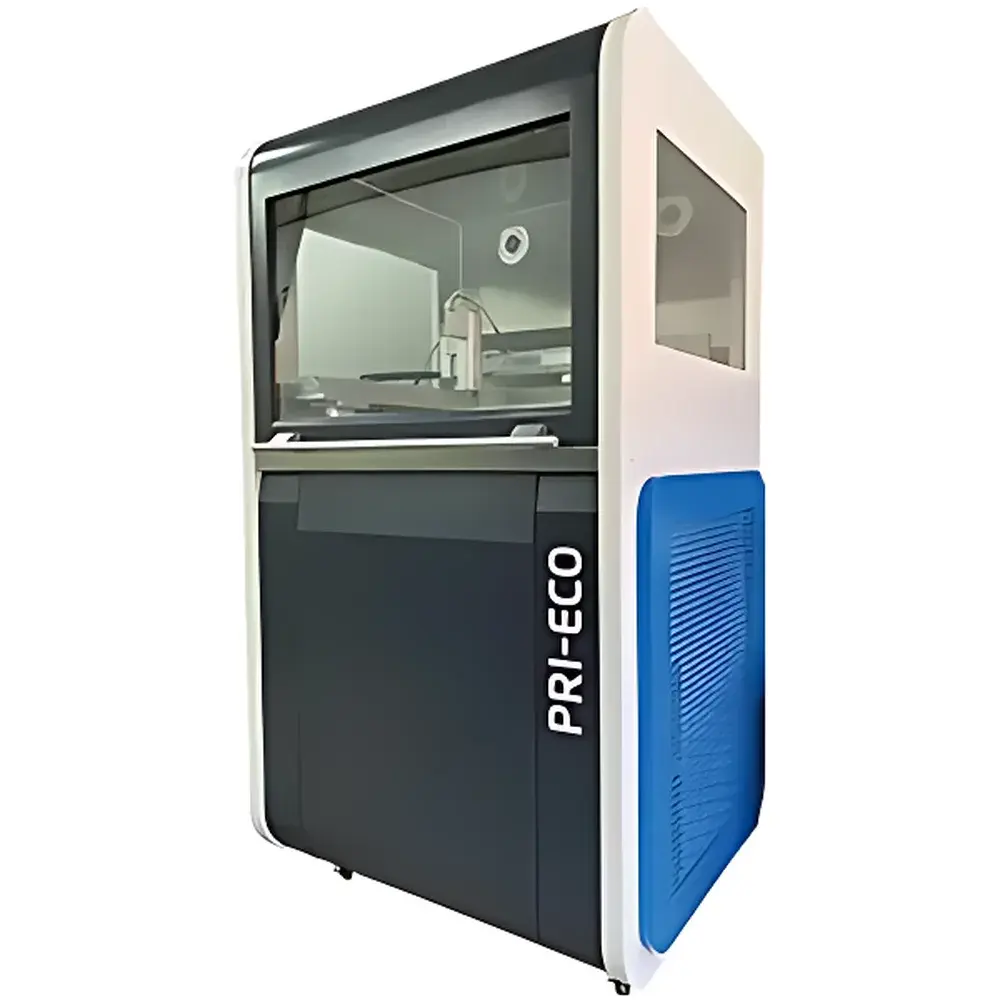
The Pri-eco PRI-8800 is an engineered platform for high-resolution, automated soil incubation under precisely controlled and dynamically programmable temperature regimes, enabling continuous, real-time quantification of CO₂ and H₂O fluxes from soil samples. It operates on the principle of closed-chamber gas exchange monitoring coupled with active thermal programming—where soil respiration rates are measured across ≥20 discrete or continuously ramped temperature points (–15 °C to +60 °C) to robustly parameterize the temperature sensitivity of organic matter decomposition (Q₁₀). Unlike conventional static incubators limited to 3–5 fixed temperatures, the PRI-8800 eliminates interpolation bias in Arrhenius- or exponential Q₁₀ fitting by delivering high-density thermal response curves with ±0.05 °C stability and ≥1 °C/min average ramp rate. Its integrated architecture combines a 25-position auto-sampler, Peltier-assisted refrigeration/heating chamber, and built-in NDIR-based CO₂/H₂O analyzer—enabling unattended operation over hours to weeks while maintaining traceable environmental control per ASTM D5918 and ISO 16072 standards for soil respiration testing.
Key Features
- Automated temperature programming: Supports user-defined stepwise, linear, or sinusoidal thermal profiles—including diel, seasonal, or multi-year simulated warming scenarios.
- Ultra-stable thermal control: Chamber temperature uniformity ±0.05 °C at setpoint; sensor accuracy ±0.15 °C; internal cavity dimensions 400 × 400 × 200 mm (W×D×H).
- High-throughput sample handling: 25-position stainless-steel sample tray; 307 mL 304 stainless-steel incubation vials; optional PTFE transfer rings and 4.8 cm-diameter stainless-steel core samplers for undisturbed soil extraction.
- Integrated gas analysis: Onboard dual-channel NDIR analyzer measuring CO₂ (0–2000 ppm, ±2% accuracy) and H₂O (0–6% vol, ±2% accuracy); 1 L/min standardized flow; zero/span drift <2% per year.
- Modular analytical expansion: Compatible with external high-precision analyzers including multi-gas (CO₂/CH₄/N₂O/H₂O) systems and isotope-ratio infrared spectrometers (e.g., δ¹³C-CO₂) via standardized 1/8″ stainless-steel or PTFE gas lines.
- Full environmental traceability: Internal pressure sensor (±0.05% FS), humidity-controlled electronics (<99% RH, non-condensing), and audit-ready logging compliant with GLP and FDA 21 CFR Part 11 requirements when paired with validated software.
Sample Compatibility & Compliance
The PRI-8800 accommodates heterogeneous soil matrices—including mineral soils, peats, permafrost cores, and amended substrates—within standardized 307 mL stainless-steel vials or optional 150 mL borosilicate glass bottles rated for –15 °C to +60 °C operation. Sample integrity is preserved via inert gas purging (ambient air buffer or certified calibration gases) and sealed PTFE-lined lids. The system meets mechanical and electrical safety requirements per IEC 61010-1 and supports method validation per ISO 16072 (soil respiration measurement), ASTM D5918 (laboratory incubation of soils), and USP (temperature-controlled stability testing). All thermal and gas data streams are time-stamped, pressure-compensated, and exportable in CSV/NetCDF formats for third-party modeling (e.g., R, Python, MATLAB).
Software & Data Management
Control and acquisition are managed via embedded Windows-based software with intuitive graphical workflow builder—supporting batch scheduling of temperature ramps, gas sampling intervals (1–60 min), and conditional logic (e.g., trigger CO₂ measurement only upon reaching thermal equilibrium). Raw sensor outputs undergo real-time correction for water vapor interference and barometric pressure using embedded algorithms derived from the Haldane equation and ideal gas law. Audit trails record operator ID, method version, calibration history, and all parameter changes. Data files include metadata headers compliant with ISA-Tab and MIAME standards, facilitating FAIR (Findable, Accessible, Interoperable, Reusable) data practices. Remote monitoring and secure cloud backup are supported via optional TLS-encrypted API integration.
Applications
- Q₁₀ parameterization: Generation of high-fidelity thermal response curves (>20 points) to constrain ecosystem model parameters and reduce uncertainty in climate-carbon feedback projections.
- Moisture–temperature interaction studies: Parallel manipulation of soil water content and temperature to decouple hydric and thermal drivers of microbial respiration—critical for arid-land pulse-response research (e.g., post-rainfall carbon flushes).
- Substrate quality effects: Evaluation of how C:N ratio, clay content, pH, or exogenous amendments (biochar, fertilizers, inhibitors) modulate temperature sensitivity across incubation time series.
- Microbial community dynamics: Integration with pre-/post-incubation DNA sequencing or PLFA analysis to correlate shifts in taxonomic composition with observed Q₁₀ variability.
- Isotopic turnover kinetics: Coupling with ¹³C-labeled substrates and isotope-ratio analyzers to resolve source-partitioned respiration (e.g., native vs. added C) under dynamic thermal regimes.
FAQ
What is the minimum number of temperature points required to calculate Q₁₀ with statistical rigor?
Robinson (2017) demonstrated that ≥20 discrete temperature measurements significantly improve curve-fitting reliability and reduce inter-soil similarity artifacts inherent in low-resolution (3–5 point) protocols.
Can the PRI-8800 operate under sub-zero conditions for permafrost studies?
Yes—the chamber maintains stable operation from –15 °C to +60 °C, with compressor-cooled thermal management and condensation-controlled internal airflow.
Is the built-in CO₂/H₂O analyzer suitable for long-term unattended deployment?
The NDIR module features 12-month zero/stability certification and requires annual calibration; drift compensation algorithms mitigate thermal and humidity cross-sensitivity.
How does the system handle condensation during cold-stage incubations?
The chamber employs heated gas lines, condensate traps, and controlled ventilation (front-bottom intake / rear-top exhaust) to prevent liquid accumulation in optical paths or sensors.
Can third-party gas analyzers be synchronized with PRI-8800 temperature events?
Yes—TTL or Ethernet-triggered acquisition ensures temporal alignment between thermal transitions and external analyzer readings, with timestamp synchronization accuracy <100 ms.



