
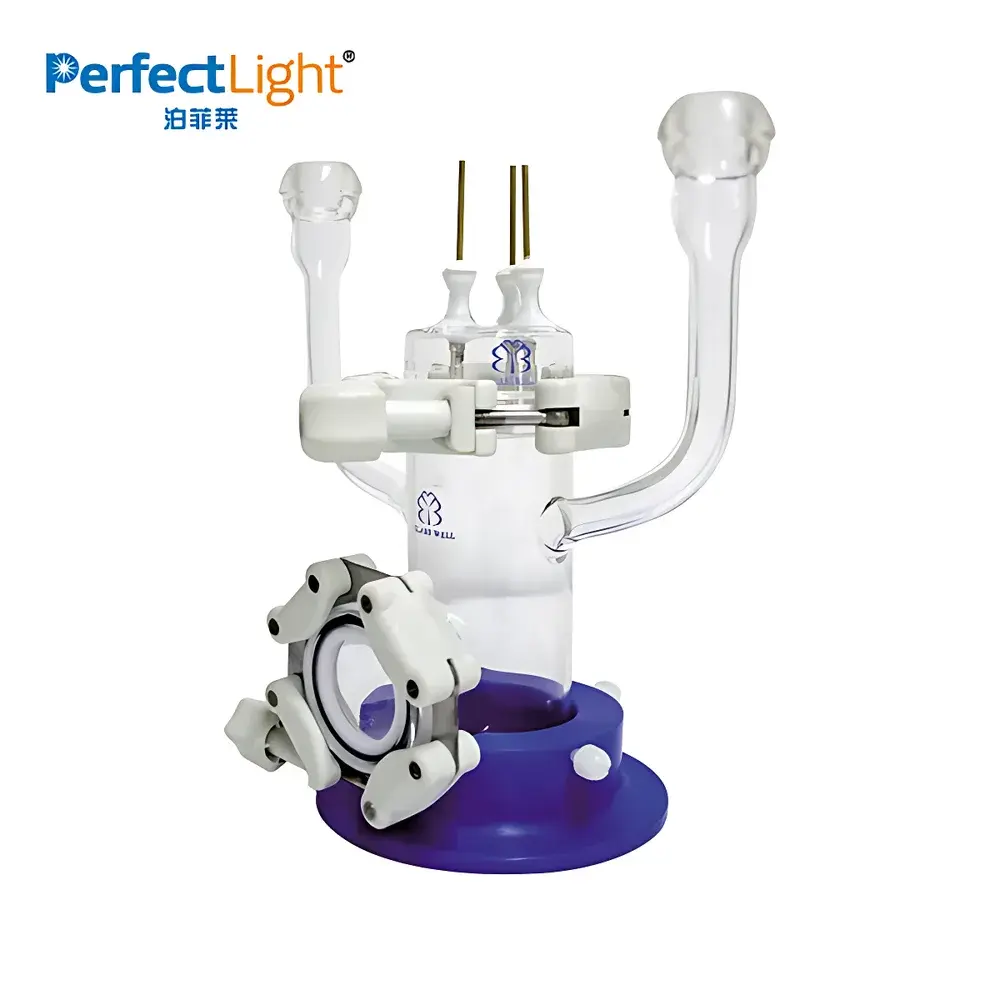
P60-45 High-Integrity Single-Chamber Three-Electrode Photoelectrochemical Reactor
| Brand | PerfectLight |
|---|---|
| Origin | Beijing, China |
| Model | P60-45 |
| Material | Borosilicate Glass (Duran-type) |
| Working Pressure | Up to 0.6 MPa (6 bar) |
| Total Volume | 180 mL |
| Usable Reaction Volume | ~90 mL |
| Electrode Configuration | Integrated Removable Three-Electrode Cap (WE/RE/CE) |
| Optical Window | Fused Silica (Quartz), Φ45 mm × 3.5 mm |
| Sealing System | Grooved Flange with Viton/FKM O-rings |
| Clamping | Dual Chain-Type Clamps (P60 & P45) |
| Electrodes | Ag/AgCl Reference Electrode (standard), Pt Sheet Counter Electrode (10 × 10 × 0.1 mm), PTFE-Shielded Working Electrode Holder |
Overview
The PerfectLight P60-45 High-Integrity Single-Chamber Three-Electrode Photoelectrochemical Reactor is an engineered platform for controlled, reproducible photoelectrocatalytic studies under inert or pressurized atmospheres. Designed explicitly for integration with Labsolar-series solar simulation and gas-circulation systems, it operates on the principle of compartmentalized electrochemical measurement within a sealed optical cell—enabling simultaneous illumination, potentiostatic control, and real-time gas-phase product analysis. Its all-glass construction (borosilicate 3.3, equivalent to Duran® or Pyrex®) ensures chemical inertness toward common solvents (acetonitrile, aqueous electrolytes, alcohols) and compatibility with UV–vis irradiation down to ~190 nm. The reactor’s single-chamber architecture eliminates inter-compartment diffusion artifacts, supporting accurate Faradaic efficiency quantification and mechanistic kinetic modeling in photocatalytic CO₂ reduction, water splitting, and organic transformation studies.
Key Features
- Integrated three-electrode cap with standardized BNC and banana-jack terminals: working electrode (WE) holder with PTFE-insulated shaft, Ag/AgCl reference electrode (3 M KCl fill solution, double-junction optional), and Pt sheet counter electrode (10 × 10 × 0.1 mm)—all independently insertable and position-adjustable.
- Grooved flange interface sealed by fluorocarbon (FKM/Viton®) O-rings, rated for continuous operation up to 0.6 MPa (6 bar) at 80 °C; validated per ASTM E2912 leak-rate specifications (<1 × 10⁻⁹ mbar·L/s He).
- Dual chain-clamp system (P60 and P45) enables rapid assembly/disassembly without torque tools; includes matched inner/outer retaining rings and triple O-ring redundancy per clamp set.
- Removable fused silica optical window (Φ45 mm × 3.5 mm, UV-grade, AR-coated optional) providing >90% transmission from 190–2500 nm; window alignment is repeatable to ±0.1° via precision-ground seating.
- Modular base support with integrated leveling feet and threaded mounting holes (M6) for rigid coupling to optical tables, glovebox feedthroughs, or Labsolar gas-handling manifolds.
Sample Compatibility & Compliance
The P60-45 accommodates heterogeneous catalysts (powders, thin films, electrodes on conductive substrates), homogeneous molecular complexes, and colloidal suspensions. Its 90 mL effective volume permits stoichiometric gas–liquid–solid phase reactions while maintaining sufficient headspace for headspace sampling (via septum-piercing GC syringe ports, optional add-on). All wetted materials comply with ISO 10993-5 cytotoxicity standards and are extractables-tested per USP . The design conforms to GLP-aligned documentation practices: serial-numbered components, traceable calibration certificates for supplied electrodes, and flange-torque history log templates included in the user manual. It supports audit-ready workflows compliant with FDA 21 CFR Part 11 when paired with validated potentiostats and data acquisition software.
Software & Data Management
While the reactor itself is hardware-only, its mechanical and electrical interfaces are fully compatible with industry-standard electrochemical workstations (e.g., BioLogic SP-300, CHI 760E, PalmSens EmStat GO) and gas chromatography data systems (e.g., Agilent OpenLab CDS, Thermo Chromeleon). The electrode cap’s terminal layout follows IEEE 1137-2008 wiring conventions for three-electrode cells. All configuration parameters—including clamp torque values, window transmission curves, and electrode positioning coordinates—are documented in machine-readable JSON format (supplied with delivery) for LIMS integration and automated experiment metadata tagging.
Applications
- Quantitative photoelectrochemical water oxidation and proton reduction kinetics under simulated AM 1.5G illumination.
- Faradaic efficiency determination in photocatalytic CO₂-to-CO/CH₄ conversion using online GC-TCD/FID coupling.
- In situ/operando spectroelectrochemical measurements (UV-Vis-NIR, Raman) via the quartz window.
- Stability assessment of photoanodes (e.g., BiVO₄, Fe₂O₃) and photocathodes (e.g., Cu₂O, Si) under chronoamperometric stress testing.
- Electrolyte screening for iodide/triiodide, cobalt bipyridyl, or ferrocene-based redox mediators in dye-sensitized systems.
FAQ
Is the reactor suitable for corrosive electrolytes such as concentrated HCl or HF?
No. While borosilicate glass resists most aqueous and organic media, hydrofluoric acid and hot concentrated phosphoric or hydrochloric acid will etch the glass surface and compromise structural integrity and seal reliability.
Can the optical window be replaced with CaF₂ or MgF₂ for deep-UV extension?
Yes—custom window inserts with standard Φ45 mm × 3.5 mm geometry and matching groove depth are supported; contact technical support for mechanical tolerance specifications and thermal expansion matching guidance.
What is the maximum recommended operating temperature?
80 °C continuous; short-term excursions to 100 °C are permissible if pressure is reduced proportionally and thermal cycling is minimized to avoid O-ring compression set.
Does the Ag/AgCl reference electrode include a frit junction?
Yes—the standard electrode features a porous Vycor® frit (3–5 µm pore size) and is supplied with 3 M KCl filling solution; double-junction variants with outer sleeve electrolyte (e.g., 0.1 M KNO₃) are available upon request.
Are CAD models and dimensional drawings provided?
Yes—STEP (.stp) and PDF engineering drawings (ASME Y14.5 compliant) are delivered with each unit and accessible via the customer portal using the serial number.



