
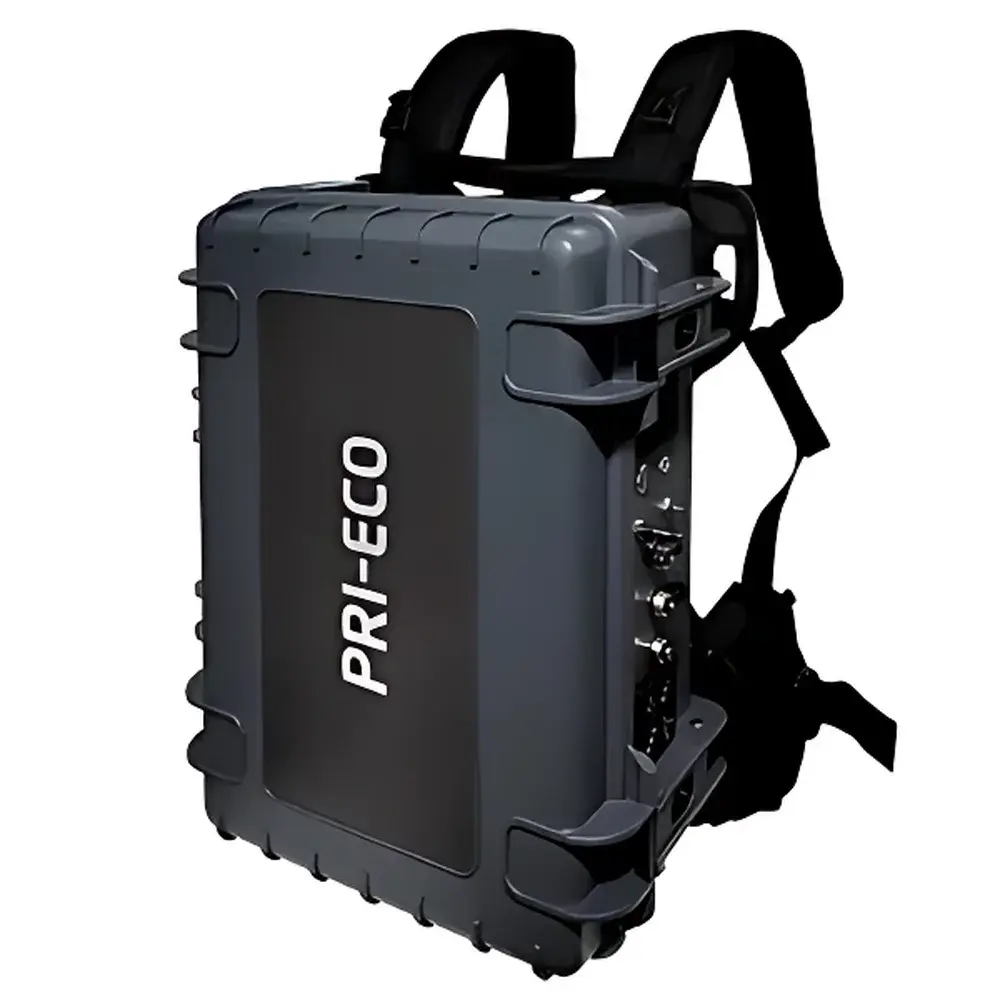
Pri-eco PRI-8635 Portable Multi-Gas Soil Respiration Measurement System
| Brand | Pri-eco |
|---|---|
| Origin | Beijing, China |
| Manufacturer Type | Direct Manufacturer |
| Product Category | Domestic |
| Model | PRI-8635 |
| Instrument Type | Multi-Parameter Soil Respiration Analyzer |
| Power Consumption (Steady State) | < 28 W |
| Power Supply | 12 V Rechargeable Lithium Battery |
| Dimensions | 475 × 372 × 192 mm |
| Weight (Analyzer Unit) | 13 kg |
| Soil Chamber Weight | 1.8 kg |
| Soil Chamber Diameter × Height | 220 mm × 120 mm |
| Chamber Volume | 3718 cm³ |
| Soil Collar Area | 314 cm² |
| CO Detection Limit (5-min avg) | 0.05 ppb |
| CO₂ Detection Limit (5-min avg) | 0.6 ppm |
| N₂O Detection Limit (5-min avg) | 0.05 ppb |
| H₂O Detection Limit (5-min avg) | 10 ppm |
| CO Range | 0–500 ppm |
| CO₂ Range | 0–2000 ppm |
| N₂O Range | 0–500 ppm |
| H₂O Range | 0–3 %v/v |
| Sample Flow Rate | 800 mL/min (adjustable) |
| Ambient Humidity Tolerance | < 99 % RH (non-condensing) |
| Air Pressure Measurement Range | 150–1150 mbar |
| Air Pressure Accuracy | ±2 mbar |
| Soil Temperature Range | −20 to +85 °C |
| Soil Temperature Accuracy | ±0.2 °C |
| Soil Moisture Range | 0–100 % volumetric |
| Soil Moisture Accuracy | ±3 % |
| Dynamic Pressure Compensation | Yes (Patent ZL201420354126.4) |
| Integrated Tablet PC | Yes |
Overview
The Pri-eco PRI-8635 Portable Multi-Gas Soil Respiration Measurement System is an engineered field-deployable instrument designed for high-precision, simultaneous quantification of carbon monoxide (CO), carbon dioxide (CO₂), nitrous oxide (N₂O), and water vapor (H₂O) fluxes from soil surfaces. It operates on the principle of tunable mid-infrared direct absorption spectroscopy (MIR-DAS), a technique offering inherent selectivity and minimal cross-sensitivity among target gases due to their unique fundamental vibrational absorption bands in the 2–10 µm spectral region. The analyzer integrates real-time pressure and temperature stabilization within its optical path—critical for maintaining stoichiometric calibration integrity under variable ambient conditions. Unlike nondispersive infrared (NDIR) or electrochemical sensors, MIR-DAS enables trace-level detection without consumables or frequent recalibration, supporting long-term unattended operation in remote ecological sites, agricultural trials, and permafrost monitoring networks.
Key Features
- Simultaneous, real-time measurement of CO, CO₂, N₂O, and H₂O concentrations at sub-ppb (CO, N₂O) and sub-ppm (CO₂, H₂O) precision over integration times ≥5 minutes
- Dynamically pressure-compensated soil chamber (patented design ZL201420354126.4) that actively equalizes internal chamber pressure with ambient barometric pressure—eliminating advective bias caused by wind-induced pressure gradients or soil gas exsolution artifacts
- Integrated soil environmental sensor suite: high-accuracy thermistor-based soil temperature probe (±0.2 °C), time-domain reflectometry (TDR)-compatible soil moisture sensor (±3 % vol), and absolute air pressure transducer (±2 mbar, 150–1150 mbar range)
- Optimized chamber geometry: 220 mm diameter × 120 mm height (3718 cm³ volume) with standardized 314 cm² collar area—enabling consistent flux calculation via Fick’s first law and compatibility with international soil respiration protocols (e.g., ISO 16635:2021)
- Low-power architecture: draws 8 hours of continuous measurement cycles on a single charge
- Embedded Android-based tablet interface with intuitive graphical workflow: parameter configuration, live gas concentration plots, real-time flux computation (automatic or manual mode), and on-device data export in CSV/NetCDF formats
Sample Compatibility & Compliance
The PRI-8635 is validated for use across diverse soil matrices—including sandy loams, clay-rich vertisols, organic peats, and frozen active layers—without requiring sample pretreatment or chemical reagents. Its non-destructive, closed-chamber methodology adheres to established best practices outlined in ASTM D6577-22 (Standard Guide for Soil Respiration Measurements) and supports GLP-compliant data acquisition when paired with timestamped metadata logging. All gas concentration outputs are traceable to NIST-certified reference standards. The system meets IEC 61326-1:2013 requirements for electromagnetic compatibility in field instrumentation and operates reliably within ambient humidity up to 99 % RH (non-condensing). No hazardous materials or regulated substances are employed in its optical or electronic subsystems.
Software & Data Management
Data acquisition, visualization, and post-processing are managed through the proprietary Pri-eco FieldLink™ software suite preinstalled on the integrated tablet. The application implements automated baseline correction, temperature/pressure compensation algorithms per ISO 17025:2017 Annex A.3, and configurable averaging windows (1 s, 1 min, 5 min) aligned with IPCC Tier 2 reporting guidelines. Raw spectra and processed concentration time series are stored locally with embedded GPS coordinates, UTC timestamps, and operator-defined site descriptors. Export options include comma-separated values (CSV) for Excel or R integration, and NetCDF-4 files compliant with CF-1.8 metadata conventions—facilitating ingestion into global databases such as FLUXNET or the Global Soil Respiration Database (SRDB v5). Audit trails record all user-initiated parameter changes and calibration events, satisfying FDA 21 CFR Part 11 requirements for electronic records where applicable.
Applications
- Quantifying greenhouse gas (GHG) exchange dynamics in terrestrial ecosystems—especially CO, a key tracer of incomplete combustion and atmospheric oxidation capacity
- Evaluating nitrogen cycling efficiency in fertilized agroecosystems via coupled CO₂:N₂O emission ratios
- Monitoring microbial redox transitions in wetland soils and thawing permafrost using multi-gas covariance analysis
- Validating biogeochemical model outputs (e.g., DAYCENT, DNDC) through high-temporal-resolution field flux datasets
- Supporting carbon credit verification under Verra VM0042 (Soil Carbon Quantification Methodology) and similar MRV frameworks
- Long-term eddy covariance tower gap-filling and chamber network intercomparison studies
FAQ
What gas species does the PRI-8635 measure simultaneously, and at what detection limits?
The system measures CO, CO₂, N₂O, and H₂O vapor concurrently. Typical 5-minute averaged detection limits are 0.05 ppb for CO, 0.6 ppm for CO₂, 0.05 ppb for N₂O, and 10 ppm for H₂O.
How does the dynamic pressure compensation system improve flux accuracy?
It actively maintains pressure equilibrium between the chamber headspace and ambient atmosphere using a feedback-controlled vent valve, suppressing advective gas transport errors induced by wind or barometric fluctuations—improving flux uncertainty by up to 40 % compared to static chambers.
Is the system suitable for frozen or snow-covered soils?
Yes—the soil temperature probe operates from −20 to +85 °C, and the chamber seal design accommodates moderate snow load; however, full snow cover requires removal prior to collar insertion to ensure physical contact with mineral/organic soil layers.
Can the PRI-8635 be integrated with external meteorological stations or eddy covariance systems?
Yes—via RS-485 and optional Ethernet/Wi-Fi modules, it supports Modbus RTU and NMEA 0183 protocols for synchronized acquisition of PAR, soil heat flux, and turbulence data.
What maintenance is required for long-term field deployment?
No routine optical alignment or consumable replacement is needed. Recommended annual verification includes zero/span gas checks using certified mixtures and validation of pressure/temperature sensor drift against NIST-traceable references.







