
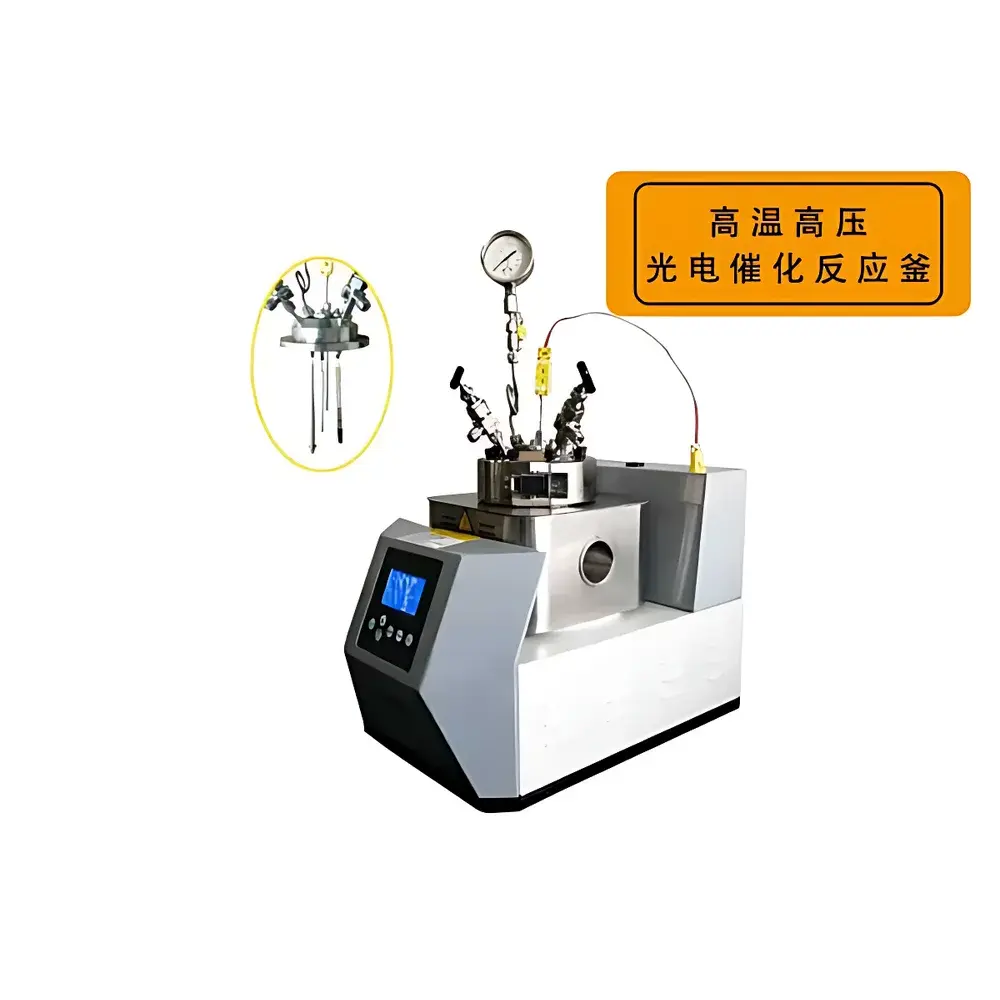
PerkinElmer LC-D Sapphire Photoelectrochemical High-Pressure Reactor
| Brand | PerfectLight |
|---|---|
| Origin | Beijing, China |
| Model | LC-D |
| Reactor Type | Benchtop High-Pressure Photoelectrochemical Reactor |
| Effective Volume | 500 mL |
| Construction Material | Hastelloy C-276 body with Sapphire optical window |
| Operating Temperature Range | Ambient to 150 °C (internal) |
| Maximum Working Pressure | 10 MPa |
| Pressure Gauge Range | 0–16 MPa |
| Rupture Disc Set Point | 12.5 MPa |
| Heating System | 1.2 kW modular electric heater |
| Stirring Options | Internal magnetic stirring or paddle-type mechanical stirring |
| Stirring Speed | 0–1200 rpm, continuously adjustable |
| Control System | MRSC-LC-D V1.06 with LCD display (temperature, rpm, elapsed time), dual-direction rotation, timer-based hold/stop, audible & visual alarm |
| Accessories | Sampling tube (1), needle valve (1), three-way ball valve (1) |
Overview
The PerkinElmer LC-D Sapphire Photoelectrochemical High-Pressure Reactor is a purpose-engineered benchtop platform for conducting simultaneous photochemical and electrochemical catalytic reactions under rigorously controlled high-pressure and elevated-temperature conditions. Unlike conventional single-mode reactors, the LC-D integrates optical access, electrical interfacing, and pressure containment within a unified, compact architecture—enabling true synergistic photoelectrocatalysis (PEC) in sealed environments up to 10 MPa and 150 °C. Its core measurement principle relies on the concurrent application of monochromatic or broadband illumination through a high-transmittance sapphire viewport while maintaining precise thermal regulation and homogeneous mass transfer via dual-mode stirring. Designed for reproducible kinetic studies and catalyst screening, the reactor supports fundamental investigations into energy-conversion pathways—including CO2 reduction, VOC mineralization, nitrogen fixation, and sulfur capture—under industrially relevant thermodynamic constraints.
Key Features
- Optically optimized sapphire viewport (≥85% transmission from 190–5500 nm), rated for continuous operation at ≤12.5 MPa burst pressure, ensuring long-term integrity under cyclic thermal and mechanical stress.
- Hastelloy C-276 reactor body provides exceptional resistance to chloride-induced pitting, acidic electrolytes, and oxidizing media—critical for sustained operation in corrosive PEC electrolytes such as aqueous HCl, H2SO4, or molten salt systems.
- Dual stirring modalities: high-torque internal magnetic coupling (up to 1200 rpm) for low-viscosity media; detachable mechanical paddle agitator for viscous slurries or heterogeneous suspensions containing catalyst particles or electrodes.
- MRSC-LC-D V1.06 control system with real-time digital feedback loops for temperature (±0.5 °C accuracy), rotational speed (±10 rpm resolution), and time-based event sequencing—fully programmable for multi-step reaction protocols.
- Integrated acoustic–optical alarm system triggered by overpressure (>10 MPa), overtemperature (>150 °C), or stirrer stall—compliant with IEC 61000-6-2 electromagnetic immunity standards.
- Modular accessory interface: standardized 1/4″ Swagelok ports accommodate optional gas dosing lines, reference electrode feedthroughs, potentiostat connectors, and in-line optical fiber couplers for operando UV-Vis or Raman spectroscopy.
Sample Compatibility & Compliance
The LC-D accommodates liquid-phase, slurry-phase, and gas-saturated reaction mixtures, including aqueous, non-aqueous, and supercritical CO2-based systems. It is routinely deployed in laboratories adhering to ISO/IEC 17025:2017 for method validation and ASTM D7503 (standard test method for photocatalytic activity of materials). The reactor’s pressure containment design conforms to ASME BPVC Section VIII Div. 1 requirements for Class I vessels, and its electrical safety architecture meets UL 61010-1 and EN 61010-1. For regulated pharmaceutical or battery-material synthesis workflows, audit trails generated by the MRSC-LC-D controller support GLP/GMP documentation per FDA 21 CFR Part 11 when paired with timestamped data export (CSV/Excel).
Software & Data Management
The MRSC-LC-D V1.06 firmware supports local data logging at user-defined intervals (1–60 s), with all parameters stored internally on non-volatile memory. Export is performed via USB-A port to standard FAT32-formatted drives; no proprietary software installation is required. Logged datasets include absolute timestamps, PID setpoints, actual sensor readings, and alarm event flags. Optional RS-485 Modbus RTU interface enables integration into centralized LabVIEW or Python-controlled automation frameworks for unattended multi-reactor campaigns. All firmware updates are delivered as signed binary packages verified via SHA-256 checksums to ensure traceability and cybersecurity compliance.
Applications
- Quantitative evaluation of photoelectrocatalyst performance under simulated industrial pressure–temperature envelopes (e.g., CO2 hydrogenation to CH4 or CH3OH at 5–8 MPa and 120–150 °C).
- In situ electrochemical impedance spectroscopy (EIS) coupled with pulsed LED illumination to resolve charge-transfer kinetics at semiconductor–electrolyte interfaces.
- High-pressure photocatalytic degradation of persistent organic pollutants (e.g., PFAS, chlorinated benzenes) in water matrices under UV–vis irradiation.
- Electrochemically assisted photocatalytic nitrogen fixation using TiO2/g-C3N4 heterojunctions under N2/H2 atmospheres.
- Corrosion-electrochemistry studies of electrode materials in aggressive high-pressure electrolytes relevant to next-generation flow batteries.
FAQ
Can the LC-D be used for reactions requiring inert atmosphere purging prior to pressurization?
Yes—the reactor includes dedicated purge/inert-gas inlet ports compatible with standard mass-flow controllers and vacuum–pressure cycling sequences down to 10−2 mbar residual pressure before gas charging.
Is the sapphire window replaceable in the field without specialized tools?
Yes—window replacement follows ASME-compliant torque specifications and requires only a calibrated torque wrench and standard hex keys; full procedure documented in the OEM service manual.
Does the system support external potentiostat integration for three-electrode electrochemical measurements?
Yes—two isolated feedthroughs (Pt/Ir and Ag/AgCl-compatible) are provided on the reactor head; electrical isolation exceeds 100 MΩ at 500 V DC.
What is the maximum allowable ramp rate for temperature during programmed heating cycles?
The controller enforces a default ramp limit of 5 °C/min to prevent thermal shock to the sapphire window; this value is configurable up to 10 °C/min in expert mode with user-signed waiver.
Are calibration certificates available for the integrated pressure and temperature sensors?
Yes—NIST-traceable calibration reports (ISO/IEC 17025-accredited) are optionally supplied at time of delivery, covering both primary transducers and secondary display units.
Related Products



