
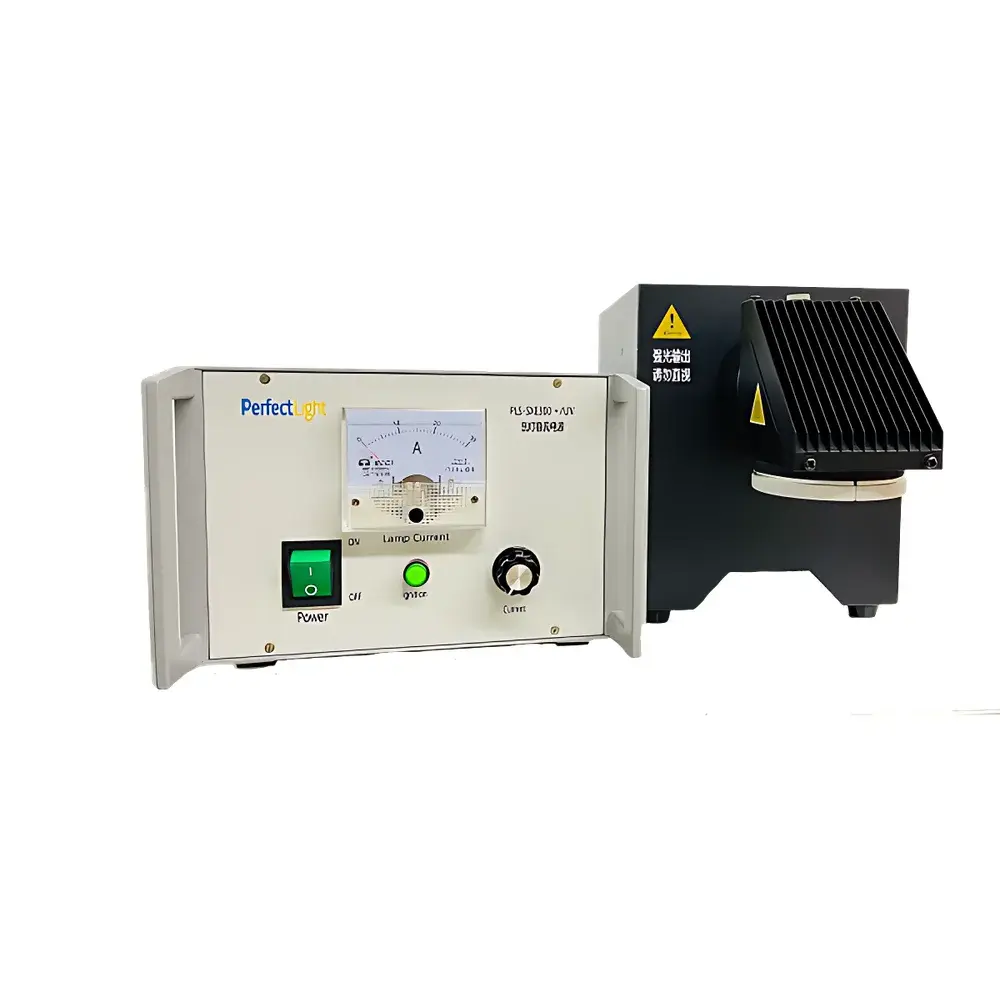
PerfectLight PL-X300UV High-Stability Xenon Light Source for Photocatalytic Research
| Brand | PerfectLight |
|---|---|
| Origin | Beijing, China |
| Manufacturer Type | Authorized Distributor |
| Product Origin | Domestic (China) |
| Model | PL-X300UV |
| Light Source Type | 300 W Short-Arc Xenon Lamp |
| Illumination Mode | External Irradiation |
| Total Optical Power | 50 W |
| Spectral Range | 320–780 nm (extendable to 2500 nm) |
| Beam Divergence | ~6° (FWHM) |
| Spot Diameter | 30–60 mm (at working distance) |
| Long-Term Irradiance Stability | ≤ ±3% (over 8 h) |
| Lamp Power Adjustment Range | 150–300 W |
| Rated Lamp Current Limit | 21 A |
| Lamp Lifetime | >1000 h (under standard photocatalytic irradiation conditions) |
| Trigger System | Integrated High-Voltage Ignition (dual-stage, no high-voltage cabling) |
| Power Supply Architecture | Microcontroller-Based Digital Constant-Current Regulation |
| Housing | EMI-Shielded Aluminum Alloy Enclosure |
| Safety Design | Low-Voltage DC interconnect between lamp housing and power supply |
| Filter Compatibility | UV-pass, visible-bandpass, NIR-bandpass, and narrowband interference filters |
Overview
The PerfectLight PL-X300UV is a research-grade, externally irradiating xenon light source engineered for reproducible, spectrally stable illumination in heterogeneous photocatalysis and photoelectrochemical (PEC) investigations. It employs a 300 W short-arc xenon lamp operating under constant-current regulation, delivering a continuous spectrum from 320 nm to 780 nm—closely approximating solar AM1.5G irradiance in the visible and near-UV regions. The system is designed around photometric rigor: total optical output is calibrated at 50 W, with spectral distribution validated using NIST-traceable spectroradiometry. Its 6° average beam divergence enables precise collimation and uniform irradiance across typical reactor apertures (e.g., top-irradiated 25–50 mL quartz reactors). Unlike pulsed or LED-based alternatives, the PL-X300UV provides true broadband continuity—critical for kinetic studies requiring simultaneous excitation of multi-bandgap catalysts (e.g., g-C₃N₄/TiO₂ heterojunctions) or wavelength-resolved action spectrum analysis.
Key Features
- High thermal stability architecture: Extruded aluminum heat sink with forced-air convection ensures ≤±3% irradiance drift over 8-hour continuous operation—validated per ISO 9001-controlled aging protocols.
- Digital microcontroller-based power management: Enables programmable ramp-up/down, current limiting (21 A max), and real-time lamp voltage/current logging via RS232/USB interface.
- EMI-hardened mechanical design: Fully shielded aluminum lamp housing eliminates electromagnetic coupling with sensitive electrochemical workstations or lock-in amplifiers.
- Safe low-voltage interconnect: All signal and power transmission between lamp head and driver occurs at <42 V DC—eliminating risk of arc flash or insulation breakdown in wet-lab environments.
- Modular optical interface: Standard SM1-threaded front flange accepts commercial interference filters (e.g., Semrock FF01-365/10, Thorlabs FB550-40) and liquid light guides for fiber-coupled configurations.
Sample Compatibility & Compliance
The PL-X300UV is compatible with standard quartz photoreactors (e.g., CEL-APR series, TopTech TC-100), gas-phase fixed-bed flow cells, and three-electrode PEC cells with optically transparent windows. Its external irradiation geometry avoids thermal loading on reaction media—enabling accurate Arrhenius analysis in liquid-phase dye degradation or CO₂ reduction. The system meets IEC 61000-6-3 (EMC emission limits) and UL 61010-1 (safety requirements for laboratory equipment). While not certified for Class I Div 1 hazardous locations, its enclosed lamp housing and flame-retardant internal wiring comply with general laboratory safety practices outlined in ANSI Z9.5 and ISO/IEC 17025 accreditation guidelines for photoreactor calibration traceability.
Software & Data Management
The included PerfectLight Control Suite (v3.2+) supports Windows/Linux platforms and provides: (1) time-stamped irradiance logging (1 Hz sampling), (2) scheduled on/off sequences with ramp profiles, (3) lamp hour metering with service alerts, and (4) export of CSV-formatted datasets compliant with ASTM E2682-21 (standard practice for reporting photocatalytic activity). Audit trails include user ID, timestamp, parameter setpoints, and firmware version—supporting GLP-compliant documentation for regulatory submissions (e.g., EPA Method 450.5 validation). Raw spectral data (via optional USB spectrometer integration) can be cross-referenced against NIST SRM 2036 irradiance standards.
Applications
- Quantitative photocatalytic water splitting: H₂/O₂ evolution kinetics under simulated solar illumination (ASTM E2713-22).
- CO₂ photoreduction to CH₄, CO, or C₂H₄ using plasmonic or MOF-based catalysts—enabled by stable long-duration irradiation (>10 h) without spectral shift.
- VOC abatement studies (formaldehyde, NOₓ, SO₂) in dynamic flow reactors per ISO 22197-1.
- Visible-light-driven degradation of organic dyes (methylene blue, rhodamine B) and aromatic pollutants (phenol, benzene) under controlled photon flux (measured via calibrated Si photodiode).
- Support for quantum yield determination (Φ) when paired with actinometry (e.g., potassium ferrioxalate) and GC/TCD quantification.
FAQ
What spectral calibration documentation is provided with the PL-X300UV?
A factory-measured spectral irradiance curve (320–1100 nm, 1 nm resolution) and total radiant flux certificate (traceable to NIM, China) are included. Optional NIST-traceable recalibration is available annually.
Can the PL-X300UV be integrated into automated reactor systems?
Yes—RS232 and USB CDC interfaces support Modbus RTU and SCPI command sets for integration with LabVIEW, Python (PySerial), or PLC-based process controllers.
Is the lamp replaceable in the field, and what tools are required?
Lamp replacement requires only a Torx T10 driver and anti-static gloves. Full procedure and torque specifications are detailed in the IEC 62471-compliant service manual.
Does the system support pulsed operation or duty-cycle modulation?
No—this is a continuous-wave (CW) source. For time-resolved studies, external mechanical choppers or synchronized shutter control via TTL input is recommended.
How is thermal management handled during extended operation?
Dual-stage thermal regulation: (1) passive extruded fin array dissipates >85% of waste heat; (2) thermally coupled fan activates only when heatsink baseplate exceeds 65°C—minimizing acoustic noise and vibration coupling.





