
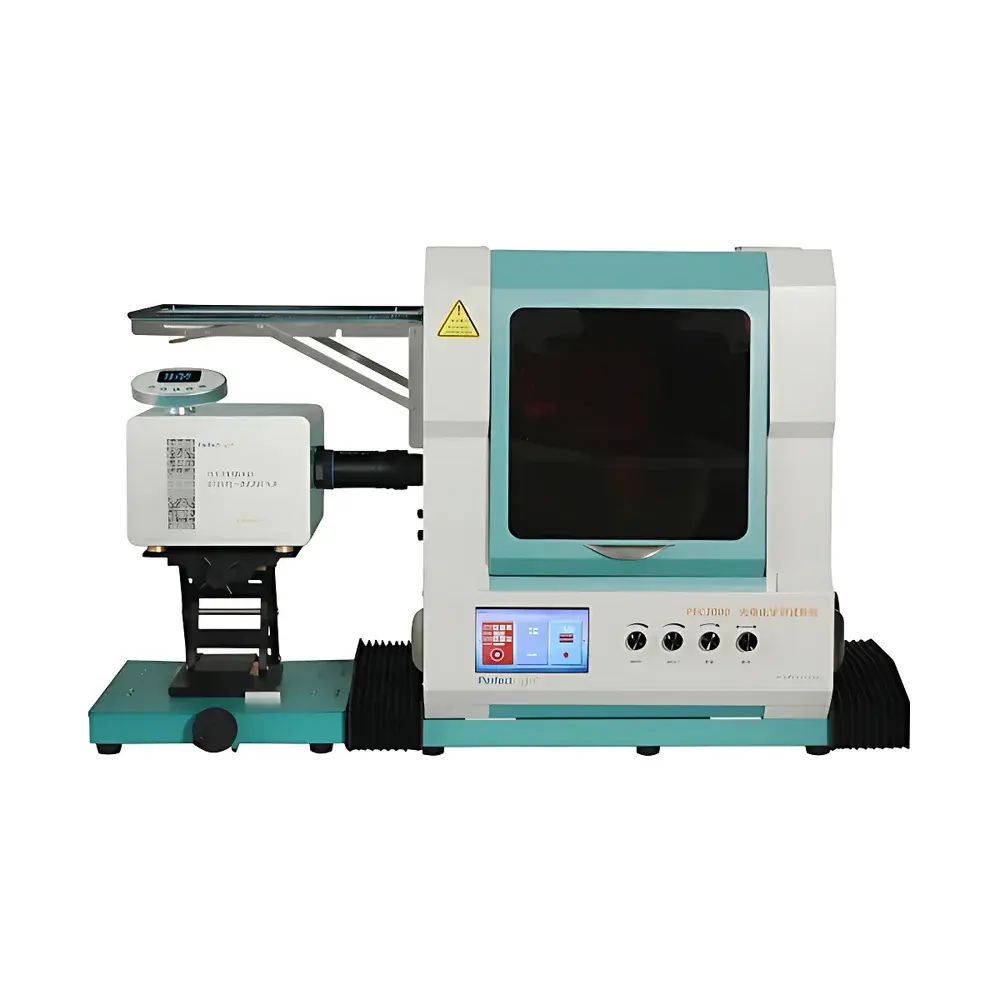
PEC2000 Photoelectrochemical Testing System
| Brand | PerfectLight |
|---|---|
| Origin | Beijing, China |
| Model | PEC2000 |
| Reaction Pressure | Ambient (0 bar gauge) |
| Reaction Temperature | Room Temperature (20–25 °C) |
| Catalyst Loading Capacity | Not Applicable (Flow-through / Immobilized Electrode Configuration) |
| Light Source Power | 300 W (Adjustable 150–300 W) |
| Illumination Uniformity | ≤3% |
| Long-term Intensity Drift | ≤2% |
| Spectral Range | 350–800 nm |
| Effective Irradiation Area | 10×10 to 50×50 mm² |
| Irradiance | Up to 3000 mW/cm² |
| Optical Power Measurement Range | 0–20 W (Accuracy: ±1 mW) |
| Chopping Interval | 1 s – 30 min |
| X-axis Translation Range (Chamber) | 0–80 mm |
| Y-axis Translation Range (Turntable) | 0–10 mm |
| Electrochemical Compatibility | Three-electrode configuration (working, counter, reference), integrated gas-tight lid |
| Reactor Volume | 180 mL (Effective Liquid Volume ≈90 mL) |
| Photodetector Spectral Response | 0.2–11 μm |
Overview
The PEC2000 Photoelectrochemical Testing System is a purpose-built, benchtop platform engineered for quantitative photoelectrochemical (PEC) characterization of semiconductor photoelectrodes and catalytic thin films under controlled illumination conditions. It operates on the fundamental principle of separating photogenerated charge carriers at an illuminated solid–liquid interface—typically a metal oxide or chalcogenide working electrode immersed in aqueous electrolyte—and measuring the resulting photocurrent, transient response, electrochemical impedance, and gaseous product evolution (e.g., H₂ and O₂) in real time. Designed specifically for compliance with ASTM E1021 and ISO 15443-2 standards for photoelectrochemical performance evaluation, the system integrates optical, electrochemical, and gas analytical subsystems within a compact, vibration-damped enclosure. Its core architecture eliminates manual alignment dependencies through motorized and precision-machined mechanical stages, ensuring reproducible incident photon flux delivery across multiple experimental configurations—including single-chamber PEC cells, custom flow reactors, and Faradaic efficiency validation setups when interfaced with the optional PerfectLight 6A gas chromatography module.
Key Features
- Integrated six-position motorized turntable with programmable positioning: collimation alignment station, optical power calibration station, standard single-compartment PEC reactor station, customizable reactor station, reference measurement station, and blank background station.
- Laser-guided collimation system with visible red diode (635 nm) for rapid beam centering and angular verification prior to spectral irradiation.
- Digital feedback-controlled 300 W xenon arc lamp source with continuous power regulation (150–300 W), enabling precise photon flux tuning without spectral shift artifacts.
- Uniform rectangular illumination field (10×10 to 50×50 mm²) with ≤3% spatial non-uniformity and ≤2% intensity drift over 8-hour operation—validated per IEC 60904-9:2020 Class AAA requirements.
- Gas-tight, three-electrode PEC reactor (180 mL total volume, ~90 mL electrolyte capacity) featuring quick-release grooved flange joints, replaceable quartz or UV-fused silica optical windows, and integrated reference electrode port.
- Real-time electrochemical acquisition supporting I–V sweeps, chronoamperometry (I–t), and electrochemical impedance spectroscopy (EIS) up to 100 kHz via external potentiostat integration (e.g., BioLogic SP-300 or CHI 760E).
- Optical power monitoring using a calibrated thermopile sensor (0.2–11 μm spectral response) with ±1 mW resolution and NIST-traceable calibration certificate.
Sample Compatibility & Compliance
The PEC2000 accommodates planar photoanodes and photocathodes mounted on conductive substrates (FTO, ITO, Ni foam, Ti foil) as well as suspended nanoparticle films deposited on porous membranes. Its modular reactor design supports both static batch-mode and dynamic flow-through configurations. All wetted components comply with USP Class VI biocompatibility and ASTM F2129 pitting corrosion resistance standards. The system meets essential safety requirements per IEC 61010-1:2010 for laboratory electrical equipment and includes redundant thermal cutoffs, fan-failure shutdown logic, and current-limiting circuitry. For regulated environments, full audit trail capability is enabled when paired with GLP-compliant data acquisition software (e.g., EC-Lab v12+ or NOVA 2.1.4), supporting 21 CFR Part 11 electronic signature and data integrity protocols.
Software & Data Management
Instrument control and data synchronization are managed via the PerfectLight PEC-Control Suite—a Windows-based application supporting multi-channel time-stamped acquisition (light trigger, potentiostat output, gas chromatograph signal, temperature log). The software provides automated sequence scripting for light-on/light-off transients, chopped illumination experiments, and multi-step polarization protocols. Raw datasets are exported in HDF5 and CSV formats with embedded metadata (wavelength, power density, electrode area, electrolyte composition). Integration with MATLAB, Python (via PyVISA), and LabVIEW is supported through documented COM/NI-VISA APIs. All calibration files—including lamp spectral irradiance, photodetector responsivity, and reactor geometric factor—are stored in encrypted XML containers with version history.
Applications
- Quantitative assessment of photoconversion efficiency (ABPE, IPCE) for metal oxide, perovskite, and covalent organic framework (COF) photoelectrodes.
- Stability testing under prolonged illumination (≥100 h) with in situ pH and dissolved oxygen monitoring.
- Faradaic efficiency determination for solar-driven water splitting (H₂/O₂ evolution ratio) when coupled to the PerfectLight 6A GC system equipped with thermal conductivity detection (TCD) and 5Å molecular sieve column.
- Charge transfer resistance mapping via intensity-modulated photocurrent spectroscopy (IMPS) and intensity-modulated photovoltage spectroscopy (IMVS).
- Photoelectrocatalytic CO₂ reduction product distribution analysis (formate, methanol, CO) using online gas chromatography–mass spectrometry (GC–MS) interfaces.
- Educational use in advanced undergraduate and graduate electrochemistry laboratories for hands-on PEC fundamentals instruction.
FAQ
Does the PEC2000 support dual-chamber H-cell configurations?
No—the base system is optimized for single-compartment, three-electrode photoelectrochemical cells. Dual-chamber configurations require custom reactor integration and separate ion-conducting membrane mounting hardware, available upon request as an OEM add-on.
Can the light source be replaced with a LED array for monochromatic studies?
Yes—optional LED modules (365, 405, 450, 520, 630 nm) with collimated output and driver-controlled current regulation can be installed in place of the xenon lamp housing. Each module includes factory-calibrated irradiance maps and spectral half-width specifications.
Is the system compatible with potentiostats from third-party manufacturers?
Yes—standard analog voltage/current I/O (±10 V, 0–20 mA) and digital trigger lines (TTL) enable seamless synchronization with Gamry, BioLogic, Pine Research, and Princeton Applied Research instruments.
What maintenance is required for long-term optical stability?
Lamp replacement every 1,000 hours (xenon) or 10,000 hours (LED), quarterly recalibration of the thermopile sensor against a NIST-traceable reference, and biannual inspection of O-ring integrity and quartz window transmission (UV-Vis spectrophotometer verification recommended).
How is gas-tightness verified during installation?
A helium leak test is performed at the factory using a residual gas analyzer (RGA) with sensitivity down to 1×10⁻⁹ mbar·L/s. Users receive a signed leak test report; field verification can be conducted using a handheld helium sniffer probe and calibrated mass flow controller.



