
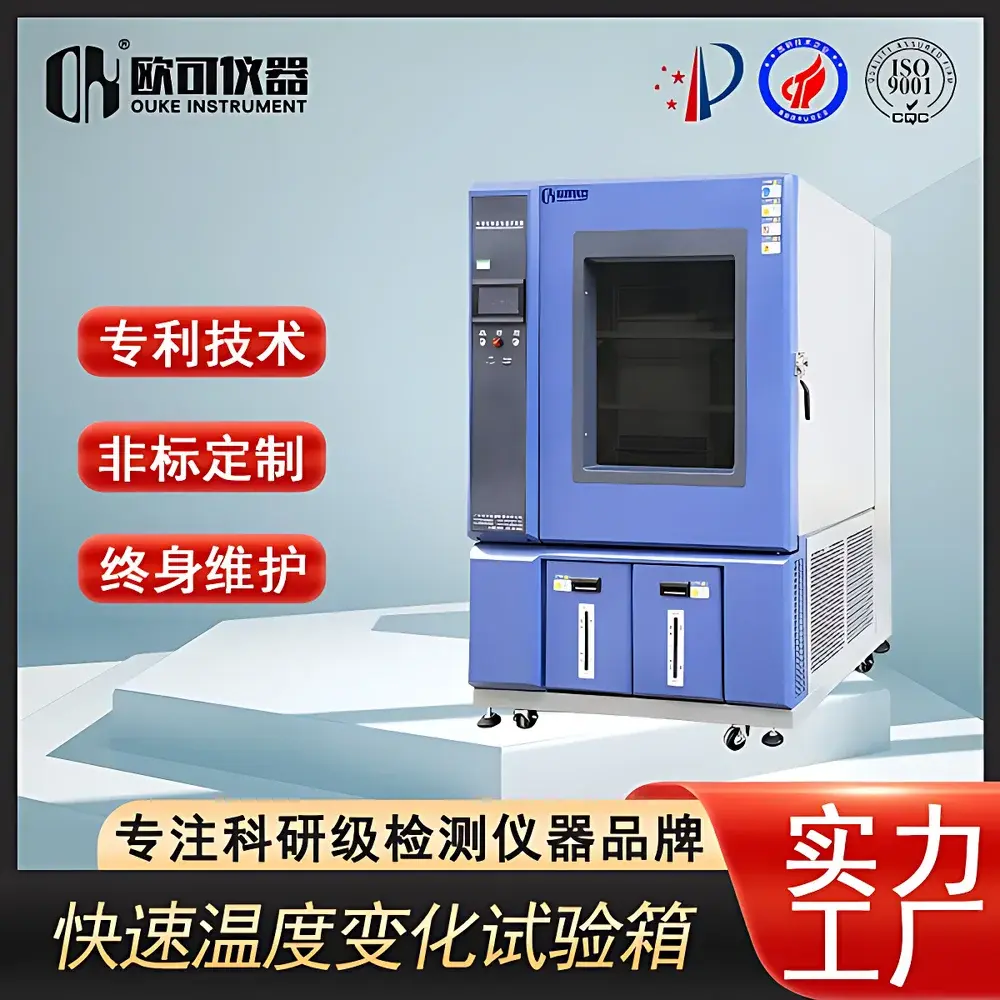
English Product Name
| Brand | OK Instruments |
|---|---|
| Origin | Guangdong, China |
| Manufacturer Type | Direct Manufacturer |
| Country of Origin | China |
| Model | KS-TH-225.000 |
| Price | USD 14,000 (FOB Guangdong) |
Overview
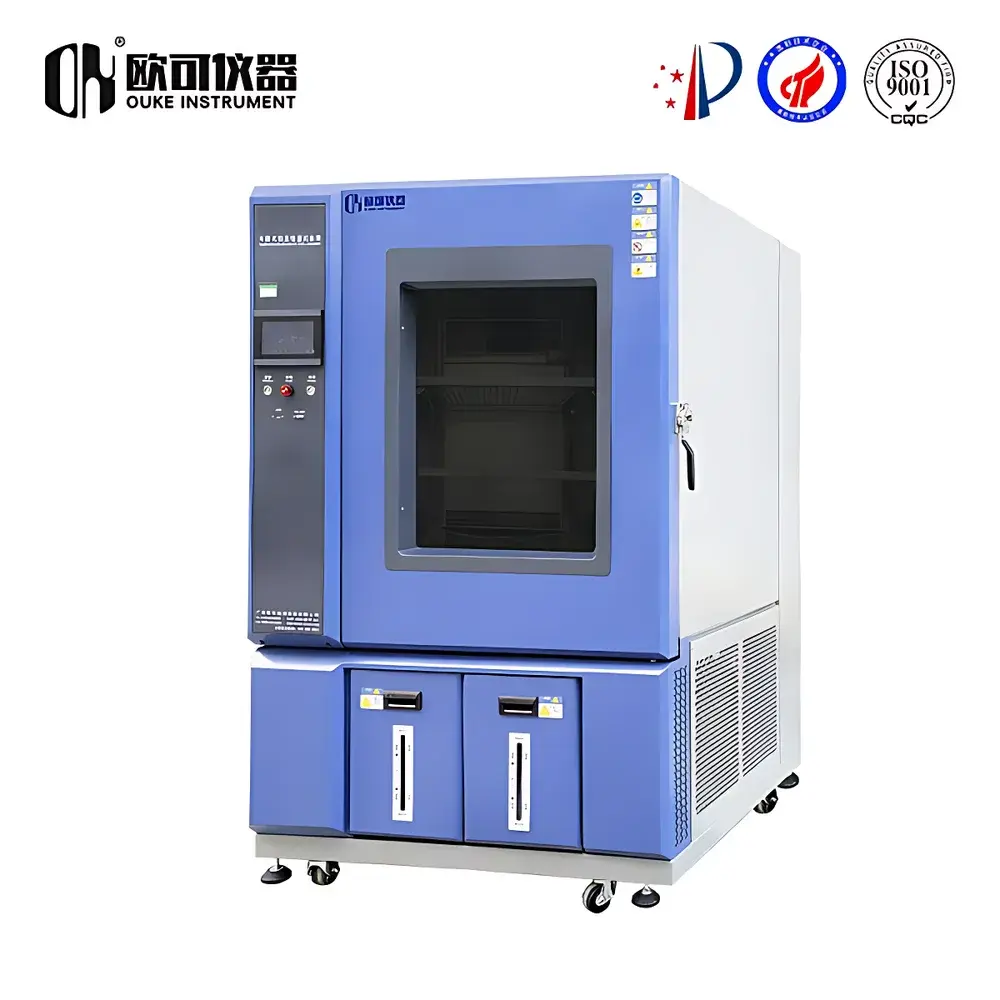
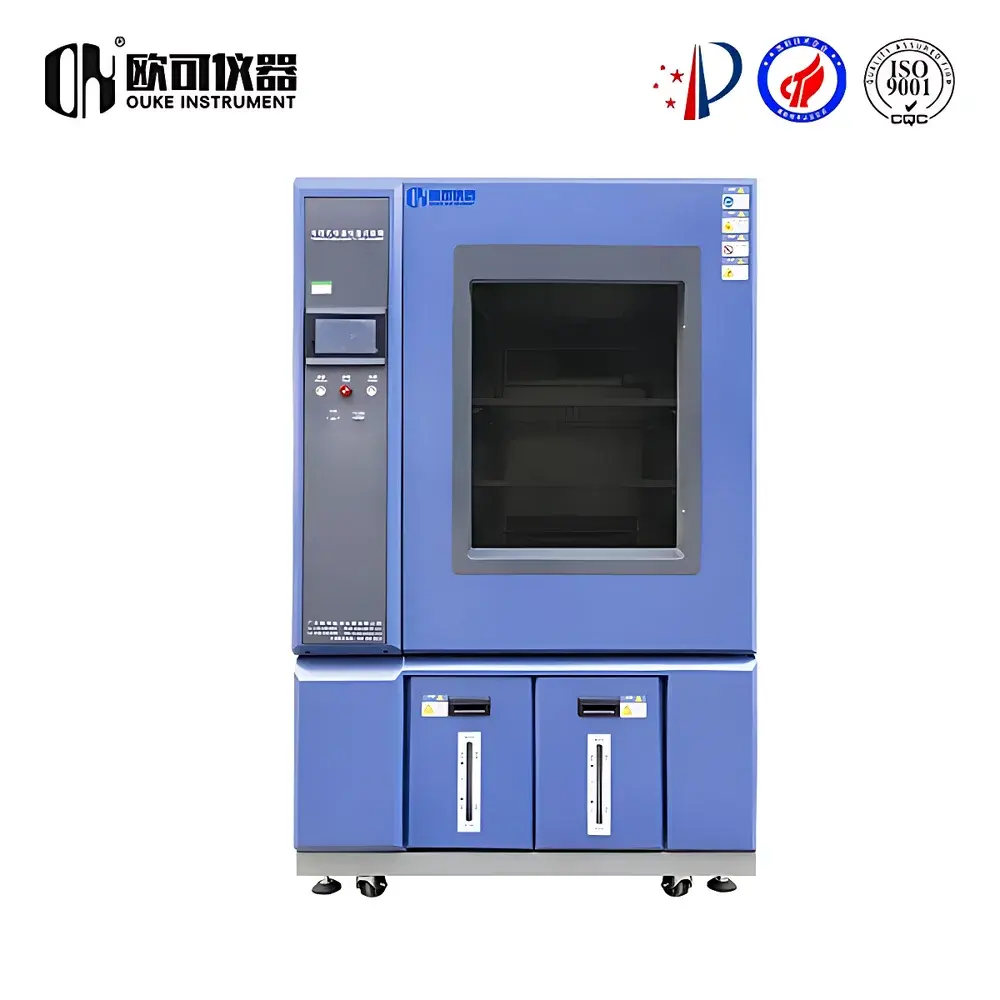
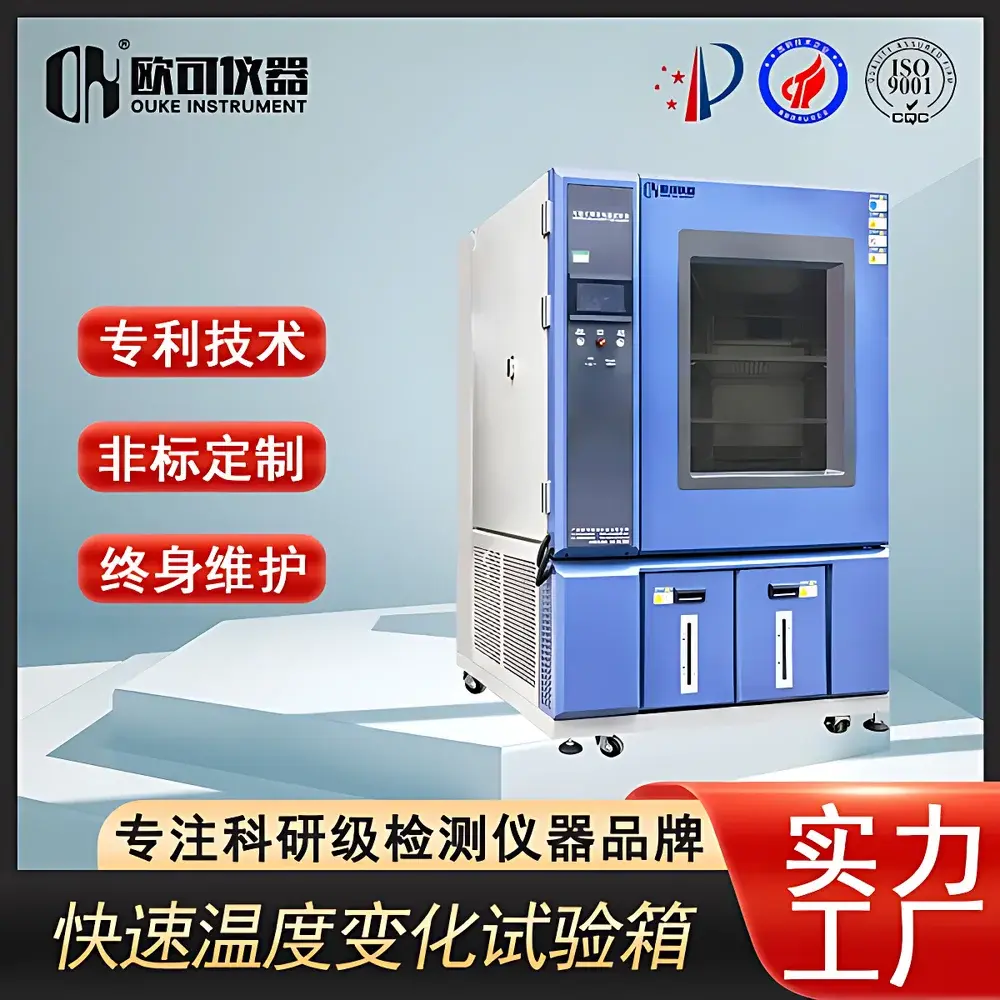
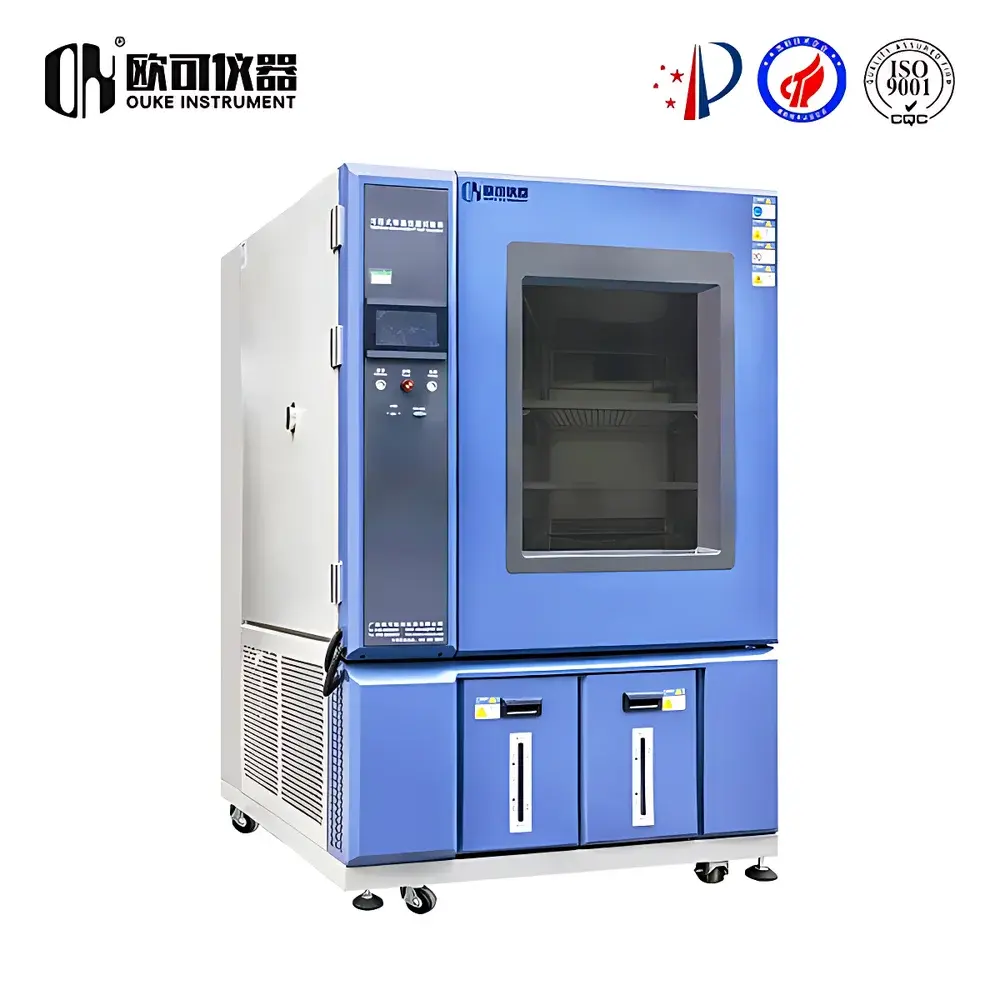
The OK KS-TH-225.000 Rapid Temperature Change Test Chamber is an engineered environmental stress screening (ESS) system designed for accelerated thermal cycling validation of electronic components, automotive modules, aerospace subsystems, and high-reliability PCB assemblies. It operates on a forced-air convection principle with dual refrigeration and electric heating circuits, enabling precise, repeatable transitions between extreme temperature extremes—typically −70 °C to +180 °C—with programmable ramp rates up to 15 °C/min (subject to load and chamber configuration). The chamber’s architecture complies with the thermal profile requirements defined in MIL-STD-810H Method 503.5 (Temperature Shock), IEC 60068-2-14 (Change of Temperature), and JEDEC JESD22-A104E, supporting both two-zone and single-chamber thermal shock methodologies. Its 225 L internal volume (600 × 750 × 500 mm W×H×D) accommodates standard test fixtures and production-grade DUTs while maintaining ±0.5 °C temperature uniformity (at steady state) and ±2.0 °C accuracy across the full operating range.
Key Features
- Double-wall construction: Outer casing in brushed-finish SUS304 stainless steel; interior liner in electropolished mirror-finish SUS304 for corrosion resistance and cleanroom-compatible surface integrity.
- High-efficiency insulation: 100 mm composite thermal barrier comprising rigid polyurethane foam (λ ≈ 0.022 W/m·K) and high-density fiberglass matting, minimizing heat leakage and stabilizing thermal response.
- Optimized airflow system: Long-life, high-torque AC motor driving multi-blade stainless steel impeller; vertical laminar flow path ensures uniform thermal distribution and eliminates cold/hot spots per ISO 16750-4 Annex C.
- Sealed access design: Dual-lip silicone gasket with high-tensile retention; counterbalanced, no-backlash door handle mechanism for consistent compression force and leak-tight closure at all temperatures.
- Observation window: Triple-layer tempered glass assembly with embedded ITO (indium tin oxide) conductive film for anti-fogging and real-time visual monitoring without thermal distortion.
- Utility integration: Standard 50 mm diameter port on left side wall (with silicone plug and clamping collar) for feedthrough of power, signal, or sensor cables under pressure-balanced conditions.
- Full-spectrum safety architecture: Independent hardware-based overtemperature cutoff (separate from main controller), door interlock, compressor high-pressure cutout, phase failure detection, and real-time fault logging with timestamped event codes.
Sample Compatibility & Compliance
The KS-TH-225.000 supports samples up to 30 kg gross mass with dimensional clearance for industry-standard test trays (e.g., JEDEC trays, MIL-STD-1344 mounting plates). Its thermal performance meets traceable calibration requirements per ISO/IEC 17025 when used with accredited external reference sensors. The chamber is compatible with GLP/GMP-compliant validation protocols—including IQ/OQ/PQ documentation packages—and supports audit-ready data integrity features aligned with FDA 21 CFR Part 11 (when paired with OK’s optional compliant software suite). All electrical components conform to IEC 61000-6-2 (immunity) and IEC 61000-6-4 (emission) standards. CE marking is applied per Machinery Directive 2006/42/EC and EMC Directive 2014/30/EU.
Software & Data Management
The embedded 7-inch TFT-LCD HMI runs OK’s proprietary ESSControl™ firmware, featuring touch-enabled parameter entry, hierarchical user access levels (Operator/Engineer/Administrator), and built-in data historian with non-volatile flash storage. Up to 120 test programs (each supporting 1200 segments) can be stored locally; segment logic allows conditional branching, loop nesting, and dynamic setpoint modulation via time-based triggers. Real-time curve rendering displays both target and actual temperature trajectories with configurable scaling and overlay capability. RS-232 and RS-485 interfaces enable daisy-chain multi-chamber control and integration with LabVIEW, MATLAB, or MES systems. Optional USB data logger (1 GB capacity) provides CSV-formatted records with user-selectable sampling intervals (1–600 s), automatic file rotation, and checksum-verified export—replacing legacy chart recorders without compromising data chain-of-custody.
Applications
This chamber is routinely deployed in reliability laboratories for solder joint fatigue analysis (IPC-9701), thermal interface material (TIM) characterization, battery cell abuse testing (UN 38.3 thermal cycling), and qualification of MEMS devices per AEC-Q200. It serves as a primary tool in HALT/HASS (Highly Accelerated Life/Stress Screening) workflows where rapid thermal transients expose latent defects such as delamination, wire bond lift, or coefficient-of-thermal-expansion (CTE) mismatch failures. Automotive Tier-1 suppliers use it to validate ECUs against ISO 16750-4 thermal shock cycles; semiconductor fabs apply it for wafer-level burn-in correlation studies. Its programmability also supports custom profiles required by customer-specific PPAP submissions and APQP Stage 3 validation plans.
FAQ
What is the maximum achievable temperature transition rate?
The nominal ramp rate is 15 °C/min between −40 °C and +85 °C under no-load conditions. Actual rate depends on payload mass, thermal mass, and setpoint span; detailed rate vs. load curves are provided in the Performance Validation Report.
Does the chamber support nitrogen purge or inert atmosphere operation?
Standard configuration does not include gas inlet/outlet ports; however, optional N₂ purging kits (with mass flow controller and pressure relief valve) are available upon request and require factory integration.
Can test data be exported in CSV or XML format for LIMS integration?
Yes—USB logging exports time-stamped CSV files with columns for timestamp, setpoint, chamber PV, ramp rate, segment ID, and alarm status; XML schema definition is available under NDA for enterprise API development.
Is remote monitoring possible via Ethernet or Wi-Fi?
Ethernet connectivity is not standard but can be added via optional industrial-grade RS-485-to-Ethernet gateway; Wi-Fi is not supported due to electromagnetic interference constraints in controlled lab environments.
What calibration documentation is supplied with shipment?
Each unit ships with a Factory Calibration Certificate (traceable to NIM, China), including as-found/as-left data for temperature uniformity, stability, and ramp verification at three critical points (−40 °C, +25 °C, +125 °C) per IEC 60068-3-5.



