
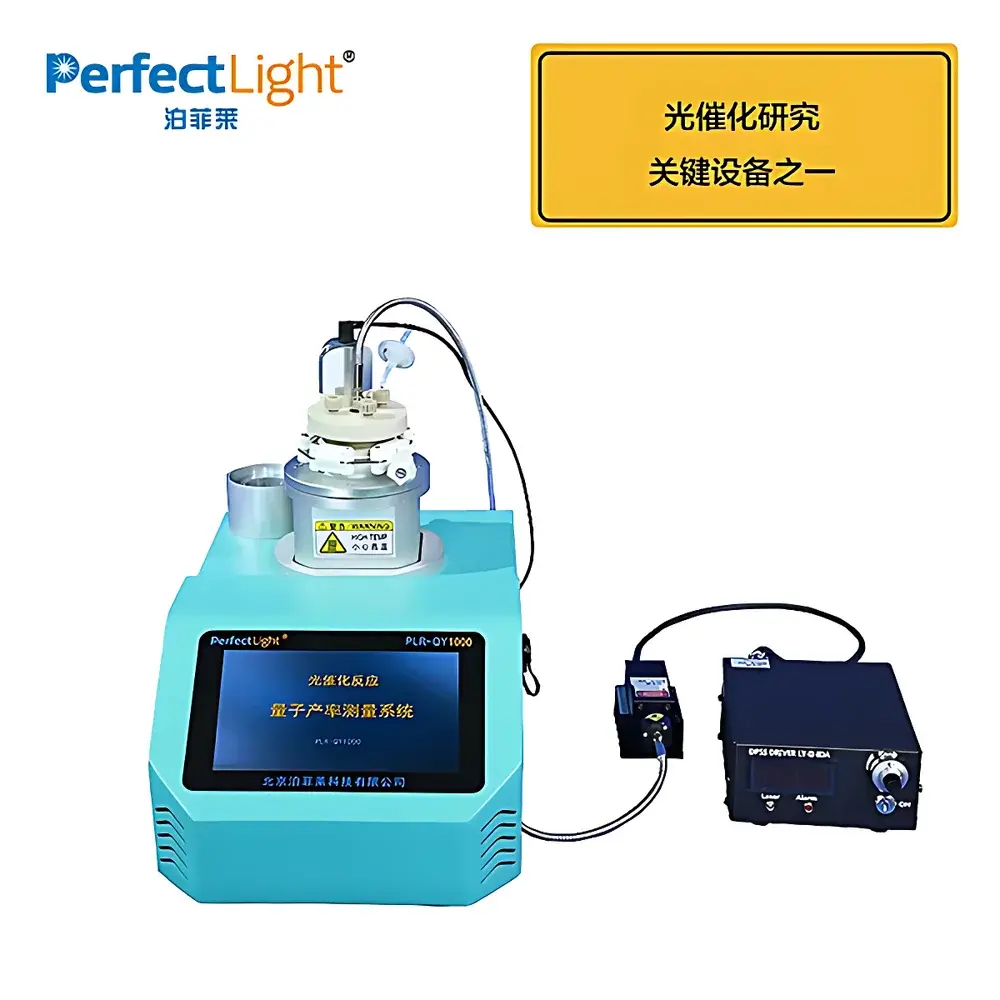
PLR-QY1000 Photocatalytic Quantum Yield Measurement System
| Brand | PerfectLight |
|---|---|
| Origin | Beijing, China |
| Model | PLR-QY1000 |
| Light Source | 405 nm Laser Diode (standard), optional wavelengths available |
| Reaction Volume | ~150 mL internal headspace (calibration-dependent) |
| Liquid Sample Volume | 100 mL (adjustable range) |
| Pressure Range | 20–130 kPa (absolute) |
| Purge Gas | N₂, delivery pressure 0.4–0.45 MPa |
| Purge Cycles | 0–255 programmable |
| Residual O₂ | ≤100 ppm after purge |
| Stirring Speed | 250–1250 rpm |
| Temperature Control | 0–60 °C (via external circulating chiller) |
| Humidity & Temperature Monitoring | Integrated in-situ sensors |
| Quantum Yield Range | 0.05%–100% |
| Data Export | USB flash drive interface |
| Compliance | Designed for ISO/IEC 17025-aligned photocatalytic testing workflows |
Overview
The PLR-QY1000 Photocatalytic Quantum Yield Measurement System is a purpose-engineered platform for the quantitative determination of apparent quantum yield (AQY) and reaction kinetics in heterogeneous photocatalytic processes. It operates on the fundamental principle of actinometric photon counting: monochromatic laser irradiation (standard 405 nm) delivers a precisely known photon flux into a geometrically optimized blackbody spherical reactor. The integrated U-shaped optical window ensures near-zero photon loss via total internal reflection and absorption within the reaction medium—enabling rigorous photon balance closure required by IUPAC-recommended protocols for quantum efficiency reporting. Unlike broadband lamp-based systems, the laser source eliminates spectral uncertainty, allowing direct conversion from measured optical power (W) to incident photon number rate (mol·s⁻¹) using Planck’s relation and wavelength-specific correction. This metrological traceability underpins reproducible AQY values across laboratories and supports benchmarking against ISO 25922 (photocatalytic hydrogen production) and ASTM E2877 (quantum yield determination).
Key Features
- Blackbody spherical reactor with U-shaped fused silica optical window: minimizes photon scattering and escape, achieving >99.8% effective photon absorption by the liquid phase.
- Stabilized 405 nm laser diode (±0.5 nm linewidth) with calibrated optical power monitoring—traceable to NIST-standard photodiodes.
- In-situ dual-parameter environmental sensing: real-time monitoring of internal temperature and relative humidity during irradiation, critical for vapor-phase equilibria and catalyst surface hydration state.
- Integrated thermostatic coupling port: compatible with standard laboratory chillers for precise temperature regulation (0–60 °C) and suppression of non-photochemical thermal contributions.
- Programmable gas handling module: built-in vacuum pump and precision pressure regulator enable automated inert gas (N₂) purging (0–255 cycles), residual O₂ reduction to ≤100 ppm, and controlled reaction pressure modulation (20–130 kPa absolute).
- Motor-driven magnetic stirring with speed control (250–1250 rpm): ensures homogeneous suspension of particulate photocatalysts and uniform mass transfer without introducing quartz-shaft contamination.
- Onboard data acquisition with USB export: time-stamped sensor readings (T, RH, pressure, stir speed) and experimental metadata saved directly to user-provided USB storage—no proprietary software dependency.
Sample Compatibility & Compliance
The PLR-QY1000 accommodates aqueous and organic solvent-based photocatalytic suspensions (e.g., TiO₂, g-C₃N₄, MOFs, perovskite nanocrystals) with typical loading concentrations of 0.1–2.0 g·L⁻¹. Its 150 mL headspace volume and 100 mL nominal liquid capacity support stoichiometric gas evolution analysis (H₂, O₂, CH₄) via GC or online MS coupling. All wetted materials—quartz windows, PTFE-sealed flanges, and 316L stainless-steel body—are chemically inert under UV–vis irradiation and acidic/basic conditions (pH 2–12). The system architecture conforms to GLP documentation requirements: timestamped purge logs, pressure ramp profiles, and environmental sensor traces are natively recorded and exportable for audit trails. While not certified as Class I Div 1 equipment, it meets CE electromagnetic compatibility (EN 61326-1) and low-voltage safety (EN 61010-1) directives for laboratory use.
Software & Data Management
The PLR-QY1000 employs embedded firmware with a minimal, deterministic real-time OS—eliminating OS-level variability that compromises measurement repeatability. All operational parameters (laser ON/OFF timing, purge sequence, pressure setpoints, stir speed ramps) are configured via a tactile membrane keypad with LCD feedback. No cloud connectivity or remote access is implemented; data integrity is preserved through local, write-once USB export in CSV format—ensuring full compliance with FDA 21 CFR Part 11 principles for electronic records where user-defined audit trails are maintained externally. Users retain complete ownership of raw photon count proxies (power × time), gas evolution integrals, and environmental baselines—facilitating independent validation against IUPAC Technical Report guidelines on photocatalytic quantum yield reporting.
Applications
- Quantitative AQY determination for H₂ evolution under monochromatic irradiation (405 nm), enabling bandgap-resolved activity mapping.
- Pressure-dependent kinetic studies of photocatalytic CO₂ reduction, including product selectivity analysis under sub-atmospheric to mild overpressure conditions.
- Humidity-controlled evaluation of hydroxyl radical generation pathways in advanced oxidation processes (AOPs).
- Thermal contribution isolation via isothermal irradiation experiments across 10–60 °C ranges.
- Inter-laboratory round-robin testing for catalyst certification under ISO/TC 201/WG12 photocatalysis standards.
FAQ
Is the 405 nm laser source replaceable with other wavelengths?
Yes—the optical mount accepts collimated laser modules from 365 nm to 660 nm (e.g., 375 nm for wide-bandgap oxides, 532 nm for visible-light sensitizers), provided beam diameter and divergence comply with the U-window acceptance angle.
How is photon flux calibrated prior to experiment?
Each system ships with a NIST-traceable thermopile sensor and calibration certificate. Users perform pre-run power measurement at the reactor window interface using the included handheld meter; the value is entered manually to compute incident photons per second.
Can the system interface with external gas chromatographs?
Yes—standard 6 mm Swagelok ports are provided for seamless connection to GC sampling loops or mass spectrometer inlets, with pressure-rated tubing rated to 150 kPa.
What is the minimum detectable quantum yield?
At 100% laser duty cycle and 120-minute irradiation, the detection limit corresponds to ~0.05% AQY for H₂ evolution (based on typical GC-TCD sensitivity and 150 mL headspace volume), assuming optimal catalyst loading and zero background signal.
Does the system support automated sequential wavelength testing?
No—wavelength changes require manual laser module replacement and recalibration. However, the firmware supports stored parameter sets per wavelength, enabling rapid reconfiguration between pre-validated protocols.



