
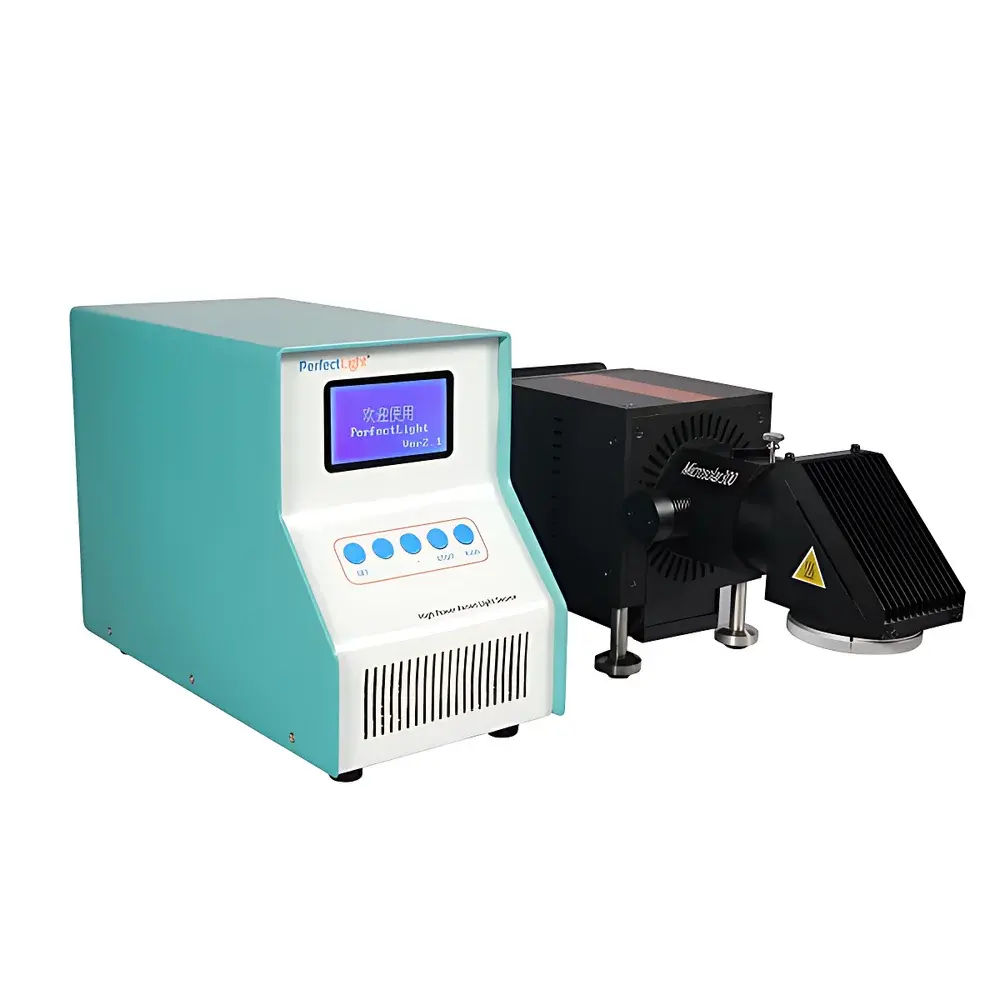
PerkinElmer Microsolar300 Xenon Light Source
| Brand | PerkinElmer |
|---|---|
| Origin | Beijing, China |
| Manufacturer Type | Authorized Distributor |
| Origin Category | Domestic (China) |
| Model | Microsolar300 |
| Light Source Type | Xenon Arc Lamp |
| Illumination Mode | External Irradiation |
| Total Optical Power | 50 W (Visible: 19.6 W |
| UV | 2.6 W) |
| Spectral Range | 320–780 nm (extendable to 2500 nm with optional filters) |
| Beam Divergence | ~6° (average) |
| Spot Diameter | Adjustable via working distance (30–60 mm) |
| Long-Term Irradiance Stability | ≤ ±3% over 8 h |
| Lamp Lifetime | >1000 h (under standard photocatalytic operating conditions) |
| Lamp Power Rating | 300 W |
| Power Adjustment Range | 150–300 W |
| Output Current | 21 A |
| Power Supply Ripple | 200 mVp-p |
| Control Modes | Constant-Current (Programmable) and Constant-Irradiance (Optical Feedback) |
| Display | LCD with real-time relative irradiance value and lamp hour counter |
| Safety Features | Fan-fault protection, post-shutdown fan delay, overcurrent/overload cutoff, low-voltage lamp-to-power-supply cabling (no high-voltage transmission), patented integrated heat-dissipation structure (CN Patent No. 201320740323.5) |
Overview
The PerkinElmer Microsolar300 Xenon Light Source is a precision-engineered optical instrument designed for reproducible, long-duration photochemical and photoelectrochemical experimentation. It employs a stabilized 300 W short-arc xenon lamp as its emission core, delivering broadband spectral output spanning 320–780 nm—covering the full near-UV, visible, and early NIR regions—with optional extension to 2500 nm using calibrated interference or bandpass filters. Its operation is grounded in two complementary control paradigms: constant-current (programmable) mode for deterministic power delivery, and constant-irradiance (optical feedback) mode enabled by an integrated photodiode-based closed-loop monitoring system. This dual-mode architecture ensures rigorous experimental repeatability across multi-hour or multi-day photocatalytic protocols—particularly critical in hydrogen evolution, overall water splitting, and photoelectrochemical cell (PEC) characterization where irradiance drift directly impacts quantum yield calculation and kinetic modeling.
Key Features
- Optical feedback-controlled irradiance regulation with ≤ ±3% stability over 8-hour continuous operation—validated via NIST-traceable radiometric calibration protocols.
- Dual operational modes: programmable constant-current (21 A max) and real-time irradiance-stabilized (light-controlled) output, selectable via front-panel interface.
- Integrated 3.5-inch LCD display showing real-time relative irradiance (% of nominal), cumulative lamp operating hours, and user-configurable timer functions.
- Patented thermal management architecture (CN Utility Model Patent No. 201320740323.5) enabling sustained 300 W operation without thermal throttling or spectral shift.
- Low-voltage DC interconnection between lamp housing and power supply—eliminating hazardous high-voltage cabling and reducing EMI susceptibility.
- Comprehensive hardware safety suite: fan-failure detection, automatic shutdown on overcurrent/overload, and intelligent post-operation fan delay for residual heat dissipation.
- Adjustable beam geometry: average divergence of 6° yields uniform irradiance profiles at working distances of 30–60 mm, compatible with standard quartz cuvettes, electrochemical cells, and custom reactor mounts.
Sample Compatibility & Compliance
The Microsolar300 is engineered for integration into ISO/IEC 17025-compliant analytical laboratories and GLP-regulated photocatalytic testing environments. Its spectral fidelity and temporal stability support method validation per ASTM E2635 (Standard Practice for Determining Photocatalytic Activity of Materials Using a Methylene Blue Degradation Test) and ISO 22197-1 (Photocatalytic Air Purification Performance). The system complies with IEC 61000-6-3 (EMC emission limits) and IEC 61010-1 (safety requirements for laboratory electrical equipment). Its modular filter-mount design accommodates standardized Schott, Thorlabs, or Omega optical filters—enabling precise isolation of UV-A (315–400 nm), visible (400–700 nm), or NIR bands for wavelength-resolved action spectrum studies.
Software & Data Management
While the Microsolar300 operates as a standalone benchtop instrument, its digital control bus supports optional RS-232 or USB-to-serial interfacing for external automation. LabVIEW™, Python (PySerial), or MATLAB® scripts can trigger mode switching, initiate timed irradiation sequences, and log real-time irradiance values (via relative % output scaling). All operational parameters—including lamp-on time, mode selection history, and fault-event timestamps—are retained in non-volatile memory for audit trail generation. When deployed in FDA-regulated R&D settings, the system’s deterministic behavior and hardware-enforced safety interlocks align with 21 CFR Part 11 principles for electronic record integrity, provided timestamped logs are exported and archived externally.
Applications
- Photocatalytic Water Splitting: Stable 8-h irradiance enables quantitative H2/O2 evolution rate measurement under AM 1.5G-simulated illumination, supporting catalyst benchmarking per IEA Task 35 reporting guidelines.
- Photoelectrochemical (PEC) Characterization: Synchronized light pulsing and potentiostat triggering facilitate transient photocurrent spectroscopy and incident photon-to-current efficiency (IPCE) mapping.
- VOC and Aqueous Pollutant Degradation: Validated for formaldehyde, NOx, SOx, methylene blue, rhodamine B, and benzene degradation kinetics under controlled irradiance and temperature.
- Wavelength-Selective Photochemistry: Coupled with monochromators or bandpass filters, enables action spectrum determination for CO2 reduction, organic synthesis, and photopolymerization studies.
- Material Photostability Testing: Used in accelerated aging protocols for perovskite solar cells, MOFs, and dye-sensitized architectures per ISO 105-B02 (lightfastness standards).
FAQ
What spectral range does the Microsolar300 cover without filters?
The unfiltered output spans 320–780 nm, with measurable emission extending into the NIR up to ~2500 nm when paired with appropriate quartz-transmissive optics and detector calibration.
Is the lamp lifetime specification validated under constant-irradiance mode?
Yes—>1000 h is measured under continuous 300 W operation in constant-current mode at 25°C ambient; lifetime may extend further under pulsed or reduced-power operation.
Can the system be integrated into a glovebox environment?
The lamp housing is air-cooled and requires external ventilation; however, the low-voltage DC interface allows safe feedthrough via standard electrical bulkhead connectors—subject to inert-gas compatibility verification of O-rings and gaskets.
Does the optical feedback system require recalibration?
The factory-calibrated photodiode sensor is drift-compensated in firmware; no user recalibration is required, though annual verification against a NIST-traceable reference detector is recommended for GLP compliance.
What power supply specifications must be met for stable operation?
A dedicated 220 V AC ±5%, 50/60 Hz circuit with minimum 16 A breaker rating and <5% total harmonic distortion (THD) is required to maintain specified ripple (<200 mVp-p) and avoid current modulation artifacts.





