
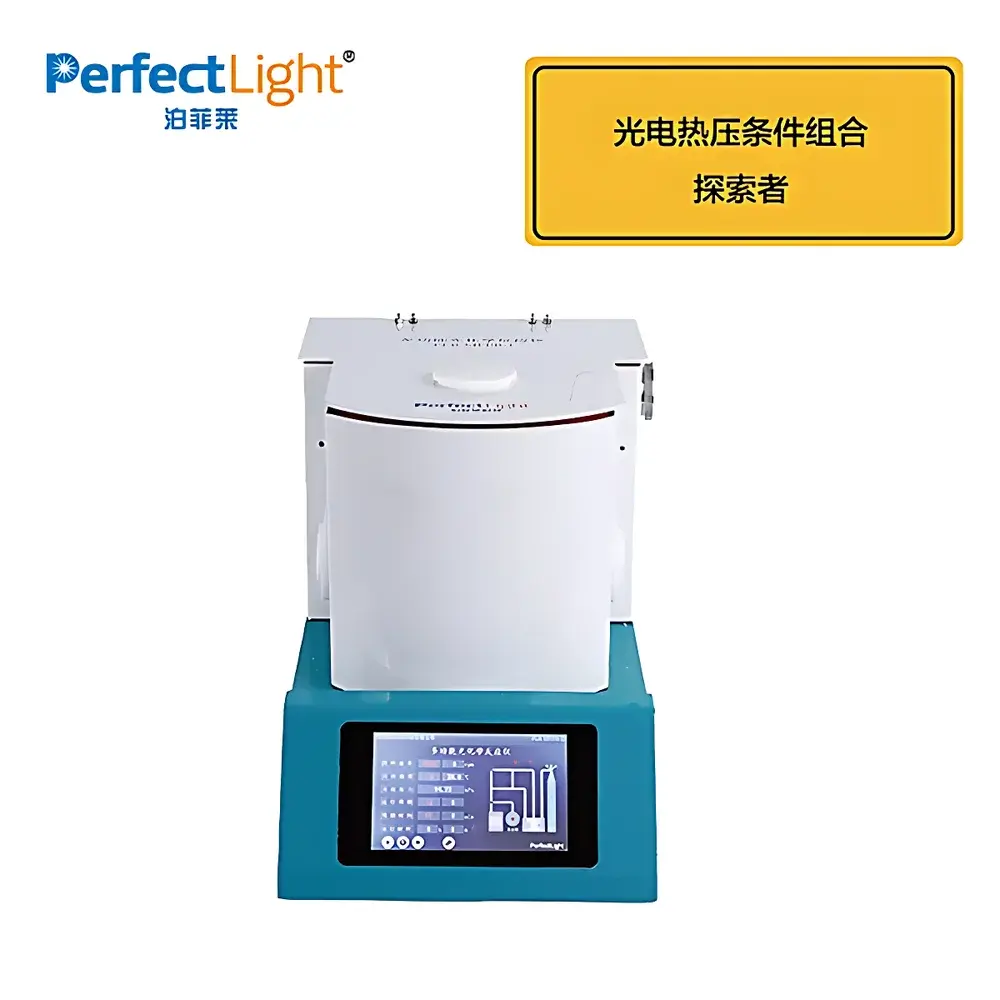
PerfectLight PLR-MFPR-I Multifield Photocatalytic Reaction System
| Brand | PerfectLight |
|---|---|
| Origin | Beijing, China |
| Model | PLR-MFPR-I |
| Temperature Range | Ambient to 180 °C |
| Temperature Control Accuracy | ±0.5 °C |
| Operating Pressure Range | −50 kPa to 0.9 MPa (gauge), 50 kPa to 1.0 MPa (absolute) |
| Reaction Volume | 100 mL (total internal volume: 120 mL) |
| Sampling Volume | 100 µL per cycle |
| Minimum Sampling Interval | 3 min |
| Magnetic Stirring Speed | 200–1500 rpm, precision ±1 rpm |
| Optical Window | Sapphire, transmission >97% from 190 nm to 5 µm, clear aperture 27.5 mm |
| Reactor Construction | Stainless steel outer body with chemically inert borosilicate glass liner rated for 0.9 MPa |
Overview
The PerfectLight PLR-MFPR-I Multifield Photocatalytic Reaction System is an engineered platform for controlled, reproducible investigation of photocatalytic CO2 reduction under coupled optical, thermal, and pressure stimuli. Unlike conventional ambient-pressure photoreactors, the PLR-MFPR-I implements a sealed, pressurizable batch reactor architecture grounded in Couette-type mixing and calibrated radiant energy delivery. Its core design addresses fundamental mass-transfer limitations in gas–liquid–solid photocatalysis—specifically low aqueous CO2 solubility and insufficient catalyst–reactant interfacial contact—by enabling simultaneous modulation of temperature (up to 180 °C), absolute pressure (up to 1.0 MPa), and incident photon flux (via top- or side-illumination configurations). The system operates on a closed-loop feedback principle: dual Pt100 temperature sensors independently monitor both reactor bulk and heating module temperatures, while a high-stability magnetic stirrer (200–1500 rpm, ±1 rpm precision) ensures homogeneous suspension of particulate photocatalysts and enhances CO2 dissolution kinetics. All critical components—including the sapphire optical window (190 nm–5 µm transmission), pressure-rated glass liner, and stainless-steel housing—are selected for long-term chemical inertness and mechanical integrity under elevated thermal and pressure loads.
Key Features
- Triple-field actuation: Independent control of irradiance (UV–NIR), temperature (ambient to 180 °C, ±0.5 °C accuracy), and pressure (50 kPa to 1.0 MPa absolute) enables systematic study of synergistic effects in photocatalytic CO2 conversion.
- Integrated automated sampling: A built-in, thermostatically isolated valve manifold permits direct online injection into GC or GC–MS systems without external hardware modification—operable across the full pressure range (80 kPa–0.9 MPa absolute) and at temperatures up to 180 °C.
- Dual illumination compatibility: Modular reactor lid supports both top-irradiation (normal incidence) and side-irradiation (tangential beam path) geometries, facilitating comparative studies of photoelectrochemical, photothermal, and pure photocatalytic mechanisms.
- Full process automation: Onboard microcontroller manages gas purging (vacuum–pressurization cycles), temperature ramping, stirring profile sequencing, and timed sampling—all programmable via intuitive color LCD interface.
- Compact integrated architecture: All functional modules—thermal jacket, magnetic drive, sampling manifold, and gas handling lines—are co-located within a footprint of 220 × 240 × 270 mm, minimizing bench space and interconnection complexity.
Sample Compatibility & Compliance
The PLR-MFPR-I accommodates heterogeneous photocatalytic systems involving solid catalysts (e.g., TiO2, g-C3N4, MOFs), aqueous or non-aqueous liquid phases, and gaseous reagents (CO2, H2, O2, Ar). Its borosilicate glass liner resists corrosion by common reaction media including acidic/alkaline electrolytes and organic solvents. The sapphire viewport maintains optical fidelity across UV–VIS–NIR spectra, supporting action-spectrum analysis and quantum yield determination per ISO 25922 and ASTM E261. Pressure and temperature control algorithms comply with IEC 61000-4-3 for electromagnetic compatibility; the system’s digital log records timestamps, setpoints, and real-time sensor values—supporting GLP-compliant data traceability when paired with validated third-party LIMS or ELN software. While not certified to ASME BPVC Section VIII, its 0.9 MPa pressure rating aligns with ISO 15848-1 leak-tightness requirements for laboratory-scale catalytic reactors.
Software & Data Management
The embedded firmware provides local experiment scheduling, real-time parameter monitoring (temperature, pressure, rpm, valve status), and CSV-exportable time-series logs. No proprietary desktop application is required; configuration and diagnostics are performed entirely through the front-panel 4.3″ TFT display with capacitive touch interface. For integration into automated workflows, the system exposes RS-485 Modbus RTU and optional Ethernet TCP/IP interfaces—enabling synchronization with chromatographic data systems (e.g., Agilent OpenLab, Thermo Chromeleon) via standardized protocol bridges. Audit trails include operator ID (optional RFID login), method version, and calibration history—meeting foundational expectations of FDA 21 CFR Part 11 for electronic records when deployed in regulated environments under site-specific validation protocols.
Applications
- Quantitative evaluation of CO2 photoreduction pathways under thermodynamically enhanced conditions (e.g., methanol, methane, CO, formic acid selectivity vs. T/P).
- Structure–activity relationship studies of plasmonic, doped, or heterojunction photocatalysts under industrially relevant pressure–temperature regimes.
- In situ/operando spectroscopic coupling (e.g., FTIR, Raman) via the sapphire viewport for mechanistic intermediate identification.
- Photothermal catalysis benchmarking using calibrated halogen or LED arrays with spectral irradiance monitoring.
- Gas-phase kinetic modeling validation using precisely timed, pressure-compensated sampling sequences.
FAQ
What is the maximum allowable working pressure and how is it verified?
The reactor is rated for 0.9 MPa gauge pressure (1.0 MPa absolute), validated per ISO 15848-1 helium leak testing and hydrostatic proof testing at 1.5× rated pressure during manufacturing.
Can the system be used with corrosive solvents such as HF-containing electrolytes?
No—the borosilicate glass liner is incompatible with hydrofluoric acid or strong alkalis above pH 12. For aggressive media, users must verify chemical resistance using manufacturer-provided compatibility charts prior to operation.
Is the 100 µL sampling volume fixed or adjustable?
The nominal sampling volume is fixed at 100 µL per cycle; however, system response time and detector sensitivity permit quantitative analysis even at sub-ppm product concentrations when coupled with high-resolution GC–FID or GC–TCD.
Does the system support external light source triggering or synchronization?
Yes—TTL-level trigger input/output ports enable precise temporal alignment between irradiation pulses and sampling events, critical for transient kinetic studies.
How is temperature uniformity maintained across the reactor volume?
A combination of axial magnetic stirring (≥1000 rpm recommended for viscous media), jacketed heating with PID-controlled thermal inertia compensation, and dual-point sensing ensures radial and axial temperature deviation remains within ±0.8 °C under steady-state conditions.



