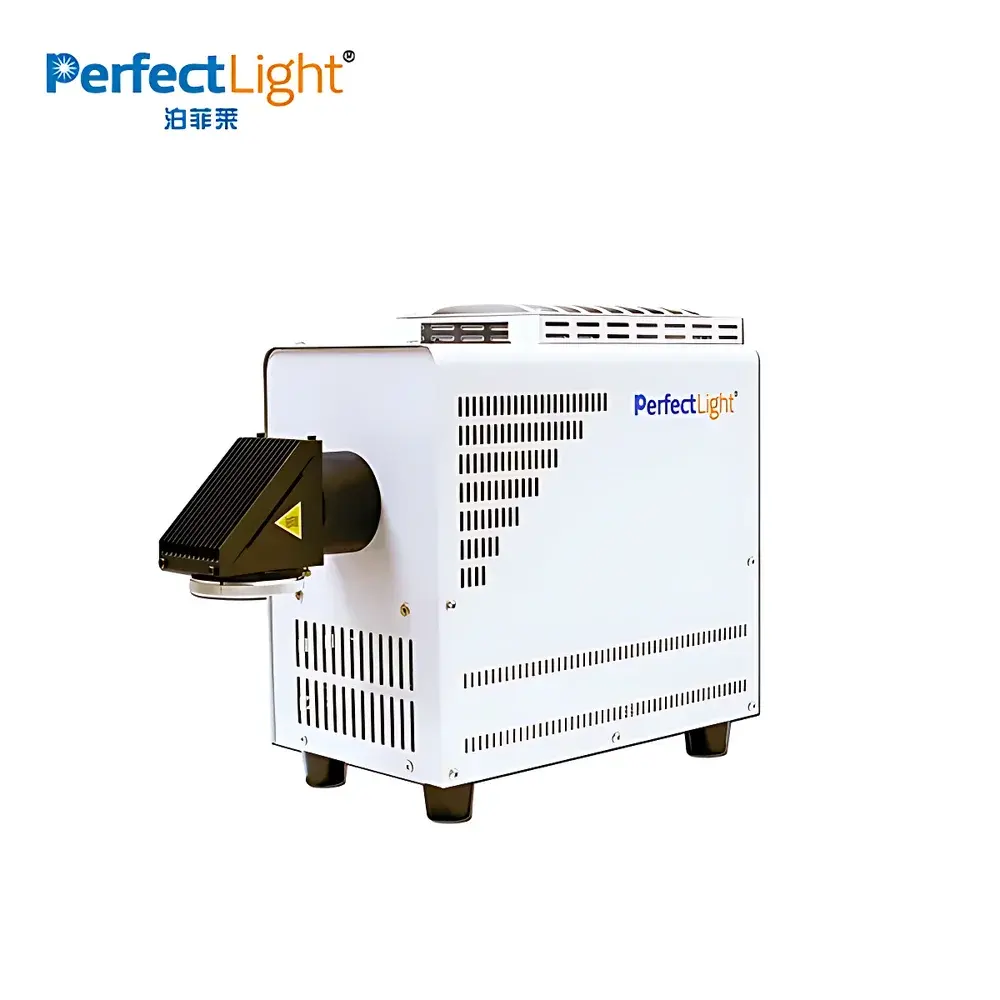
PerfectLight PLS-ILS Integrated Spherical Xenon Light Source
| Brand | PerfectLight |
|---|---|
| Origin | Beijing, China |
| Model | PLS-ILS Integrated |
| Light Source Type | Xenon Arc Lamp |
| Illumination Mode | External Irradiation |
| Lamp Power Options | 250 W / 350 W |
| Total Optical Power | 50 W |
| Irradiance | ≥2000 mW/cm² |
| Spectral Range | 320–780 nm (extendable to 2500 nm) |
| Beam Diameter | ≥50 mm (distance-dependent) |
| Divergence Angle | <10° |
| Current Regulation Range | 9–16 A |
| Lamp Lifetime | >1000 h (under standard photocatalytic irradiation conditions) |
| Long-Term Stability | ≤±3% |
| Optional Accessories | Fiber Optic Coupling Kit, Homogenizer, Liquid Filter, Light Guide Tube, Motorized Height Adjustment Stage, Mechanical Shutter, Five-Point Irradiance Calibration Set |
| Optional Filter Solutions | Bandpass Filters, Edge Filters, AM1.5G Solar Spectrum Correction Filters, Neutral Density Attenuators |
| Optional Safety Solutions | UV-Blocking Safety Goggles, Light-Tight Enclosure |
| Optional Metrology Tools | Calibrated Optical Power Meter, Fiber-Coupled Spectrometer |
Overview
The PerfectLight PLS-ILS Integrated Spherical Xenon Light Source is an engineered solution for reproducible, high-intensity broadband illumination in photochemical and photocatalytic research laboratories. Designed around a stabilized short-arc xenon lamp housed within a precisely aligned ellipsoidal reflector cavity, the system delivers collimated, uniform irradiance via external illumination geometry—enabling direct irradiation of reaction vessels, electrochemical cells, or gas-phase reactors without optical coupling losses. Its spherical reflector architecture maximizes solid-angle collection efficiency while minimizing angular divergence (<10°), ensuring high photon flux density (≥2000 mW/cm²) across a beam diameter of ≥50 mm at typical working distances. The spectral output spans 320–780 nm—covering near-UV through visible wavelengths critical for bandgap excitation of TiO₂, g-C₃N₄, perovskites, and other semiconductor photocatalysts—and supports optional extension into NIR (up to 2500 nm) using quartz-halogen auxiliary lamps or broadband filter stacks. All electrical operation is governed by a microprocessor-controlled digital power supply, enabling precise current regulation (9–16 A), programmable ramping sequences, and real-time monitoring via integrated digital ammeter.
Key Features
- Monoblock integration of lamp housing and power supply reduces footprint and electromagnetic interference—ideal for benchtop deployment in shared lab spaces.
- Interchangeable 250 W and 350 W xenon lamp modules conform to IEC 61167 standards for arc lamp safety and thermal management; standardized socket interface enables tool-free, repeatable lamp replacement with <5-minute downtime.
- Digital current regulation ensures stable arc positioning and minimized electrode sputtering, directly contributing to >1000 h operational lifetime under continuous duty cycling at rated power.
- Active thermal management includes dual-stage centrifugal cooling, thermally isolated lamp chamber, and fail-safe fan monitoring—preventing thermal runaway during extended photolysis experiments.
- Comprehensive electrical protection suite: automatic shutdown upon overcurrent (>16 A), overload detection, and post-cycle thermal soak delay to preserve cathode integrity.
- Programmable operating mode supports timed irradiation protocols, multi-step intensity gradients, and synchronization with external triggers (TTL-compatible input).
Sample Compatibility & Compliance
The PLS-ILS is compatible with standard quartz and borosilicate reaction vessels (e.g., Pyrex immersion wells, flat-bottomed cuvettes, gas-phase flow reactors), as well as custom electrochemical PEC cells equipped with optically transparent electrodes. Its external irradiation configuration avoids internal light-path obstructions, permitting unimpeded access for in situ spectroscopic probes (e.g., FTIR gas cells, Raman capillaries) or temperature sensors. The system complies with IEC 61000-6-3 (EMC emission limits) and IEC 62471 (Photobiological Safety Classification — Risk Group 3 for unfiltered output). When used with AM1.5G solar spectrum correction filters, irradiance profiles meet ASTM G173-03 reference spectra for terrestrial solar simulation. For GLP/GMP-aligned workflows, optional accessories—including calibrated power meters traceable to NIST standards and audit-ready data logging modules—support 21 CFR Part 11-compliant recordkeeping when integrated with validated laboratory information management systems (LIMS).
Software & Data Management
While the base unit operates via front-panel controls, optional PerfectLight Control Suite (v3.2+) provides USB/RS-232 interface for remote operation, script-based irradiation scheduling, and real-time current/temperature telemetry. The software logs timestamped operational parameters—including lamp-on duration, average current, thermal sensor readings, and fault event codes—with CSV export capability. All firmware updates are digitally signed and delivered via secure HTTPS portal. Audit trail functionality records user login sessions, parameter changes, and emergency stop activations—meeting minimum ALCOA+ principles for data integrity in regulated environments.
Applications
- Photocatalytic Water Splitting: Enables stoichiometric H₂/O₂ evolution studies under simulated solar illumination; optimized for suspended nanoparticle systems and immobilized thin-film catalysts.
- CO₂ Photoreduction: Supports gas-phase and aqueous-phase conversion to CH₄, CO, or C₂H₄ using tunable spectral filtering to isolate activation bands.
- VOC and NOₓ Abatement: Delivers sufficient UV-A/visible flux for kinetic evaluation of heterogeneous oxidation pathways in indoor air quality testing chambers.
- Aqueous Organic Pollutant Degradation: Facilitates pseudo-first-order rate constant determination for dyes (e.g., methylene blue), phenols, and halogenated aromatics under controlled irradiance.
- Photoelectrochemical (PEC) Characterization: Serves as a stable bias-light source for J–V curve acquisition, IPCE mapping, and transient photocurrent analysis when coupled with potentiostats.
- Spectral Responsivity Calibration: Paired with fiber-coupled spectrometers and NIST-traceable detectors, functions as a broadband reference source for quantum efficiency validation.
FAQ
What lamp types are supported beyond standard xenon?
The PLS-ILS mechanical and electrical interfaces are designed exclusively for DC-powered short-arc xenon lamps compliant with ANSI X28.1 physical dimensions and electrode spacing. Mercury-xenon or metal-halide lamps are not supported due to divergent thermal load profiles and ignition voltage requirements.
Is the spectral output certified against solar reference spectra?
The native output does not match AM1.5G without filtration. However, optional AM1.5G correction filters—characterized per ISO 9050 and supplied with individual spectral transmittance certificates—are available for quantitative solar simulation applications.
Can irradiance be spatially mapped across the beam profile?
Yes. The optional Five-Point Irradiance Calibration Set includes a NIST-traceable thermopile sensor and motorized XYZ stage, enabling ISO/IEC 17025-aligned beam uniformity assessment per IEC 60825-1 Annex F.
Does the system support automated long-term stability monitoring?
Integrated thermal and current telemetry can be logged externally via serial interface. For fully autonomous drift quantification, pairing with a calibrated photodiode array and PerfectLight Control Suite enables continuous irradiance tracking over 100+ hour campaigns.
Are safety interlocks compatible with third-party enclosures?
The unit features a dry-contact emergency stop interface (24 V DC, normally closed) and TTL-level ready signal—both configurable for integration into custom light-tight cabinets or fume hood interlock networks per EN 60204-1 requirements.