
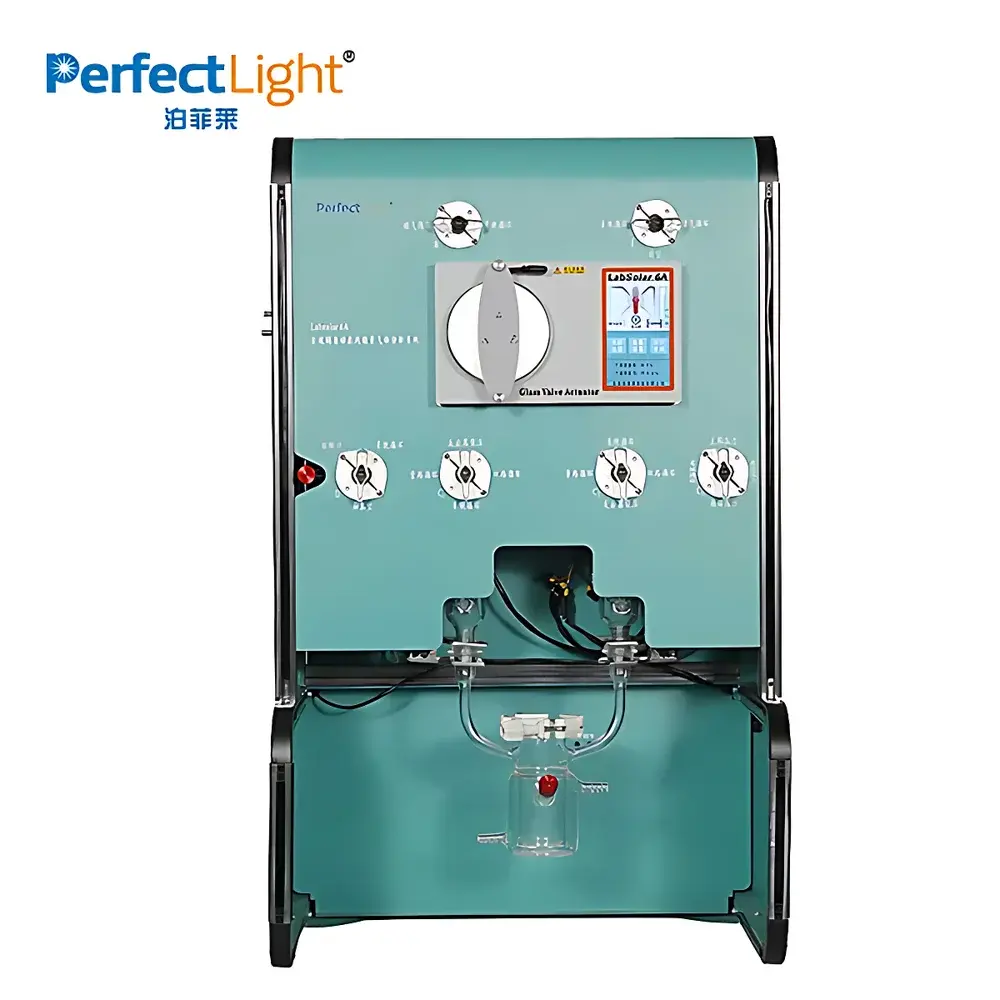
Labsolar-6A All-Glass Automated Online Trace Gas Analysis System
| Brand | PerfectLight |
|---|---|
| Origin | Beijing, China |
| Model | 6A |
| Valve Material | High-Borosilicate Glass |
| Actuation | Pneumatic/Electric Auto-Actuators |
| Gas Mixing Time | <10 min (H₂, O₂, CH₄, CO) |
| Calibration Linearity | R² > 0.9995 (H₂: 100 μL–10 mL) |
| Repeatability | RSD < 3% (n = 4) |
| Sampling Volume | 0.6 mL or 2.0 mL (selectable) |
| System Dead Volume | 65 mL |
| Vacuum Tightness | ≤1 μmol O₂/24 h |
| Absolute Vacuum Limit | ≤1.5 kPa |
| Operating Pressure Range | 0 kPa (vacuum) to ambient pressure |
| Pump Type | Oil-Free Magnetic-Drive Piston Pump (no electrical wiring in gas path) |
| Flow Direction Control | Integrated Unidirectional Valve Architecture |
| Temperature Control | 10-Stage Programmable, ±0.1 °C accuracy, up to 200 °C (loop & injection lines) |
| Condenser | Spherical or Coiled Glass Cold Trap (standard), Optional Cryogenic Cold Trap |
| Detection Limits (� | mol): H₂: 0.05 |
| O₂ | 0.1 |
| CH₄/CO | 0.0005 |
| Software | 32-bit Embedded Control Suite + 4.5″ TFT Touchscreen |
| Compliance | ASTM E2500, ISO/IEC 17025-aligned architecture, GLP-ready audit trail logging |
Overview
The Labsolar-6A All-Glass Automated Online Trace Gas Analysis System is an engineered solution for quantitative, real-time monitoring of gaseous products in low-yield heterogeneous catalytic reactions. Designed specifically for photocatalysis, photoelectrocatalysis, photothermal catalysis, and electrocatalysis research, the system operates on a closed-loop, ultra-high-integrity gas circulation principle grounded in precise volumetric sampling and inert-phase transport. Its core measurement paradigm integrates controlled vacuum-assisted gas recirculation with calibrated loop injection into downstream analytical instrumentation—typically gas chromatographs (GC) or mass spectrometers (MS). Unlike conventional batch-sampling reactors, the Labsolar-6A maintains dynamic equilibrium between reaction, adsorption/desorption kinetics, and detection—minimizing product re-adsorption artifacts that distort intrinsic turnover frequency (TOF) and quantum yield calculations. The all-glass fluidic architecture—comprising high-borosilicate glass valves, tubing, condensers, and storage vessels—ensures chemical inertness across acidic, oxidative, and reducing atmospheres, eliminating metal-catalyzed decomposition pathways and surface memory effects common in stainless-steel systems.
Key Features
- All-glass fluidic path constructed from borosilicate 3.3 glass, including precision-lapped multi-port sampling valves, 3 mm ID circulation tubing, and 150 mL gas storage reservoirs—guaranteeing zero catalytic interference and long-term adsorption stability.
- Oil-free, magnetically driven piston pump with integrated unidirectional valve architecture—eliminates electrical ingress into the gas stream, mitigating hydrogen explosion hazards and electrolytic H₂ generation during electrochemical operation.
- Programmable 10-segment temperature control (±0.1 °C) applied to both circulation loop and injection manifold, enabling kinetic studies under isothermal or gradient thermal conditions up to 200 °C.
- Automated valve sequencing via embedded 32-bit control firmware, synchronized with GC/MS trigger signals; supports manual, semi-automatic, and fully autonomous operation modes with real-time valve position feedback.
- Dual selectable定量 loop volumes (0.6 mL and 2.0 mL) allow sensitivity optimization across wide concentration ranges—from sub-ppm CO detection to percent-level O₂ evolution—without hardware modification.
- Integrated spherical or coiled glass condenser prevents water vapor breakthrough to downstream analyzers and vacuum pumps; optional cryogenic cold trap enables selective removal of volatile organics and extends pump service life.
Sample Compatibility & Compliance
The Labsolar-6A accommodates diverse reactor configurations—including top-irradiated quartz photoreactors, three-electrode PEC cells, resistively heated fixed-bed reactors, and custom-designed electrochemical flow cells—via standardized Swagelok-compatible or PTFE-sealed glass interfaces. Its vacuum integrity (≤1 μmol O₂/24 h) meets ASTM D6866 and ISO 13877 requirements for low-background oxygen evolution quantification in water-splitting studies. The system’s architecture supports GLP-compliant data governance: all valve actuations, pressure transients, temperature profiles, and sampling events are timestamped and logged with cryptographic checksums. Audit trails comply with FDA 21 CFR Part 11 principles when paired with validated third-party GC/MS data acquisition software. Vacuum grease selection (Dow Corning HV-500, -40 °C to 200 °C operating range) ensures compatibility with aggressive halogenated or sulfur-containing reaction media per ISO 8573-1 Class 1 purity standards.
Software & Data Management
The embedded 4.5-inch TFT touchscreen interface hosts a deterministic real-time OS running a modular control suite. Preconfigured instrument methods govern vacuum cycling, gas mixing intervals, loop pressurization sequences, and GC synchronization pulses—all editable via password-protected secondary debugging mode. Sensor-driven maintenance alerts notify users of vacuum grease degradation based on elapsed runtime and cumulative pressure differential. System parameters—including internal absolute pressure (0–101.3 kPa), ambient temperature, loop temperature setpoints, and valve state—are continuously streamed via RS-232 or Ethernet to external LabVIEW or Python-based data lakes. Raw logs export in CSV/TSV format with ISO 8601 timestamps, supporting traceability for journal submission and regulatory review.
Applications
- Photocatalytic overall water splitting (H₂/O₂ co-evolution) with stoichiometric ratio validation and apparent quantum efficiency (AQE) calculation at defined wavelengths.
- CO₂ photoreduction to CH₄, CO, C₂H₄, or methanol under controlled partial pressures, with kinetic discrimination between surface-bound intermediates and desorbed products.
- Photoelectrochemical (PEC) bias-dependent gas evolution profiling on BiVO₄, Fe₂O₃, or perovskite photoanodes under AM 1.5G illumination.
- Electrocatalytic HER/OER/CO₂RR benchmarking in H-cell or flow-cell configurations, decoupled from Faradaic inefficiency caused by H₂ crossover or O₂ reduction side reactions.
- Photothermal catalysis under simulated solar flux, where precise thermal management of gas loops isolates photonic vs. thermal contributions to reaction rates.
FAQ
What analytical instruments can the Labsolar-6A interface with?
It is designed for seamless integration with gas chromatographs (equipped with TCD or FID detectors), quadrupole mass spectrometers, and paramagnetic O₂ analyzers via TTL-triggered injection and analog pressure/voltage signal feedback.
Is the system suitable for corrosive gas environments (e.g., HCl, H₂S)?
Yes—the all-borosilicate construction and Dow Corning HV-500 vacuum grease provide verified resistance to halogenated and sulfidic species per ASTM C1036 exposure testing protocols.
How is calibration performed for quantitative analysis?
Calibration employs certified standard gas mixtures injected via the same 0.6/2.0 mL loop; linear response is validated over 100 μL–10 mL H₂ range (R² > 0.9995) with NIST-traceable reference materials.
Can the system operate under positive pressure?
Yes—it functions across 0 kPa (absolute vacuum) to ambient pressure, with pneumatic actuators rated for ≤200 kPa gauge pressure for specialized high-pressure screening applications.
What safety provisions exist for hydrogen-handling experiments?
The absence of electrical conductors in the gas path, combined with leak-tight glass joints, magnetic-drive pumping, and optional H₂-specific explosion-proof enclosure kits, satisfies IEC 60079-10-1 zoning requirements for Zone 1 laboratory environments.
Related Products



