
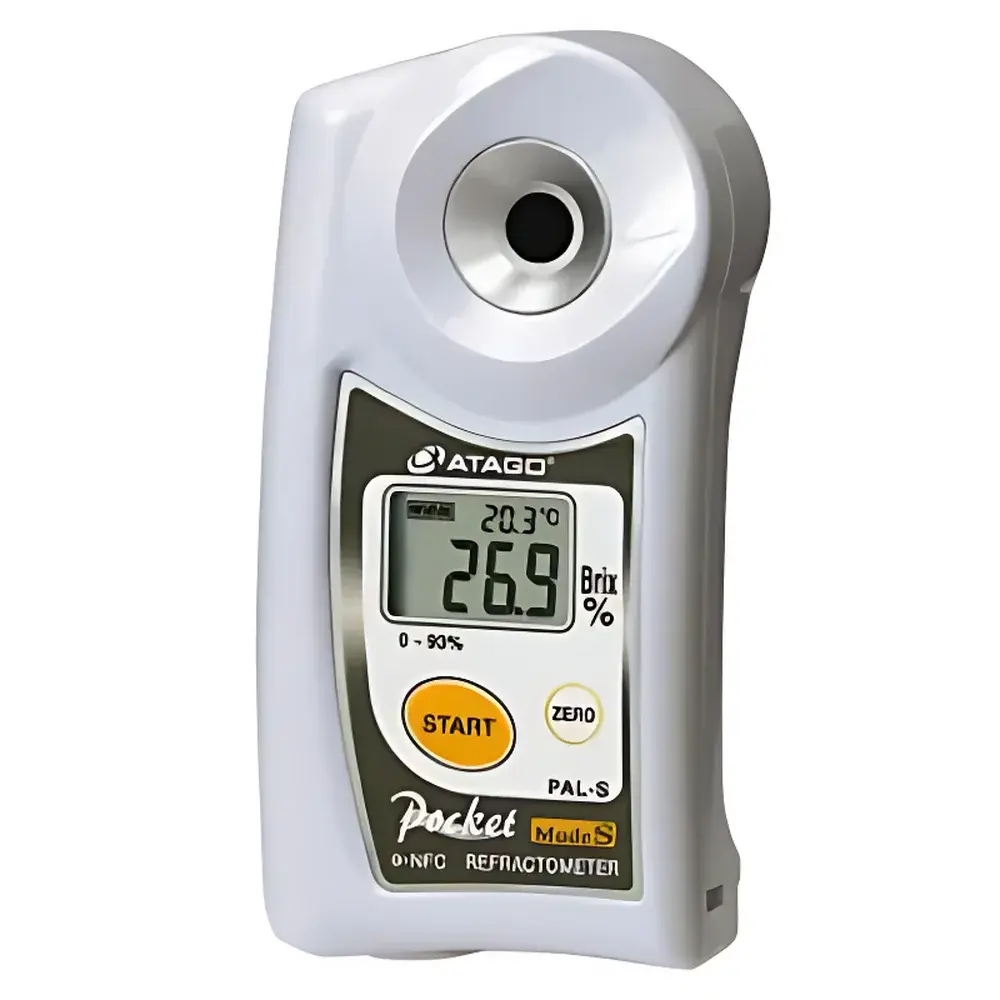
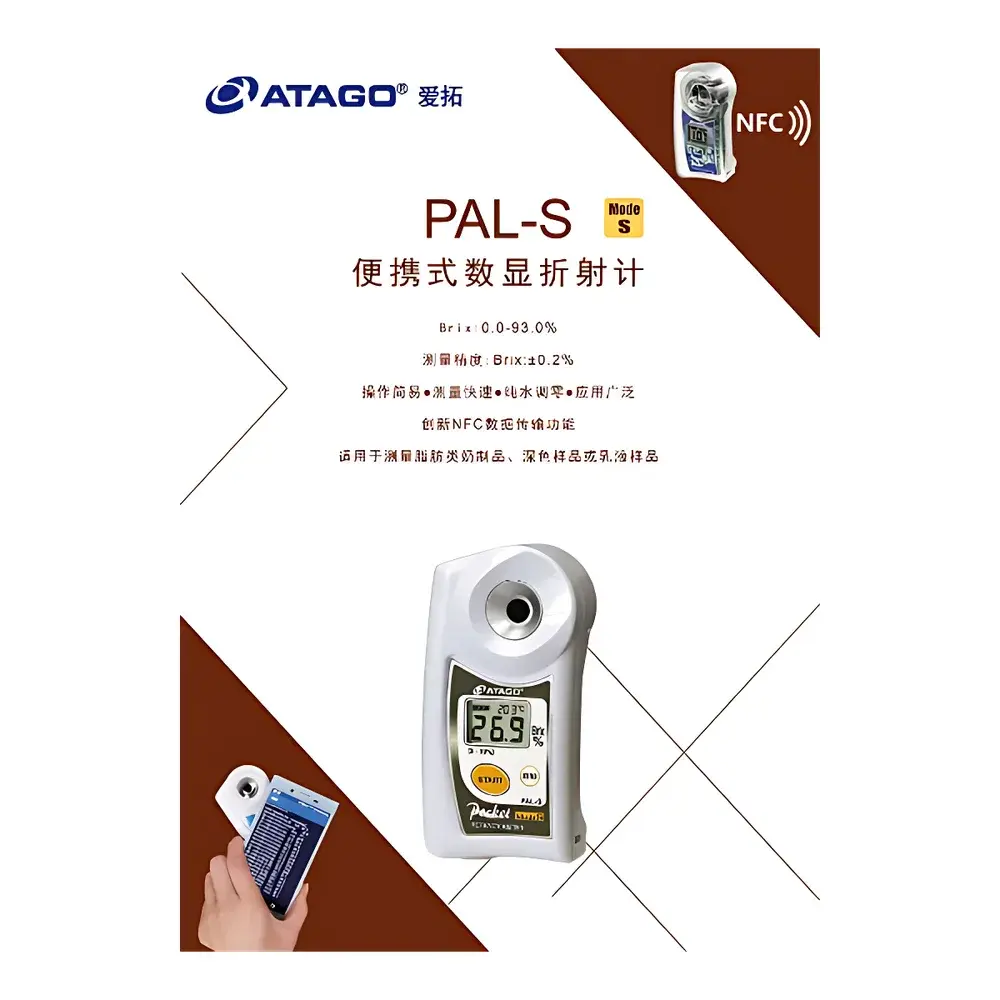
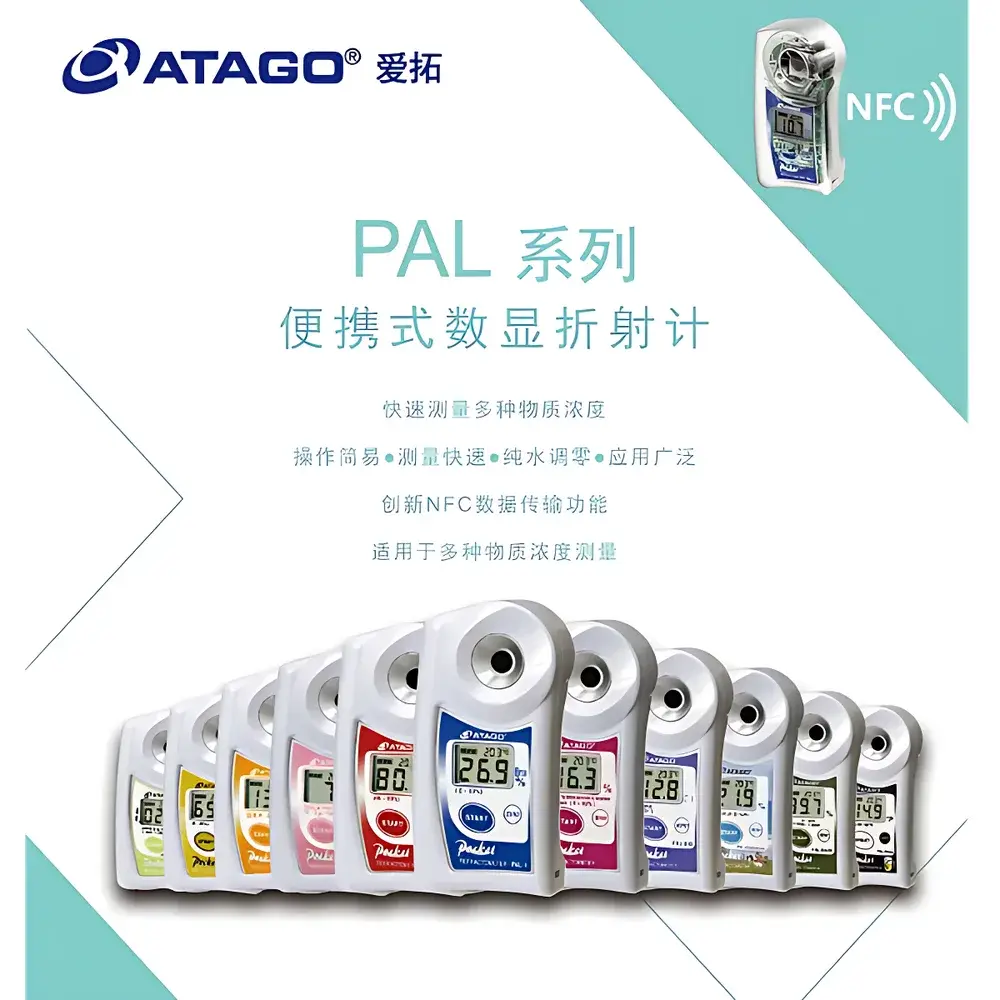
ATAGO PAL-S Dairy Dark Sample Refractometer
| Brand | ATAGO |
|---|---|
| Origin | Japan |
| Model | PAL-S |
| Product Type | Handheld Refractometer |
| Measurement Range | 0.0–93.0% (Brix or % w/w, dairy-specific scale) |
| Accuracy | ±0.2% |
| Resolution | 0.1% |
| Operating Temperature Range | 10–100°C (sample temperature) |
| Ambient Operating Temperature | 10–40°C |
| Display | Digital LCD |
| Temperature Compensation | Automatic (ATAGO Mode S algorithm) |
| Protection Rating | IP65 |
| Power | Two AAA batteries |
| Dimensions | 5.5 × 3.1 × 10.9 cm |
| Weight | 100 g (instrument only) |
Overview
The ATAGO PAL-S Dairy Dark Sample Refractometer is a purpose-engineered handheld optical instrument designed specifically for rapid, field-deployable concentration measurement of opaque, high-fat, and pigmented dairy matrices—including raw milk, cream, condensed milk, whey concentrates, and fermented dairy products. Unlike conventional Abbe-type or traditional Brix refractometers, the PAL-S employs ATAGO’s proprietary Mode S optical detection algorithm, which dynamically compensates for light-scattering artifacts induced by suspended fat globules, casein micelles, and melanoidins in thermally processed or aged dairy samples. This enables stable, repeatable refractive index (nD) conversion to concentration (% w/w) without sample dilution, centrifugation, or filtration—critical for on-farm collection points, dairy co-op receiving bays, and quality control checkpoints where time, portability, and robustness are non-negotiable. The device operates on the fundamental principle of total internal reflection at the prism-sample interface; incident light undergoes critical-angle shift proportional to solute concentration, digitally resolved via high-sensitivity photodiode array and factory-calibrated against NIST-traceable dairy reference standards.
Key Features
- Mode S optical engine: Enhances measurement reproducibility for turbid, emulsified, and dark-colored dairy samples by minimizing scattering-induced signal drift.
- Dairy-optimized calibration curve: Pre-programmed scale correlates refractive index to total solids (TS), lactose-equivalent Brix, or fat-adjusted concentration per ISO 5725-2 (accuracy) and ISO 8586 (sensory and instrumental inter-laboratory validation).
- IP65-rated enclosure: Dust-tight and protected against low-pressure water jets—suitable for humid, cold-room, or outdoor farm environments.
- Real-time automatic temperature compensation (ATC): Compensates for sample temperature fluctuations between 10°C and 100°C using integrated thermistor feedback, eliminating manual correction tables.
- High-contrast digital LCD display with backlight: Ensures legibility under variable ambient lighting (e.g., barn interiors, truck cabins, processing line stations).
- Zero-maintenance optical path: Sapphire-coated prism surface resists scratching, corrosion, and organic residue buildup common in dairy applications.
Sample Compatibility & Compliance
The PAL-S is validated for direct measurement of undiluted, unfiltered liquid and semi-liquid dairy samples—including whole milk (≥3.5% fat), skim milk, buttermilk, yogurt beverages, chocolate milk, coffee creamers, and whey protein isolates. It excludes powdered or highly viscous gels (e.g., set yogurt, cheese curds) requiring homogenization prior to analysis. All firmware and calibration protocols comply with ISO 21527-1 (microbiological methods for dairy) and ISO 5725-based precision requirements for routine QC instrumentation. While not FDA 21 CFR Part 11-compliant as a standalone device (lacking audit trail or user authentication), it supports GLP/GMP-aligned documentation when paired with ATAGO’s optional PAL-Link data logging software and timestamped export to CSV or Excel formats.
Software & Data Management
The PAL-S operates as a stand-alone instrument with no embedded memory or Bluetooth/Wi-Fi connectivity. However, optional accessories—including the PAL-Link USB interface cable and ATAGO’s free PAL-Link PC application—enable real-time data streaming, batch export, statistical summary (mean, SD, CV%), and PDF report generation. Exported datasets retain full metrological traceability: each reading includes sample ID, date/time stamp, operator code (manually entered), ambient temperature, and measured value with uncertainty (±0.2%). Data files conform to ISO/IEC 17025 Clause 7.7 requirements for record retention and integrity.
Applications
- On-site raw milk acceptance testing at collection centers (fat-corrected solids estimation pre-payment).
- Process monitoring during evaporation, standardization, and homogenization in dairy plants.
- Quality verification of inbound cream, whey permeate, and lactose solutions in ingredient manufacturing.
- Field-based R&D support for new product development involving plant-based dairy analogs (e.g., oat milk, almond cream), provided correlation studies are performed against reference methods (e.g., AOAC 972.16).
- Teaching laboratories in food science curricula for hands-on instruction in optical property–composition relationships.
FAQ
Does the PAL-S require periodic recalibration with certified standards?
Yes. ATAGO recommends verification against a traceable sucrose or dairy-specific reference solution (e.g., NIST SRM 1993) before each shift or after exposure to extreme thermal cycling.
Can the PAL-S measure ethanol content in fermented dairy products like kefir?
No. It reports total soluble solids—not volatile compounds. Ethanol quantification requires gas chromatography (GC) or enzymatic assay.
Is the prism surface compatible with caustic cleaning agents used in CIP systems?
The sapphire-coated prism resists short-term contact with 1–2% NaOH or nitric acid, but immersion or abrasive scrubbing is prohibited. Rinse with deionized water immediately after use.
What is the minimum sample volume required for reliable measurement?
Approximately 0.3 mL—sufficient to fully cover the prism sensing area without overflow.
Does the device meet international regulatory requirements for export-controlled instrumentation?
Yes. The PAL-S contains no dual-use components and is classified under ECCN 6A993 (non-sensitive optical instruments), permitting unrestricted global shipment under standard commercial terms.



