
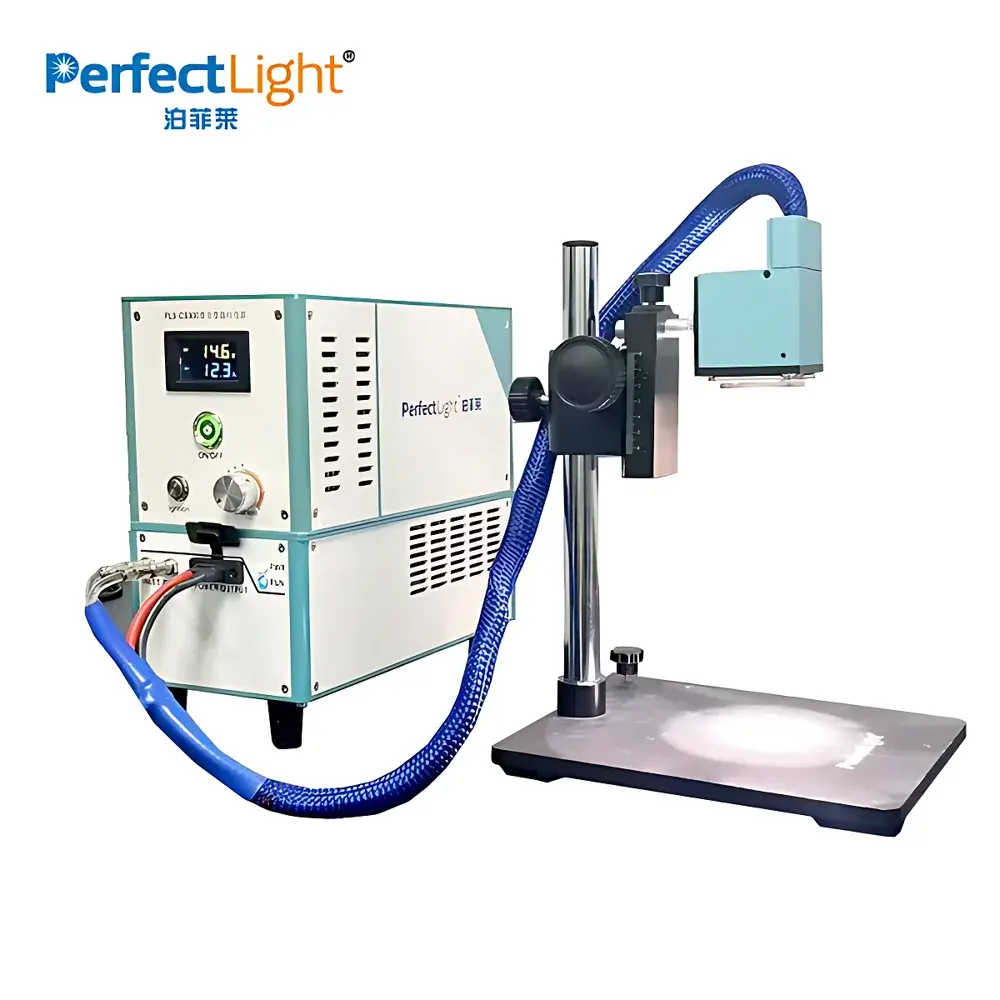
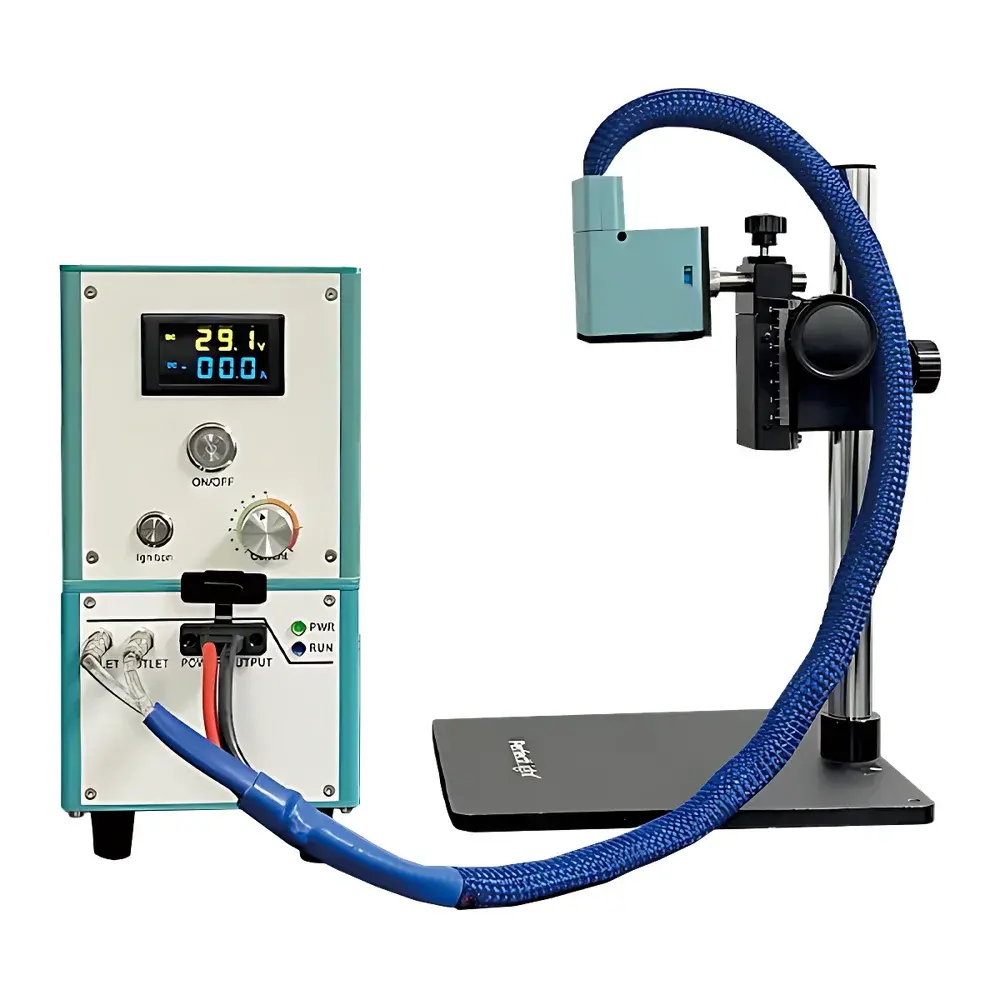
PerkinElmer PEL-Portable Liquid-Cooled Ceramic Xenon Light Source
| Brand | PerkinElmer |
|---|---|
| Model | PEL-Portable Liquid-Cooled Ceramic Xenon Light Source |
| Light Source Type | Xenon Arc Lamp |
| Cooling Method | Active Liquid Cooling |
| Spectral Range | 300–2500 nm |
| Illumination Mode | External Irradiation |
| Beam Delivery | Omnidirectional Mounting Interface |
| Origin | Beijing, China |
| Compliance | CE, RoHS, ISO 9001-certified Manufacturing |
Overview
The PerkinElmer PEL-Portable Liquid-Cooled Ceramic Xenon Light Source is a high-intensity, spectrally continuous broadband illumination system engineered for precision optical laboratory applications requiring solar-simulated irradiance in compact, field-deployable configurations. Based on a stabilized ceramic xenon short-arc lamp housed within a hermetically sealed, liquid-cooled thermal management module, this source delivers stable radiometric output with minimal thermal drift over extended operation cycles. Its emission profile spans 300–2500 nm — covering deep UV through visible to near-infrared — and closely matches the ASTM G173-03 global solar reference spectrum (AM1.5G) in both spectral continuity and relative intensity distribution. Unlike air-cooled or pulsed alternatives, the integrated closed-loop liquid cooling system enables sustained CW (continuous-wave) operation at rated power without spectral shift or arc instability, making it suitable for quantitative photoreactor studies where irradiance reproducibility and temporal stability are critical.
Key Features
- Compact, self-contained chassis (W × D × H: 280 × 190 × 145 mm) with integrated pump, heat exchanger, and DC-powered cooling circuit — no external chiller required.
- Ceramic envelope xenon lamp with ≥5,000-hour operational lifetime and <±0.5% RMS irradiance stability over 8-hour continuous run (measured at 500 nm, 1 m distance, ±2% ambient temperature variation).
- Optimized elliptical reflector optics delivering collimated or focused beam profiles via interchangeable front-end adapters (collimator, fiber-coupler, or integrating sphere interface).
- Omnidirectional mounting flange (M6 threaded holes on four faces) enabling arbitrary orientation without mechanical goniometers or repositioning fixtures.
- Real-time lamp voltage/current monitoring and thermal feedback loop with automatic power derating below 15°C or above 35°C ambient to preserve arc integrity and spectral fidelity.
- EMI-shielded enclosure compliant with CISPR 11 Class B limits; safety interlock circuitry meeting IEC 61010-1 requirements for Class II laser product ancillary illumination.
Sample Compatibility & Compliance
The PEL light source is compatible with standard quartz-glass photochemical reactors (e.g., Pyrex®-free cylindrical or flat-bottom vessels), electrochemical cells with optical windows (CaF₂, sapphire, or fused silica), and custom-built gas-phase flow-through photoreactors. It supports standardized sample geometries defined in ASTM E2584 (photocatalytic activity measurement), ISO 22197-1 (NOₓ decomposition), and ISO 10678 (dye degradation under simulated solar irradiation). All optical interfaces comply with ANSI Z87.1 impact-resistant lens specifications when used with optional UV-blocking safety shields. The system architecture adheres to GLP-compliant data traceability requirements: lamp operating hours, cumulative energy dose (J/cm²), and thermal sensor logs are timestamped and exportable via USB-C in CSV format.
Software & Data Management
The embedded microcontroller supports bidirectional communication via USB-C or RS-485 Modbus RTU protocol. Optional PerkinElmer Photometry Suite (v3.2+) provides real-time irradiance mapping, spectral calibration correction using NIST-traceable reference detectors, and automated dose control for time-resolved quantum yield experiments. All session data — including lamp ignition history, coolant temperature ramp profiles, and user-defined exposure protocols — are stored with SHA-256 hash integrity verification and support 21 CFR Part 11 audit trail generation when deployed in regulated QA/QC environments. Export formats include HDF5 (for MATLAB/Python integration), .tdms (LabVIEW), and .xlsx with embedded metadata per ISO/IEC 17025 documentation standards.
Applications
- Quantitative photocatalytic water splitting (H₂/O₂ evolution) and CO₂ reduction kinetics under AM1.5G-equivalent irradiance.
- Gas-phase photocatalytic oxidation of VOCs, formaldehyde, NOₓ, and SOₓ in continuous-flow reactors with online GC-MS or FTIR detection.
- Homogeneous and heterogeneous photolysis studies of aqueous organic pollutants (azo dyes, phenols, BTEX) with in situ UV-Vis absorbance monitoring.
- Photoelectrochemical (PEC) cell characterization including incident photon-to-current efficiency (IPCE) mapping and open-circuit potential decay analysis.
- Light-induced phase transition studies in photochromic thin films and MOF-based optical sensors requiring broadband excitation with precise dosimetry.
- Calibration reference source for spectroradiometers and solar simulators undergoing ISO/IEC 17025 accreditation.
FAQ
What is the recommended working distance for optimal irradiance uniformity?
For ±5% spatial uniformity across a 20 mm diameter area, the recommended working distance is 150–250 mm from the output port. Uniformity maps are provided in the calibration certificate shipped with each unit.
Can the system be synchronized with pulsed measurement equipment (e.g., transient absorption spectrometers)?
Yes — the lamp power supply includes TTL-compatible trigger input (5 V CMOS) for external gating, with jitter <100 ns and delay programmable from 0–5 s in 1 µs steps.
Is spectral recalibration required after lamp replacement?
Yes. Each new ceramic xenon lamp exhibits minor spectral variance due to electrode aging and fill gas composition. A full spectral recalibration using the included NIST-traceable photodiode array spectrometer is mandatory and documented in the GLP-compliant calibration log.
Does the liquid cooling system require periodic maintenance?
The sealed glycol-water coolant loop requires no servicing for 24 months or 4,000 operating hours. After that, coolant replacement and pump filter inspection are recommended per the maintenance schedule in Section 7.2 of the technical manual.



