
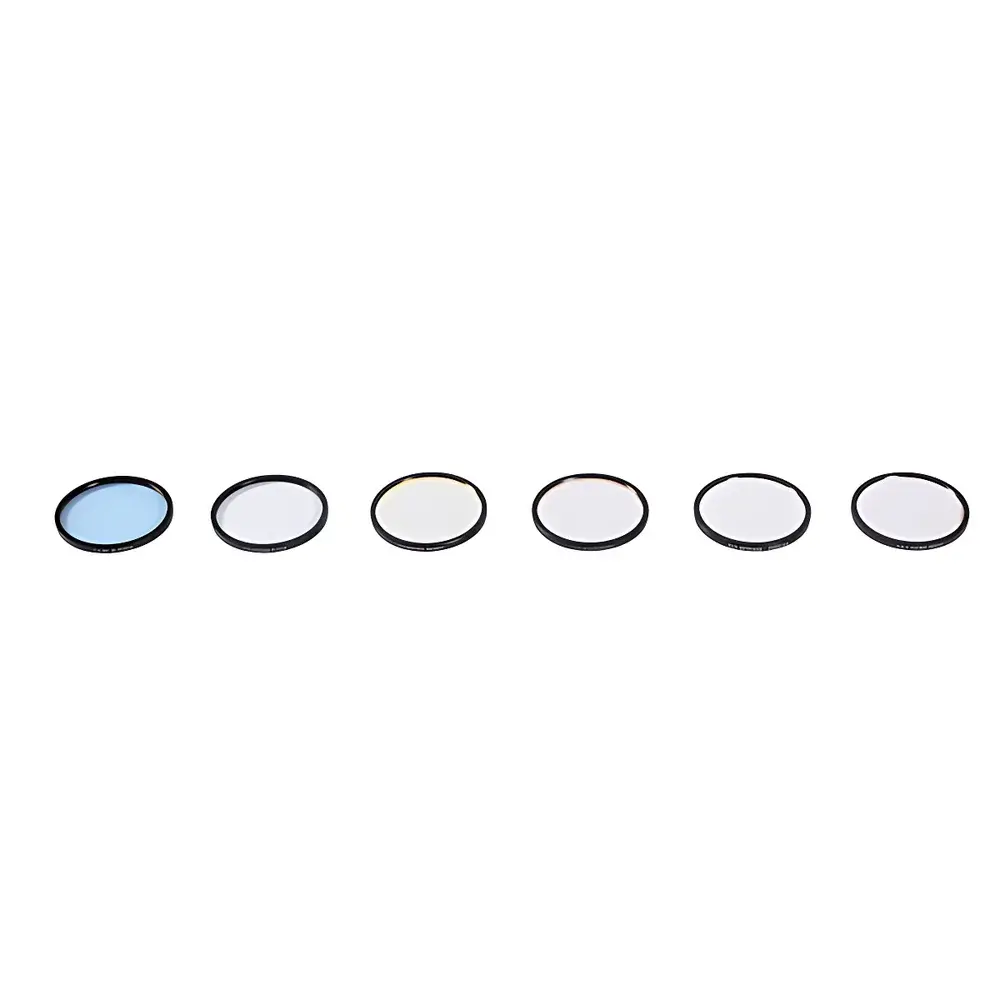
PerfectLight UVCUT420 Long-Wave Pass Optical Filter
| Brand | PerfectLight |
|---|---|
| Origin | Beijing, China |
| Model | UVCUT420 |
| Component Type | Optical Filter |
| Substrate Material | Fused Silica (Quartz) |
| Diameter | 63 mm |
| Clear Aperture | >57 mm |
| Cut-on Wavelength | 420 nm (typical, long-wave pass configuration) |
| Spectral Performance | High OD (>4) below cutoff, >90% average transmission above cutoff |
| Surface Quality | 20–10 scratch-dig |
| Parallelism | <1 arcmin |
| Thickness | 3.0 ± 0.1 mm |
| Coating | Hard-dielectric multilayer on both sides |
Overview
The PerfectLight UVCUT420 is a precision-engineered long-wave pass (LWP) optical filter designed for rigorous photonic and photochemical applications requiring spectral discrimination at the ultraviolet–visible boundary. Operating on the principle of thin-film interference, it utilizes a robust hard-dielectric multilayer coating deposited uniformly on high-purity fused silica substrate to achieve a sharp spectral transition centered near 420 nm. Unlike absorptive filters, this interference-based design ensures minimal thermal load, negligible fluorescence, and high laser damage threshold—critical for continuous-wave or pulsed UV–vis illumination systems. The filter transmits wavelengths ≥420 nm with >90% average throughput while attenuating shorter-wavelength radiation (e.g., UVC and UVB) to an optical density (OD) exceeding 4 across 200–410 nm. Its performance is traceable to NIST-calibrated spectrophotometric reference standards and conforms to ISO 10110-7 (optical element surface quality) and ISO 9022-3 (environmental resistance testing for optical components).
Key Features
- Fused silica substrate ensures exceptional UV transparency, low thermal expansion (α ≈ 0.55 × 10⁻⁶ /°C), and superior resistance to solarization under prolonged UV exposure.
- Double-sided dielectric coating provides high environmental durability—tested per MIL-C-48497A for humidity, abrasion, and adhesion; compliant with ISO 9211-3 for coating spectral stability.
- Clear aperture >57 mm enables compatibility with standard 1-inch (25.4 mm) and 2-inch (50.8 mm) optical mounts, as well as collimated beam paths up to Ø55 mm without vignetting.
- Specified cut-on wavelength of 420 nm is defined at 50% transmission point (T₅₀) with transition width (10–90% rise) ≤15 nm—validated via calibrated double-beam UV–vis–NIR spectrophotometry (PerkinElmer Lambda 1050+).
- Surface flatness λ/4 @ 633 nm and parallelism <1 arcmin support interferometric-grade alignment in cavity optics and spectroscopic setups.
Sample Compatibility & Compliance
The UVCUT420 is routinely deployed in photochemical reactors, solar simulators, fluorescence microscopy excitation pathways, and UV curing validation systems. It is compatible with incident irradiance up to 500 mW/cm² (250–800 nm, CW) without measurable spectral shift or transmission degradation after 1,000 hours of accelerated aging (per ASTM G155 Cycle 1). All units undergo 100% spectral verification and are supplied with individual calibration certificates listing measured T(λ) data from 200–1100 nm at 1 nm resolution. The product meets ISO 17025-accredited testing requirements for optical component certification and supports GLP-compliant documentation packages upon request.
Software & Data Management
While the UVCUT420 is a passive optical component, its spectral characterization data is delivered in standardized ASCII format (.csv) and compatible with industry-standard optical design and analysis platforms—including Zemax OpticStudio, CODE V, and Thorlabs’ ThorCam SDK. Each filter’s measured transmission curve is referenced to NIST-traceable standards (SRM 2036, SRM 2068) and includes uncertainty budgets per GUM (JCGM 100:2018). For integration into automated QA/QC workflows, spectral metadata can be embedded into LabVIEW or Python-based instrument control scripts using the provided JSON manifest file containing lot number, coating date, and certified T₅₀ deviation (±0.3 nm typical).
Applications
- Photoelectrocatalysis research: Isolating visible-light response (≥420 nm) in TiO₂, g-C₃N₄, or BiVO₄ systems while excluding UV-driven side reactions.
- Solar simulation: Enabling AM1.5G-compliant visible spectrum delivery in photovoltaic quantum efficiency (QE) measurements.
- Fluorescence excitation filtering: Blocking residual UV leakage from xenon or mercury arc lamps to prevent sample photobleaching in confocal or widefield microscopes.
- UV safety monitoring: Serving as a reference-grade spectral blocker in radiometer calibration chains for ISO/CIE actinometric measurements.
- Optical system qualification: Validating spectral purity in OEM lighting modules, LED drivers, and display backlight units per IEC 62471 photobiological safety standards.
FAQ
What does “UVCUT” signify in the model name?
“UVCUT” denotes a long-wave pass filter optimized for blocking ultraviolet radiation below a specified cut-on wavelength—here, 420 nm—while transmitting visible and near-infrared light.
Is the UVCUT420 suitable for high-power laser applications?
It is rated for CW broadband sources up to 500 mW/cm². For pulsed lasers (ns–ps), LIDT must be evaluated case-by-case; contact technical support with pulse energy, repetition rate, and beam diameter parameters.
Can this filter be mounted in standard kinematic optical mounts?
Yes—its 63 mm outer diameter and 3.0 mm thickness conform to ANSI/OEOSC OP1.002-2022 mechanical interface specifications for 2-inch optics holders.
Do you provide spectral measurement reports for individual units?
Yes—each filter ships with a NIST-traceable spectral transmission certificate, including T(λ) data, T₅₀ value, and OD profile below cutoff.
Is custom cut-on wavelength available?
Yes—custom long-wave pass filters from 300 nm to 900 nm are available under ISO 9001-certified manufacturing; lead time and MOQ apply.





