
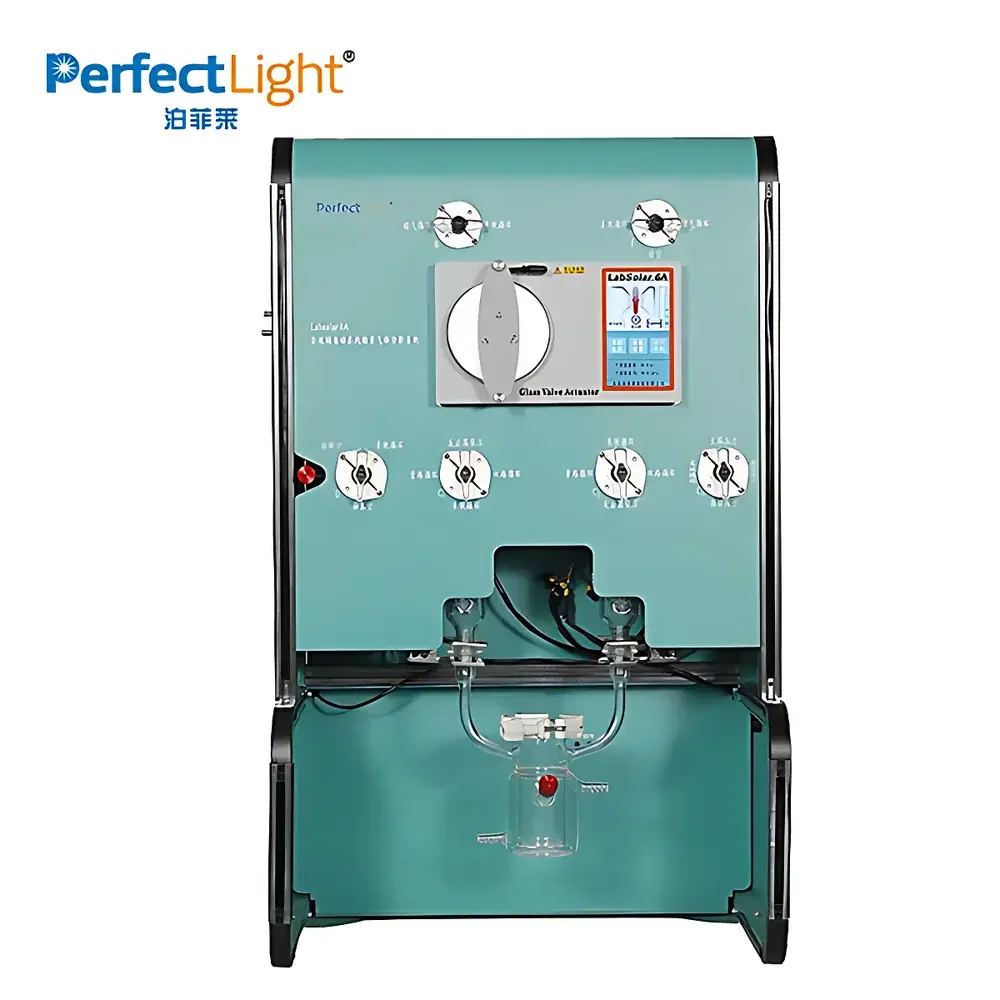
PerfectLight Labsolar-6A All-Glass Automated Online Trace Gas Analysis System for Gas-Phase CO₂ Photoreduction
| Brand | PerfectLight |
|---|---|
| Origin | Beijing, China |
| Model | Labsolar-6A Gas-Phase |
| Construction Material | Borosilicate Glass (Duran®-grade) |
| Gas Circulation Time | <10 min for H₂, O₂, CH₄, CO |
| Oxygen Leakage Rate | ≤0.1 μmol/h |
| Detection Limits (� | mol): H₂: 0.05 |
| O₂ | 0.1 |
| CH₄/CO | 0.0005 |
| Quantitative Loop Options | 0.6 mL or 2 mL |
| System Volume | 65 mL |
| Operating Pressure Range | 0 kPa (vacuum) to ambient pressure |
| Vacuum Degree | ≤1.5 kPa (absolute) |
| Temperature Control | 10-segment programmable, ±0.1°C accuracy, up to 200°C |
| Valve Count | 7 |
| Sealing Medium | Dow Corning® High-Vacuum Grease (-40–200°C) |
| Compliance | Designed for GLP-compliant catalyst evaluation under ASTM E2500 and ISO/IEC 17025-aligned workflows |
Overview
The PerfectLight Labsolar-6A is an all-glass, fully automated trace gas analysis platform engineered specifically for quantitative kinetic studies of gas-phase photocatalytic CO₂ reduction. Unlike conventional slurry-based (liquid-phase) systems, the Labsolar-6A implements a fixed-bed gas–solid reaction architecture in which humidified CO₂ flows *through* a packed catalyst bed—enabling four-orders-of-magnitude higher diffusion coefficients than aqueous media and eliminating mass-transfer limitations inherent to dissolved CO₂. The system operates on the principle of closed-loop gas recirculation coupled with periodic, valve-mediated sampling into an external gas chromatograph (GC). Its borosilicate glass construction ensures zero catalytic surface adsorption, chemical inertness toward acidic intermediates (e.g., formic acid vapor), and optical transparency for uniform irradiation. It is not a standalone detector but a complete reaction-integrated analytical workflow engine—integrating reaction chamber, magnetic-drive gas circulation, temperature-controlled condensation management, and GC-synchronized autosampling—all governed by deterministic real-time control firmware.
Key Features
- Fixed-Bed Gas-Through Reactor Architecture: Patented design (ZL 2023 2 0652037.7) enables forced convective contact between CO₂ and solid photocatalysts, maximizing active-site accessibility and minimizing boundary-layer resistance—critical for accurate turnover frequency (TOF) determination.
- Magnetic-Drive Piston Pump: Oil-free, spark-free, and intrinsically safe; delivers consistent 6 mL/stroke displacement across full pressure range (vacuum to ambient); eliminates hydrogen evolution interference and electrical ignition hazards in H₂-rich atmospheres.
- Ultra-Low Oxygen Permeability: Sealed glass manifold with precision-lapped borosilicate valves and Dow Corning® vacuum grease achieves ≤0.1 μmol/h O₂ ingress—essential for stoichiometric quantification of O₂ co-evolution during sacrificial water oxidation.
- Thermally Managed Gas Pathway: Integrated serpentine condenser and optional cryogenic trap remove H₂O, acetonitrile, and triethanolamine vapors prior to GC injection—preventing column fouling, detector saturation, and pump oil degradation.
- Programmable 10-Stage Thermal Control: Independent heating of sampling loop, transfer lines, and reactor jacket (±0.1°C stability) enables isothermal reaction monitoring and controlled desorption studies.
- Automated GC-Synchronized Sampling: Multi-port glass sampling valve with integrated quantitative loop (0.6 or 2 mL) actuates via software-defined timing—ensuring reproducible injection volume, minimal dead volume (<15 μL), and full audit trail per ICH M10 and FDA 21 CFR Part 11 requirements.
Sample Compatibility & Compliance
The Labsolar-6A accommodates heterogeneous photocatalysts—including TiO₂, g-C₃N₄, MOFs, and perovskite oxides—in powder, pellet, or monolith formats. It supports co-feed gases (H₂O vapor, N₂, Ar) and tolerates trace organic volatiles (e.g., TEOA, MeOH) without system contamination. All wetted components are Class A borosilicate glass (DIN ISO 3585), certified for long-term exposure to CO₂, H₂, CH₄, and O₂ at ≤200°C. The system meets mechanical integrity requirements outlined in ASTM E2500-21 (Good Practice for Specification and Verification of Analytical Instruments) and supports GLP-compliant data acquisition when paired with validated GC software (e.g., Agilent OpenLab CDS or Thermo Chromeleon). Full electronic logbook functionality—including valve position history, pressure transients, temperature ramps, and sampling timestamps—is retained locally on the embedded 32-bit controller.
Software & Data Management
Control is executed via a dedicated 4.5-inch TFT touchscreen running deterministic real-time firmware—not general-purpose OS. The interface displays live system pressure (kPa abs), ambient temperature (°C), valve states, and pump duty cycle. Predefined instrument methods govern GC trigger signals, vacuum pump sequencing, and multi-step thermal programs. A dual-level security model includes user-level operation mode (manual/semi-auto/auto) and engineer-level access (two-factor encrypted entry) for method calibration and diagnostic routines. Sensor-driven maintenance alerts notify users of vacuum grease replacement intervals based on cumulative pump runtime and temperature exposure. All operational events are timestamped and stored in non-volatile memory with SHA-256 checksum integrity verification—satisfying ALCOA+ principles for raw data traceability.
Applications
Primary use cases include: (1) Quantitative assessment of CO₂-to-fuel selectivity (CO, CH₄, C₂H₄) and quantum yield under AM 1.5G illumination; (2) Kinetic isotope effect (KIE) studies using ¹³CO₂; (3) Long-duration stability testing (>100 h) with unattended operation when interfaced with Microsolar-300 xenon light sources; (4) Comparative evaluation of co-catalyst loading effects under identical mass-transfer conditions; (5) In situ thermal desorption profiling of adsorbed intermediates (e.g., *COOH, *CHO) via programmed temperature ramping. The system is routinely deployed in academic photoredox laboratories and industrial catalyst screening centers requiring ISO/IEC 17025 traceable gas-phase activity metrics.
FAQ
Can the Labsolar-6A be used with liquid-phase CO₂ reduction systems?
No—it is purpose-built for gas–solid reactions. Liquid-phase configurations require separate slurry reactors with headspace sampling interfaces.
What GC detectors are compatible with the Labsolar-6A’s output signal?
TCD (for H₂, O₂, CH₄, CO, N₂) and FID (for hydrocarbons, CH₃OH vapor) configurations are supported; detector selection must match target analyte detection limits.
Is the system compliant with FDA 21 CFR Part 11 for regulated environments?
Yes—when operated in auto-mode with enabled audit trail logging, electronic signatures, and role-based access control, it satisfies electronic record/electronic signature (ER/ES) requirements for GMP pilot-scale catalyst qualification.
How is calibration performed for quantitative analysis?
Calibration uses certified standard gas mixtures (NIST-traceable) injected via the same quantitative loop and valve sequence used during experiments—ensuring identical transport dynamics and minimizing matrix effects.
Does the system support reaction under elevated pressure?
It operates from high vacuum (≤1.5 kPa) to ambient pressure only; overpressure operation requires external pressure-rated reactor modules not included in the base configuration.



