
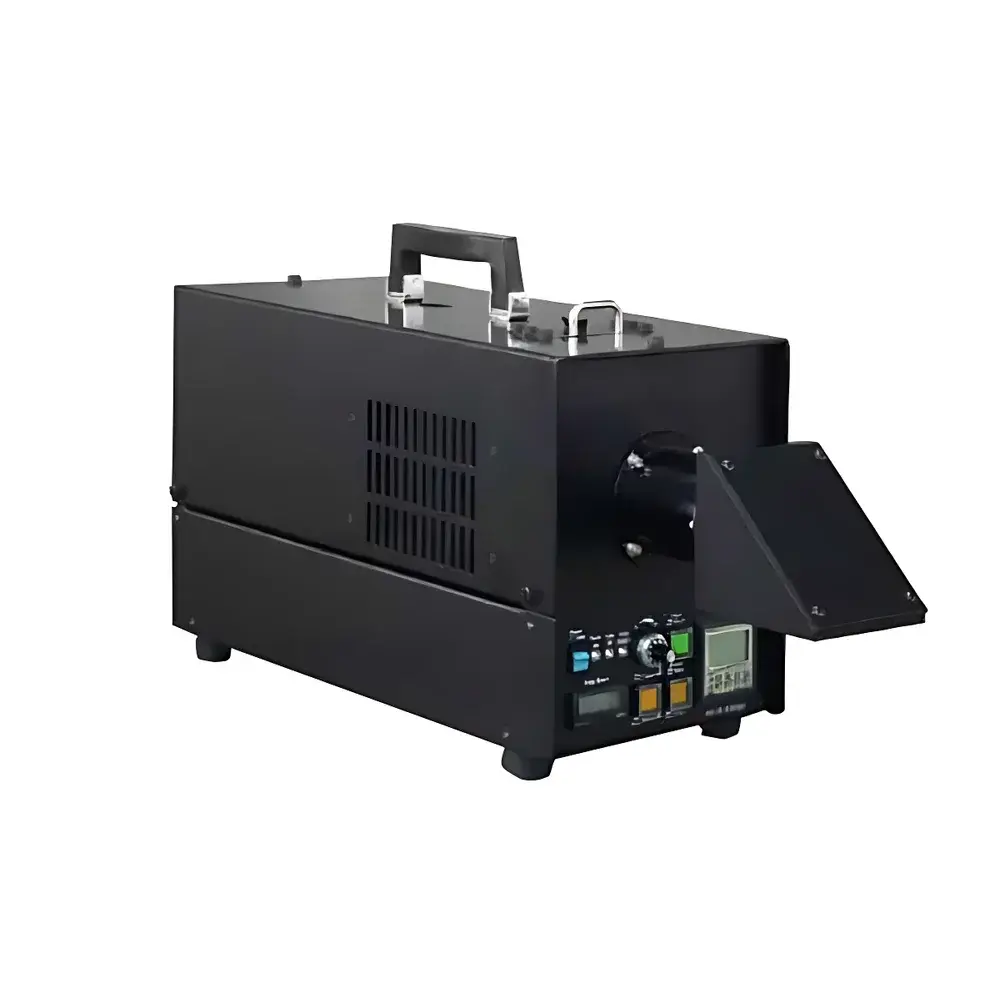
PerkinElmer AAA-Class Solar Simulator XES-40S3-TT-200
| Brand | PerkinElmer |
|---|---|
| Origin | Beijing, China |
| Manufacturer Type | Authorized Distributor |
| Product Origin | Domestic (China) |
| Model | XES-40S3-TT-200 |
| Light Source Type | Xenon Arc Lamp |
| Illumination Mode | External Irradiation |
| Radiation Area | 40 × 40 mm² |
| Spectral Match | AM1.5G (Class A) |
| Temporal Instability | <1% (Class A) |
| Spatial Uniformity | ±2% (Class A) |
| Initial Irradiance | 1.0 sun (100 mW/cm²) |
| Adjustable Irradiance Range | 70–130% of 1.0 sun |
| Lamp Lifetime | 2000 h (1000 h warranty) |
| Collimation Angle | ±4° |
| Shutter Timing Range | 0.1 s to 9990 h |
| Output Orientation Options | Vertical downward, vertical upward, horizontal left/right, 45° mirror-reflected |
| Expandable Functions | Neutral density attenuation, spectral bandpass filtering |
| Input Voltage | AC 100–220 V ±10%, 50/60 Hz |
| Operating Environment | 5–35 °C, 20–85% RH |
Overview
The PerkinElmer AAA-Class Solar Simulator XES-40S3-TT-200 is a precision-engineered xenon-arc-based illumination system designed to replicate the spectral distribution, spatial uniformity, and temporal stability of terrestrial sunlight under AM1.5G conditions. It operates on the principle of broadband continuum emission from a high-pressure short-arc xenon lamp, optically conditioned via collimating optics, reflective beam steering, and calibrated spectral filtering to meet the stringent requirements of ISO 9022-11, IEC 60904-9 (Ed. 3, 2020), and ASTM E927-19 for Class AAA performance. This classification denotes simultaneous compliance with Class A for spectral match (±25% deviation tolerance across 300–1200 nm), Class A for spatial uniformity (±2% over the defined 40 × 40 mm² irradiation field), and Class A for temporal stability (<1% RMS fluctuation over 10 s to 30 min). The simulator is not a photovoltaic tester per se, but a metrologically traceable light source platform—intended for integration into custom electrochemical cells, quantum yield reactors, or vacuum-compatible PEC measurement rigs where radiometric fidelity is non-negotiable.
Key Features
- Dual independent shutter timer system enabling precise control of exposure duration and sequencing for kinetic studies (e.g., transient photocurrent decay, time-resolved PL quenching).
- Integrated thermal cut-off protection circuitry that monitors lamp housing temperature in real time and interrupts power if ambient or internal thermal thresholds exceed safe operational limits.
- Embedded lamp-hour counter with non-volatile memory retention—critical for predictive maintenance scheduling and GLP-compliant usage logging.
- Remote optical shutter interface compatible with TTL-level digital I/O (5 V logic), supporting synchronization with potentiostats, lock-in amplifiers, or data acquisition systems via external trigger signals.
- Modular beam delivery architecture: standard vertical downward output; optional 45° mirror mount for lateral sample access; configurable horizontal or inverted orientations without optical realignment.
- Factory-calibrated irradiance output at 1.0 sun (100 mW/cm²), with continuous analog or digital adjustment from 70% to 130% via front-panel encoder or RS-232/USB command set.
Sample Compatibility & Compliance
The XES-40S3-TT-200 accommodates planar and semi-cylindrical samples up to 50 mm in diameter within its 40 × 40 mm² uniform irradiance zone. Its external illumination geometry permits direct coupling to quartz-windowed electrochemical cells, gas-phase reaction chambers, and liquid-phase cuvette holders—without requiring optical window integration into the sample stage itself. All optical components—including fused silica collector optics and cold mirrors—are certified for UV-VIS-NIR transmission (200–1100 nm) and rated for continuous operation at ≥1000 W/m² irradiance. The system conforms to IEC 61000-6-3 (EMC emissions) and IEC 61000-6-2 (immunity), and supports audit-ready documentation packages compliant with ISO/IEC 17025 calibration traceability requirements when paired with NIST-traceable reference cells (e.g., KG5-filtered Si photodiodes).
Software & Data Management
While the XES-40S3-TT-200 operates as a stand-alone hardware unit, its RS-232 and USB-C interfaces support bidirectional communication with third-party control environments—including LabVIEW, Python (PySerial), MATLAB, and custom SCADA frameworks. Firmware version 2.1+ implements IEEE 488.2 SCPI command syntax for irradiance setpoint, shutter state, lamp status, and runtime logging. All shutter timing events and lamp-on hours are timestamped and exportable as CSV files for inclusion in electronic lab notebooks (ELN) adhering to ALCOA+ principles. When deployed in regulated environments (e.g., GMP photostability testing per ICH Q1B), the system may be configured with user-access controls, electronic signatures, and 21 CFR Part 11–compliant audit trails via optional middleware integration.
Applications
- Quantum Yield Determination: Enables absolute action spectrum measurement in conjunction with calibrated spectroradiometers and integrating spheres per ISO 22197-1 and ASTM E2057.
- Photoelectrochemical (PEC) Characterization: Provides stable, spectrally matched bias illumination for Mott-Schottky analysis, incident photon-to-current efficiency (IPCE), and open-circuit voltage decay kinetics.
- Photocatalytic Reactivity Screening: Supports standardized evaluation of H₂/O₂ evolution, CO₂ reduction selectivity, and VOC mineralization under reproducible solar-simulated conditions per ISO 22197-2 and JIS R 1701-1.
- Material Photostability Assessment: Used in accelerated aging protocols for organic semiconductors, perovskite films, and dye-sensitized architectures under controlled irradiance and thermal load.
- Optical Sensor Calibration: Serves as a primary irradiance reference for calibrating UV-Vis-NIR photodetectors, radiometers, and imaging sensors in metrology labs.
FAQ
What standards does the XES-40S3-TT-200 meet for AAA classification?
It satisfies Class A criteria for spectral match (AM1.5G, IEC 60904-9), spatial uniformity (±2% over 40 × 40 mm²), and temporal stability (<1% RMS), collectively qualifying as AAA per current IEC and ASTM definitions.
Can the irradiance be calibrated traceably to NIST?
Yes—when used with an accredited reference cell (e.g., KG5-filtered Si diode with NIST-traceable responsivity certificate), users may perform in-situ irradiance calibration per ISO/IEC 17025 procedures.
Is the system suitable for vacuum or glovebox integration?
The base unit is air-cooled and rated for ambient operation only; however, the collimated output beam can be coupled into vacuum chambers or inert-atmosphere gloveboxes via quartz viewports using optional beam-transfer kits.
Does the simulator include spectral filtering options?
Standard configuration delivers full xenon spectrum; optional bandpass filters (UV-A, UV-B, VIS, NIR) and neutral density wheels are available as modular add-ons for wavelength-selective irradiation.
What maintenance is required for long-term stability?
Lamp replacement every ~1000–2000 h (per warranty and performance degradation curves); quarterly cleaning of collector optics with spectroscopic-grade solvents; annual verification of uniformity and temporal stability using a calibrated imaging radiometer.





