
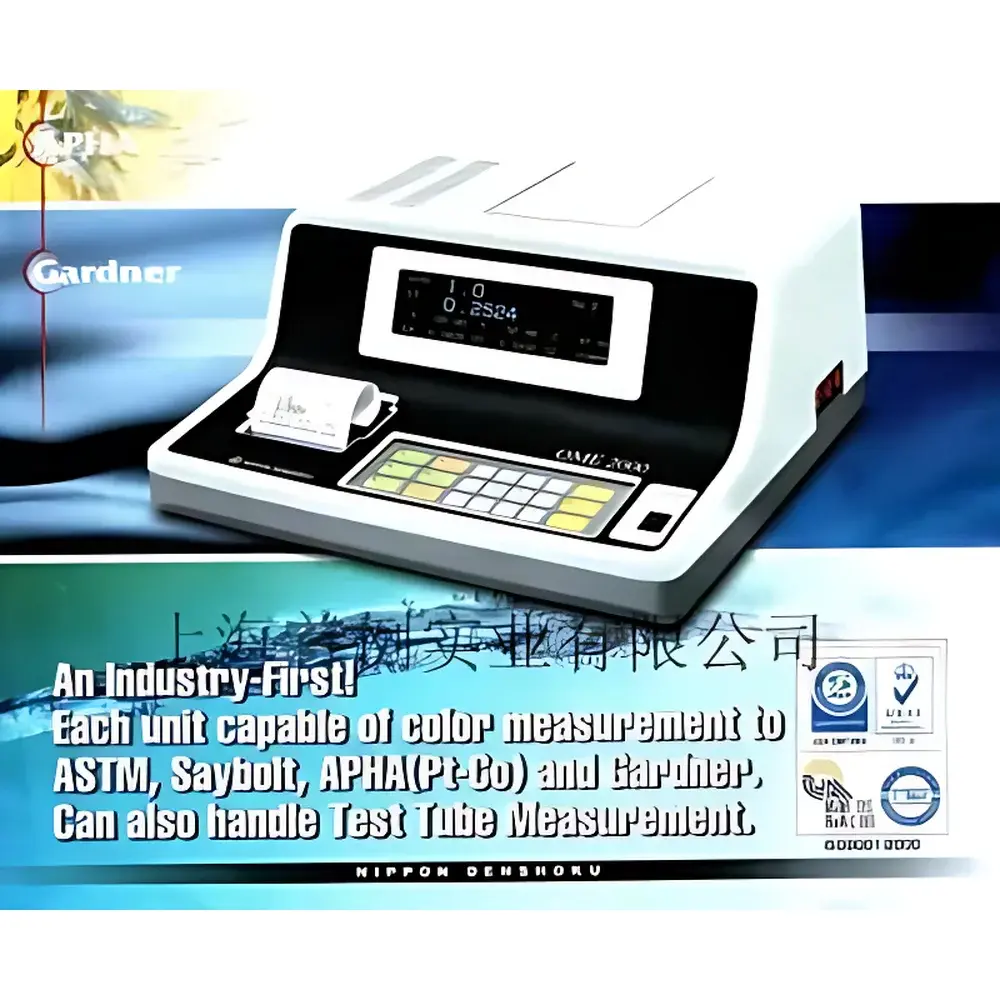
NIPPON DENSHOKU OME2000 Petroleum Colorimeter
| Brand | NIPPON DENSHOKU |
|---|---|
| Origin | Japan |
| Model | OME2000 |
| Instrument Type | Benchtop |
| Light Source | Halogen Lamp (12 V / 2 A) |
| Spectral Range | 400–700 nm (20 nm bandwidth) |
| Measurement Modes | ASTM D1500, Saybolt, APHA (Pt-Co), Gardner, CIE XYZ, CIELAB (L*a*b*) |
| Measurement Ranges | ASTM: 0–8.0 |
| Saybolt | −16 to +30 |
| APHA | 1–500 |
| Gardner | No. 1–No. 18 |
| Measurement Accuracy | ASTM D1500 (CV ≤ 3% at ASTM 1.0) |
| Aperture | φ16 mm (transmission beam) |
| Compliance Standards | JIS K 2580, JIS K 0071, ISO 2211, ISO 6271, ISO 4630, ASTM D1209, ASTM D1500, ASTM D1544, ASTM D156, ASTM D6045, USP <631> |
| Power Supply | AC 100 V, 50/60 Hz |
| Power Consumption | 120 W |
| Interface | RS-232C |
| Data Storage | Internal memory with lithium-backed backup |
| Display | Fluorescent VFD (high-contrast, wide-angle, low-light readable) |
| Printer | Thermal printer (two-stage activation, selective output) |
| Averaging | Up to 99 measurements |
| Sample Naming | Alphanumeric entry (stored & printed with results) |
| Timestamping | YY/MM/DD/HH/MM included in printout |
| Optional Accessories | Flow cell adapter, tube measurement kit |
Overview
The NIPPON DENSHOKU OME2000 Petroleum Colorimeter is a benchtop optical instrument engineered for precise, repeatable color assessment of transparent liquid hydrocarbons and related industrial oils. It operates on the principle of spectrophotometric transmittance measurement across the visible spectrum (400–700 nm, 20 nm nominal bandwidth), using a stabilized halogen lamp as its broadband illumination source. Unlike reflectance-based colorimeters, the OME2000 is optimized for transmission geometry—measuring light attenuation through standardized sample cells—to deliver quantitative color indices aligned with globally recognized petroleum and chemical industry standards. Its design prioritizes metrological integrity in regulated environments, supporting traceable calibration via certified reference solutions rather than physical tile standards. This eliminates inter-laboratory variability associated with standard plate aging or handling, and ensures long-term consistency under GLP and GMP-aligned quality systems.
Key Features
- High-fidelity analog signal chain: Incorporates an 18-bit embedded self-calibrating 16-bit A/D converter and low-drift precision amplifier, achieving ≤0.002% FSD accuracy (at Y = 100) for photometric stability across density gradients.
- Multi-standard compliance engine: Simultaneously computes and displays results in ASTM D1500, Saybolt, APHA (Pt-Co), Gardner, CIE XYZ, and CIELAB (L*a*b*) scales—each mapped to its respective reference scale per ISO, ASTM, and JIS specifications.
- Operator-centric interface: Fluorescent VFD display offers wide viewing angles, ambient-light independence, and dynamic highlighting of critical parameters; menu navigation follows intuitive dialog-driven logic without reliance on touch or graphical UI.
- Dual-stage thermal printer: Activated in two sequential steps to minimize thermal stress and extend printhead life; supports selective output of individual measurements, statistical summaries, or timestamped reports.
- Robust data governance: Internal non-volatile memory retains up to 99 measurement records with alphanumeric sample naming, full timestamping (YY/MM/DD/HH/MM), and lithium-backed backup to prevent data loss during power interruption.
- Flexible sample handling: Standard φ16 mm transmission aperture accommodates standard 10 mm or 20 mm pathlength cuvettes; optional flow-cell and tube measurement kits enable integration into inline QC workflows for refinery or lubricant blending lines.
Sample Compatibility & Compliance
The OME2000 is validated for use with clarified, low-turbidity petroleum distillates—including kerosene, diesel fuel, naphtha, base oils, and edible-grade mineral oils—as well as glycerin, solvents, and pharmaceutical excipients meeting USP clarity criteria. Its measurement methodology conforms to the optical geometry and spectral weighting functions defined in ASTM D1500 (Petroleum Products Color Standard), ASTM D1209 (APHA for clear liquids), ASTM D6045 (Gardner for resins and varnishes), and ISO 4630 (Gardner index). Regulatory alignment extends to JIS K 2580 (crude oil and products), JIS K 0071 (general colorimetric practice), and ISO 2211/6271 (APHA methodology). The instrument satisfies foundational requirements for audit readiness under FDA 21 CFR Part 11 when paired with validated SOPs and electronic record retention protocols.
Software & Data Management
While the OME2000 operates as a standalone unit, its RS-232C serial interface enables bidirectional communication with LIMS or laboratory informatics platforms. All measurement outputs—including raw spectral transmittance values (where applicable), computed indices, timestamps, sample IDs, and operator codes—are structured in ASCII-delimited format for direct ingestion into Excel, LabWare, or custom SQL databases. The firmware implements deterministic data logging with no overwriting or auto-erasure; historical records remain accessible until manually cleared. Audit trail functionality is supported via external timestamp synchronization and metadata tagging, facilitating compliance with GLP documentation requirements for method validation and instrument qualification.
Applications
- Refinery QC: Routine monitoring of distillate color stability post-treatment (e.g., clay filtration, hydrotreating) against ASTM D1500 pass/fail thresholds.
- Lubricant manufacturing: Verification of base oil whiteness and additive-induced hue shifts per JIS K 2508 and ISO 4630.
- Pharmaceutical excipient release: APHA/Pt-Co testing of purified mineral oil and white petrolatum per USP and EP 2.2.21.
- Chemical intermediates: Gardner scale assessment of alkyd resins, epoxies, and polyol clarity during synthesis and purification.
- Regulatory submissions: Generation of auditable color data packages for REACH dossiers, FDA IND filings, and ISO 9001 internal audits.
FAQ
Does the OME2000 require physical calibration tiles?
No—the instrument is factory-calibrated using NIST-traceable liquid standards and requires only periodic verification with certified reference solutions (e.g., cobalt chloride for APHA, iodine standards for ASTM D1500).
Can it measure opaque or highly viscous samples?
It is designed exclusively for transparent, low-turbidity liquids. Samples must be filtered to ≤0.45 µm and free of suspended particulates to avoid scattering artifacts.
Is the halogen lamp user-replaceable?
Yes—the 12 V / 2 A halogen lamp is a field-serviceable component with documented replacement procedure and alignment protocol.
What is the minimum sample volume required?
For standard cuvette measurement: 10 mL (using 20 mm pathlength cell); for flow-cell operation: continuous supply at ≥10 mL/min flow rate.
Does it support IQ/OQ/PQ documentation templates?
NIPPON DENSHOKU provides instrument-specific URS, FAT/SAT checklists, and test protocols compliant with ISO/IEC 17025 and ASTM E2500; site-specific PQ execution remains the responsibility of the end-user’s QA team.





