
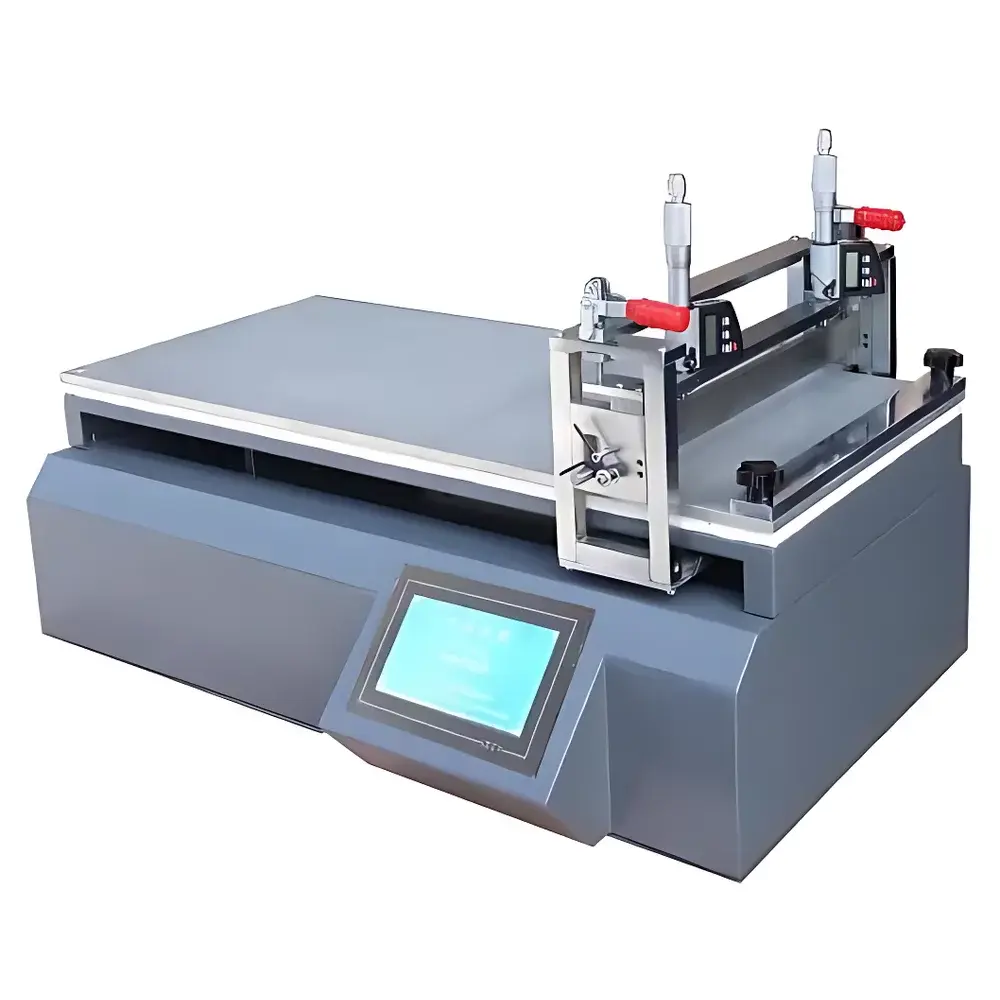
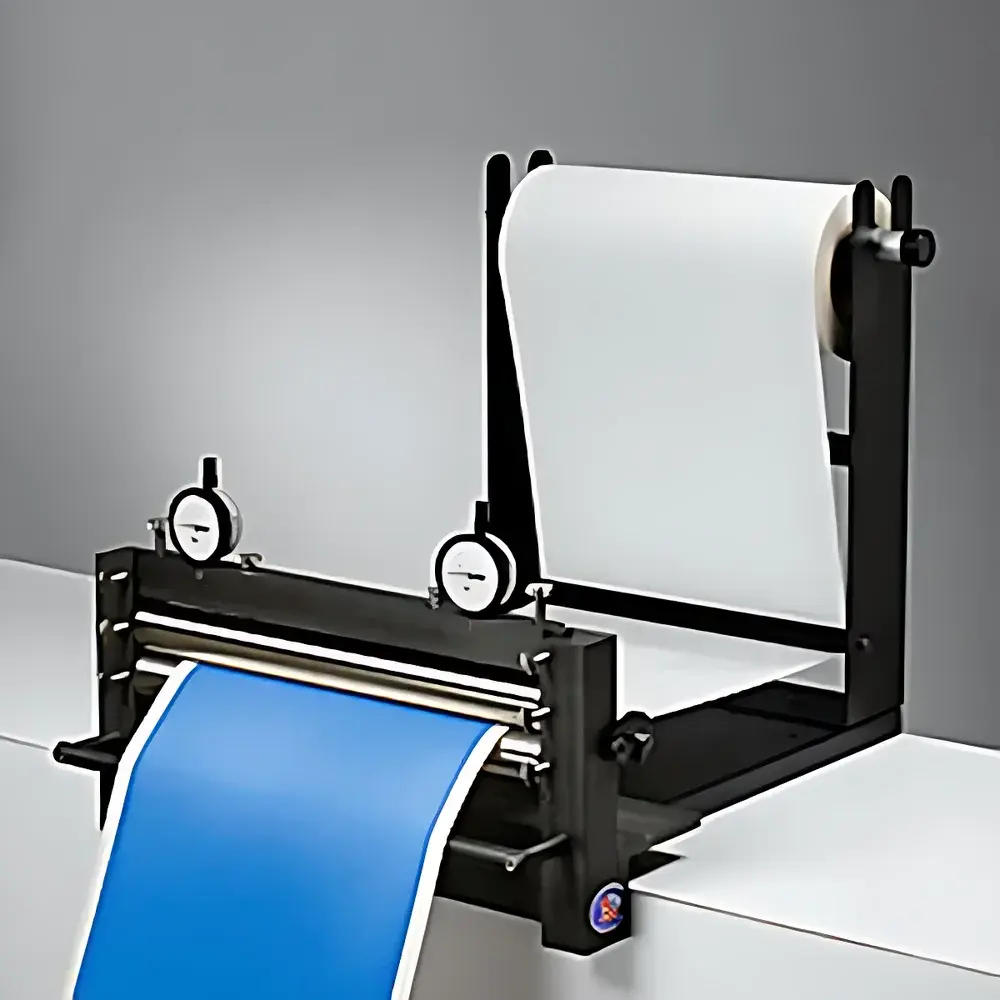
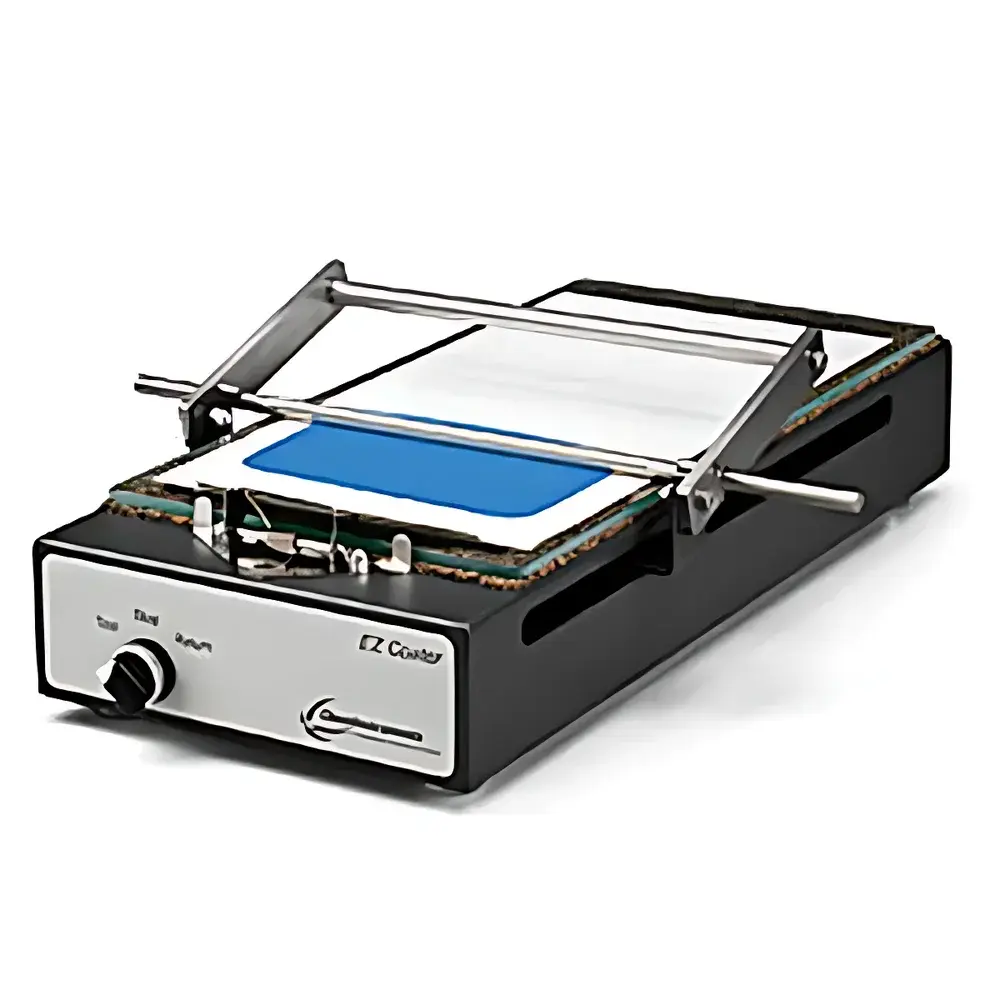
Yuelian TB100 Automated Knife-Over-Plate Laboratory Coater
| Brand | Yuelian |
|---|---|
| Origin | Guangdong, China |
| Manufacturer Type | Authorized Distributor |
| Country of Origin | China |
| Model | TB100 |
| Price Range | USD 1,400 – 2,800 |
| Control System | 5-inch PLC Touchscreen HMI |
| Wet Film Thickness Range | 0.005–3 mm |
| Thickness Accuracy | ±0.0025 mm |
| Power Supply | 220 V AC, 50 Hz |
| Rated Power | 2000 W |
| Coating Speed | 0–10 m/min (digitally presettable) |
| Coating Length | Programmable (digital preset) |
| Maximum Coating Width | 300 × 450 mm |
| Heating Temperature Range | Ambient to 160 °C (PID-controlled constant temperature) |
| Coating Methods | Adjustable knife-over-plate and wire-wound rod modes |
| Doctor Blade Material | Tungsten carbide alloy (tool-grade, modular, tool-free quick-release design) |
| Net Weight | 55 kg |
Overview
The Yuelian TB100 Automated Knife-Over-Plate Laboratory Coater is an engineered solution for reproducible, quantitative wet-film deposition in R&D and quality control laboratories. It operates on the principle of precision-controlled mechanical metering—where a rigid, thermally stabilized doctor blade or wire-wound rod traverses a substrate at a defined linear velocity and applied normal force, thereby shearing excess material to form a uniform wet film layer. Unlike manual drawdown methods—which introduce inter-operator variability in pressure, speed, and angle—the TB100 eliminates human-dependent variables through closed-loop motorized translation, programmable thermal regulation, and real-time positional feedback. Its architecture supports ISO/IEC 17025-aligned method validation protocols and is routinely deployed in formulation development for coatings, adhesives, functional inks, battery slurries, and thin-film photovoltaic materials.
Key Features
- Programmable coating parameters via integrated 5-inch PLC touchscreen HMI—enabling storage and recall of up to 99 user-defined recipes including speed, length, temperature, and coating mode.
- Dual-mode applicator system: interchangeable tungsten carbide doctor blade (for high-viscosity pastes and shear-thinning formulations) and precision-ground stainless-steel wire-wound rods (for low-to-medium viscosity liquids).
- Thermally regulated coating stage with PID-controlled heating (ambient to 160 °C), enabling solvent evaporation kinetics studies, hot-melt coating trials, and temperature-dependent rheology correlation.
- High-repeatability motion control: stepper-driven carriage with optical encoder feedback ensures ±0.0025 mm thickness consistency across 300 × 450 mm substrate area.
- Modular blade assembly with tool-free release mechanism—designed for rapid cleaning, calibration verification, and cross-contamination prevention between samples.
- Robust structural frame fabricated from anodized aluminum and stainless steel components; compliant with CE safety directives and RoHS material restrictions.
Sample Compatibility & Compliance
The TB100 accommodates rigid and semi-rigid planar substrates up to 450 mm wide and 10 mm thick—including paper, PET, PVC, aluminum sheet, cold-rolled steel, woven textiles, and composite laminates. Its non-contact thermal zone and adjustable blade clearance prevent substrate deformation during high-temperature or high-pressure application. The system meets fundamental requirements for ASTM D823 (Standard Practice for Producing Films of Uniform Thickness of Paint, Varnish, and Related Products), ISO 2808 (Paints and Varnishes—Determination of Film Thickness), and GB/T 9271–2008 (Laboratory Standards for Coating Testing). All firmware logs—including recipe execution timestamps, thermal setpoints, and motor current profiles—are timestamped and exportable for GLP-compliant audit trails.
Software & Data Management
No external PC is required: all operational logic resides in the embedded PLC controller. Coating programs are saved locally with version-stamped metadata (date/time, operator ID, substrate ID, batch number). Export options include CSV-formatted logs via USB 2.0 port for integration into LIMS or statistical process control (SPC) platforms. Firmware supports optional RS-485 Modbus RTU communication for centralized lab equipment monitoring under industrial IoT frameworks. Audit trail functionality complies with FDA 21 CFR Part 11 requirements when paired with network-authenticated user accounts and electronic signature modules (available as OEM add-on).
Applications
- Formulation screening of water-based acrylics, UV-curable resins, conductive inks, and electrode slurries for lithium-ion batteries.
- Correlation of wet-film thickness with dry-film properties (gloss, hardness, adhesion, porosity) per ASTM D3359 and ISO 2409.
- Accelerated drying behavior analysis under controlled thermal ramping (e.g., simulating oven cure profiles).
- Interfacial compatibility testing between primers and topcoats on multi-layer automotive substrates.
- Academic research in colloidal stability, capillary flow dynamics, and Marangoni-driven leveling phenomena.
- Pre-validation of pilot-scale slot-die or gravure parameters prior to scale-up.
FAQ
What substrates can be coated without pre-treatment?
Rigid, flat, and dimensionally stable substrates—including untreated aluminum, PET film, and laboratory-grade filter paper—can be coated directly. Porous or low-surface-energy materials (e.g., PP film) may require corona or plasma pre-treatment for optimal wetting.
Is the tungsten carbide blade replaceable in-house?
Yes. The blade mounts via spring-loaded clamps; replacement takes under 90 seconds with no tools. Spare blades are stocked globally and shipped with traceable calibration certificates.
Can the TB100 interface with third-party data acquisition systems?
Yes—via RS-485 Modbus RTU (standard) or optional Ethernet/IP gateway. Analog 0–10 V outputs are available for real-time speed/temperature analog monitoring.
Does the system support GMP documentation packages?
A validated IQ/OQ protocol package—including installation qualification checklists, operational test scripts, and performance verification reports—is available upon request for regulated environments.
What maintenance intervals are recommended?
Daily wipe-down of blade edges and stage surface; bi-weekly inspection of belt tension and encoder alignment; annual recalibration of thermal sensor and position encoder by certified service engineer.



