
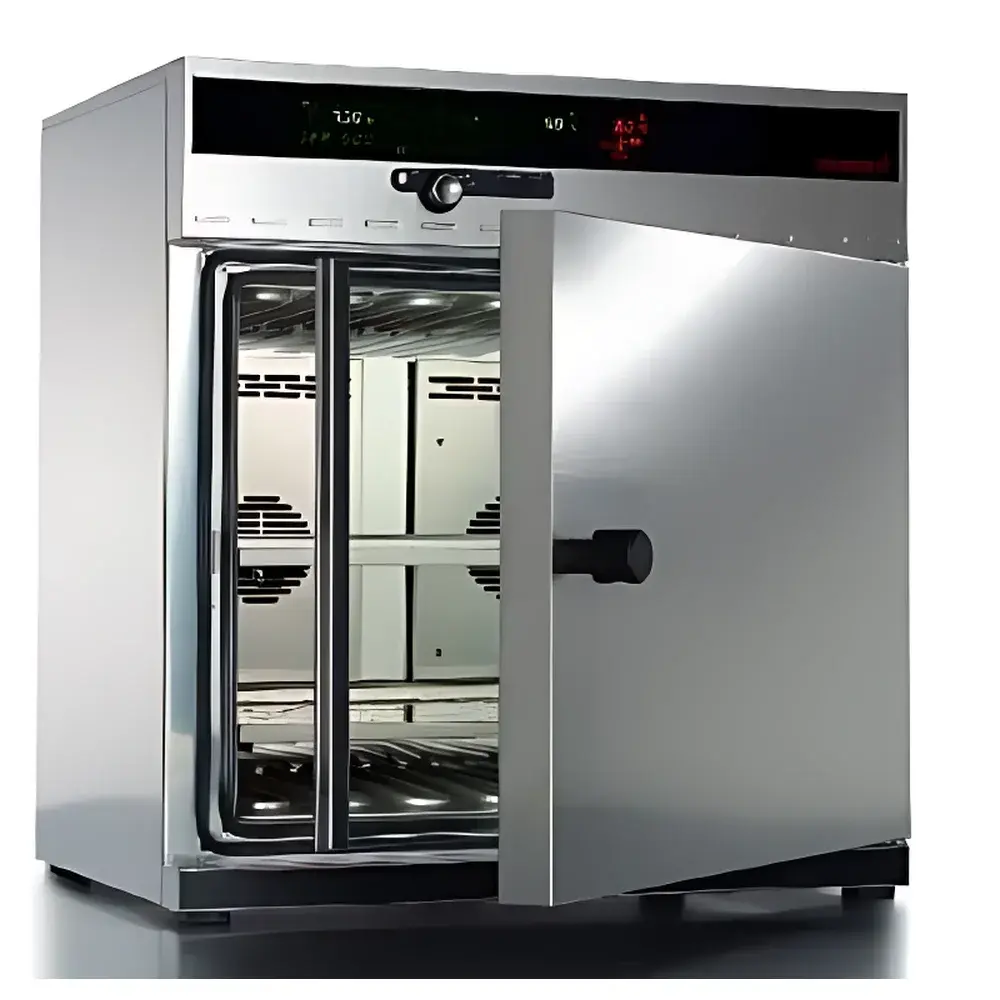
MEMMERT IPP500 Low-Temperature Biochemical Incubator
| Brand | MEMMERT |
|---|---|
| Origin | Germany |
| Model | IPP500 |
| Temperature Range | 5–70 °C |
| Temperature Uniformity (at 10 °C & 37 °C) | ±0.4 °C (DIN 12880) |
| Temperature Stability | ±0.1 °C (DIN 12880) |
| Chamber Volume | 108 L |
| Internal Dimensions (W×H×D) | 560 × 480 × 400 mm |
| External Dimensions (W×H×D, incl. handles) | 710 × 760 × 640 mm |
| Power Supply | 230 V ±10%, 50/60 Hz |
| Rated Power | 350 W (heating & cooling) |
| Programmable Ramp Segments | Up to 40 |
| Data Logging Capacity | 1024 kB (GLP-compliant) |
| Memory Card | 32 kB MEMoryCard XL |
| Calibration Certificates Provided | 10 °C & 37 °C |
| Safety Protections | TWW Class 3.3 + TB Class 1 + ASF (Auto Safety Function) |
| Cooling/Heating Technology | Peltier-based thermoelectric system (refrigerant-free) |
| Air Circulation | Forced convection via adaptive PID-controlled fan |
| Display Resolution | 0.1 °C (setpoint & actual) |
| Interface Options | USB (Celsius software), RS232, RS485, parallel printer port |
| Compliance | DIN 12880:2007-05, GLP, FDA 21 CFR Part 11 (with Celsius FDA-Edition) |
Overview
The MEMMERT IPP500 Low-Temperature Biochemical Incubator is a precision-engineered, refrigerant-free incubation platform designed for demanding life science applications requiring stable, programmable thermal environments from 5 °C to 70 °C. Unlike conventional compressor-based systems, the IPP500 employs a dual-mode Peltier thermoelectric module—enabling both heating and cooling without chlorofluorocarbons or hydrofluorocarbons—thereby eliminating maintenance-intensive refrigerant circuits and ensuring silent, vibration-free operation ideal for sensitive cell cultures and enzymatic assays. Its chamber is constructed entirely from electropolished stainless steel (AISI 304), featuring full insulation, a double-glazed internal glass door, and an outer stainless steel door with four-point adjustable locking mechanism. The unit complies strictly with DIN 12880:2007-05 for temperature uniformity and stability, delivering ≤±0.4 °C uniformity at critical setpoints (10 °C and 37 °C) and ≤±0.1 °C short-term stability under steady-state conditions. The microprocessor-controlled environment integrates adaptive PID algorithms with fuzzy logic for dynamic response to load changes, door openings, or ambient fluctuations—ensuring reproducible incubation outcomes across multi-user laboratory workflows.
Key Features
- Peltier-based thermoelectric heating/cooling system: No refrigerants, no oil, no compressors—enabling precise, low-noise, and maintenance-free temperature control.
- Dual A-class Pt100 temperature sensors in 4-wire configuration: Redundant, high-accuracy measurement with real-time cross-validation for GLP traceability.
- 40-segment programmable ramp-soak profiles: Each segment configurable for duration (1 min – 999 h), target temperature, fan speed, and hold/delay activation—supporting complex physiological or circadian simulation protocols.
- 1024 kB onboard data logger: Stores timestamped temperature readings compliant with Good Laboratory Practice (GLP); retains all programs and logs during power interruption.
- Triple-layer safety architecture: Independent TWW (Class 3.3) overtemperature controller, TB (Class 1) backup cutoff, and ASF (Auto Safety Function) for simultaneous over- and under-temperature monitoring with audible/visual alarms and automatic heater/cooler shutdown.
- USB, RS232, and RS485 interfaces: Compatible with MEMMERT’s Celsius software suite—including the FDA 21 CFR Part 11-compliant Celsius FDA-Edition—for centralized control of up to 16 units, electronic audit trails, and role-based user access (via V1/V3/V5 authorization cards).
- Real-time clock with 7-day scheduler: Supports light-cycle emulation (e.g., diurnal rhythm studies) and automated start/stop timing aligned to calendar days and hours.
Sample Compatibility & Compliance
The IPP500 accommodates a broad range of biological and biochemical samples—including mammalian and insect cell cultures, microbial growth media, enzyme kinetics assays, and reagent storage—within its 108 L stainless steel chamber. Its forced-air convection system ensures rapid equilibration and minimal thermal stratification, validated per DIN 12880 using 27-point mapping (Q2 qualification package available). The unit meets ISO/IEC 17025 calibration traceability requirements, and includes factory-issued 10 °C and 37 °C calibration certificates (traceable to national standards). Optional IQ/OQ documentation packages support GxP validation, including test reports for installation, operational performance, and temperature distribution mapping. All firmware and Celsius software modules comply with FDA 21 CFR Part 11 for electronic records and signatures when deployed with appropriate configuration controls and audit trail settings.
Software & Data Management
Celsius software—available in Standard and FDA-Edition variants—provides full remote supervision, parameter programming, real-time visualization, and exportable CSV/PDF reporting. The FDA-Edition implements role-based user authentication, electronic signatures, immutable audit trails, and configurable retention policies aligned with 21 CFR Part 11 Annex 11 requirements. Data logging supports time-stamped entries with sensor ID, setpoint, actual value, alarm status, and operator ID. The 32 kB MEMoryCard XL enables offline program transfer and archival; optional V3 temperature curve readers allow PC-based editing and batch deployment of ramp profiles. Printer output via parallel port (PCL3-compatible) or USB-to-parallel adapters (W1/W2 kits) generates hard-copy GLP-compliant records directly from the device.
Applications
- Cell culture incubation under controlled hypothermic (5–15 °C) or physiological (37 °C) conditions.
- Enzyme activity profiling across defined thermal gradients and dwell times.
- Microbial growth rate determination and antimicrobial susceptibility testing (AST).
- Long-term stability studies of biologics, vaccines, and diagnostic reagents per ICH Q5C guidelines.
- Circadian rhythm modeling using programmable 24-hour temperature/light cycles.
- Quality control of raw materials and finished products in pharmaceutical and biotech manufacturing (aligned with EU GMP Annex 11).
FAQ
Does the IPP500 require refrigerant servicing or compressor maintenance?
No. Its Peltier-based thermoelectric system operates without refrigerants, oils, or moving mechanical compressors—reducing lifecycle cost and eliminating scheduled refrigerant recovery or recharge procedures.
Can the IPP500 be validated for GMP environments?
Yes. With optional IQ/OQ documentation (Q1/Q2 packages), 27-point temperature mapping, and Celsius FDA-Edition software, the unit supports full GxP validation per ASTM E2500, EU GMP Annex 15, and FDA Process Validation Guidance.
How is data integrity ensured during power failure?
All programs, calibration offsets, and logged data are retained in non-volatile memory. The 1024 kB logger maintains timestamped records with battery-backed real-time clock synchronization.
What safety certifications does the IPP500 carry?
It conforms to EN 61010-1 (Safety Requirements for Electrical Equipment), EN 61326-1 (EMC), and carries CE marking. TWW and TB controllers are certified to DIN 12880 Class 3.3 and Class 1 respectively.
Is remote monitoring possible across a lab network?
Yes—via RS485 daisy-chaining (up to 16 units) or Ethernet interface (W6 option), integrated into LIMS or SCADA platforms using Modbus RTU or TCP/IP protocols supported by Celsius software.



