
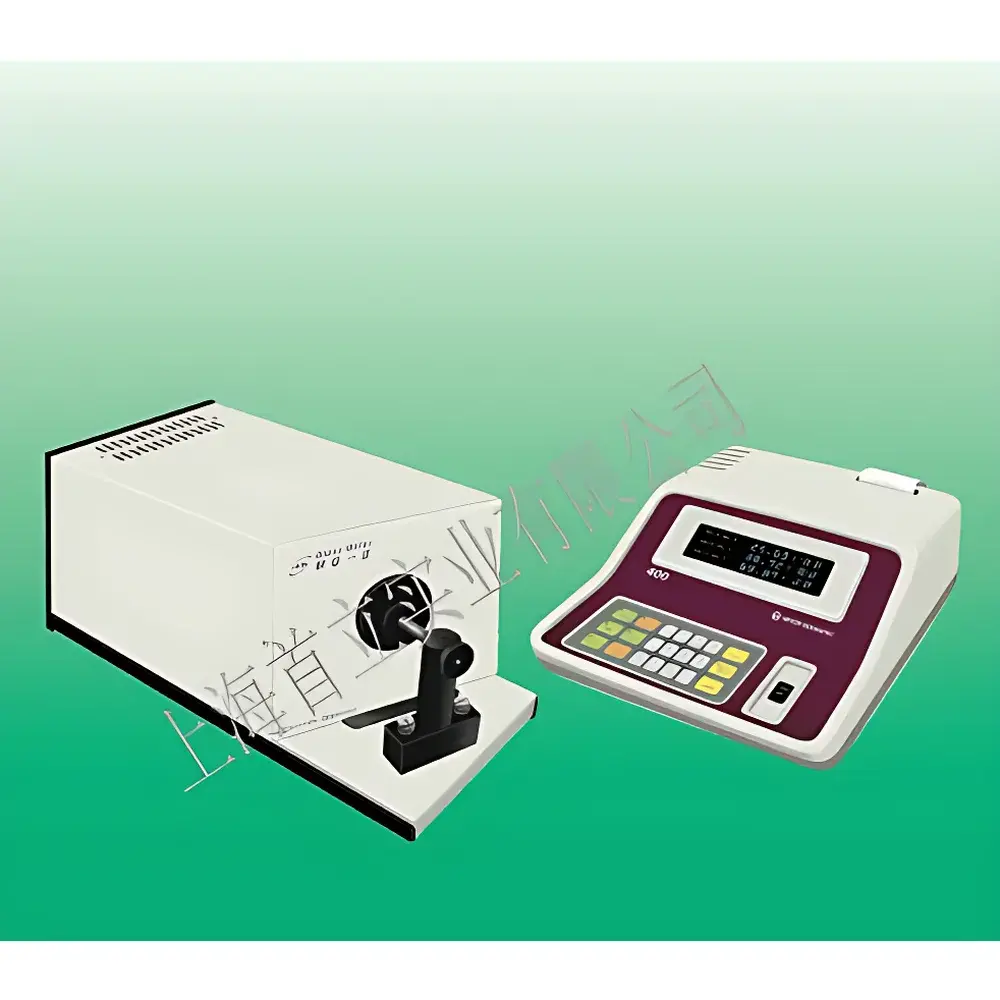
NIPPON DENSHOKU MG-II 400 Indirect Specular Reflectometer
| Brand | NIPPON DENSHOKU |
|---|---|
| Origin | Japan |
| Model | MG-II 400 |
| Light Source | Halogen lamp (5 V, 9 W) or optional white LED |
| Incident Angle | 25° |
| Detection Method | Integrating sphere |
| Measurement Aperture | Φ40 mm |
| Reflectance Range | 0.0–100.0% |
| Repeatability | Standard deviation ≤ 0.1% (10 consecutive measurements at 10 s intervals) |
| Measurement Time | Approx. 1 s |
| Compliance | JIS D 5705, ISO 5740 |
| Power Supply | 100 V AC, 50/60 Hz |
| Power Consumption | 40 VA (optical unit), 26 VA (measurement unit) |
| Dimensions (Optical Unit) | 215 × 430 × 205 mm (W×D×H), 12 kg |
| Dimensions (Measurement Unit) | 350 × 360 × 110 mm (W×D×H), 5 kg |
Overview
The NIPPON DENSHOKU MG-II 400 Indirect Specular Reflectometer is a precision optical instrument engineered for the standardized indirect measurement of specular reflectance in mirror-finished surfaces—specifically designed to comply with ISO 5740 and JIS D 5705 for automotive rearview mirrors. Unlike direct photometric methods that require calibrated reference standards at each measurement, the MG-II 400 employs an indirect calibration protocol based on geometric and photometric equivalence between a reference mirror and the test sample under fixed angular illumination (25° incident angle) and integrating sphere detection. This architecture eliminates dependency on traceable reference mirrors during routine operation while maintaining metrological traceability to national standards through factory calibration and documented uncertainty budgets. The system comprises two physically separated modules: a compact optical unit housing the light source and collimation optics, and a dedicated measurement unit containing the integrating sphere detector, signal conditioning circuitry, and display interface—enabling flexible installation in QC labs, production lines, or R&D environments where spatial constraints or electromagnetic isolation are critical.
Key Features
- ISO 5740 / JIS D 5705–compliant indirect specular reflectance measurement methodology, validated for automotive mirror certification and regulatory testing
- Dual-light-source configuration: standard 5 V, 9 W halogen lamp optimized for CIE illuminant A spectral distribution; optional white LED source available for enhanced long-term stability and reduced thermal drift
- High-repeatability optical path: 25° fixed-angle illumination coupled with an integrating sphere detector ensures consistent angular response across diverse surface geometries—including convex, concave, and flat mirror substrates
- Modular architecture separates optical excitation and signal acquisition, minimizing thermal crosstalk and facilitating maintenance, recalibration, and compliance verification
- Intuitive single-button operation: sample mounting on the Φ40 mm aperture fixture followed by one-touch measurement initiation yields reflectance (%) and ΔR (delta-reflectance) values directly on the integrated LCD display
- Robust mechanical design: aluminum alloy chassis with vibration-damped mounting interfaces; operational stability verified under continuous 10-cycle repeatability testing (≤0.1% SD at 10 s intervals)
Sample Compatibility & Compliance
The MG-II 400 is validated for quantitative reflectance assessment of optically polished, electroplated, vacuum-metallized, and chemically coated mirror surfaces. It accommodates curved mirrors (e.g., Class II and III automotive rearview mirrors per UN ECE Regulation 46), precision-ground optical flats, and industrial-grade convex safety mirrors used in logistics and transportation infrastructure. All measurements adhere to the photometric definitions and geometric tolerances specified in ISO 5740 Annex B and JIS D 5705 Clause 5. The instrument’s optical design satisfies the spectral responsivity requirements for luminance factor evaluation under CIE 15:2018, and its calibration certificate includes uncertainty statements aligned with ISO/IEC 17025–accredited practices. For GLP/GMP-regulated environments, optional audit-trail-enabled firmware (sold separately) supports 21 CFR Part 11–compliant electronic records and user-access logging.
Software & Data Management
While the MG-II 400 operates as a stand-alone instrument with real-time display and internal data storage (up to 1,000 measurement records), optional RS-232 or USB-to-serial interface enables bidirectional communication with host PCs. Dedicated Windows-compatible software provides raw data export (CSV/TXT), statistical summary reports (mean, SD, min/max, CPK), and automated pass/fail flagging against user-defined specification limits. All exported datasets include timestamp, operator ID (if configured), instrument serial number, and calibration validity status—ensuring full traceability for quality audits. Firmware updates preserve historical calibration coefficients and maintain backward compatibility with legacy measurement files.
Applications
- Automotive component QA: final inspection of rearview and side-view mirrors prior to OEM shipment
- Electroplating process control: in-line monitoring of chrome, aluminum, or silver mirror coatings on ABS, polycarbonate, or glass substrates
- Optical manufacturing: verification of coating uniformity and aging resistance in first-surface mirrors for medical endoscopes and laser cavities
- Regulatory testing laboratories: accredited testing per ISO 5740 for type approval submissions to JASIC, TÜV, or NHTSA
- R&D of smart mirrors: baseline characterization of electrochromic, thermochromic, or polymer-dispersed liquid crystal (PDLC) reflective layers under controlled illumination
FAQ
What standards does the MG-II 400 comply with for automotive mirror testing?
It conforms to ISO 5740:2006 and JIS D 5705:2012 for indirect specular reflectance measurement of rearview mirrors.
Can the instrument measure curved or convex mirrors?
Yes—the 25° fixed-angle illumination and integrating sphere detection provide accurate results for convex, concave, and flat mirror geometries per UN ECE R46 requirements.
Is the halogen lamp replaceable in the field?
Yes—halogen lamps are user-replaceable with OEM-specified units; LED source modules require factory service.
Does the MG-II 400 support GLP-compliant data archiving?
With optional firmware upgrade and PC software, it supports electronic signatures, audit trails, and 21 CFR Part 11–compliant data integrity controls.
What is the typical calibration interval recommended for ISO 5740 compliance?
Annual calibration against NIST-traceable reference standards is recommended; factory recalibration includes full optical alignment verification and uncertainty reporting.




