
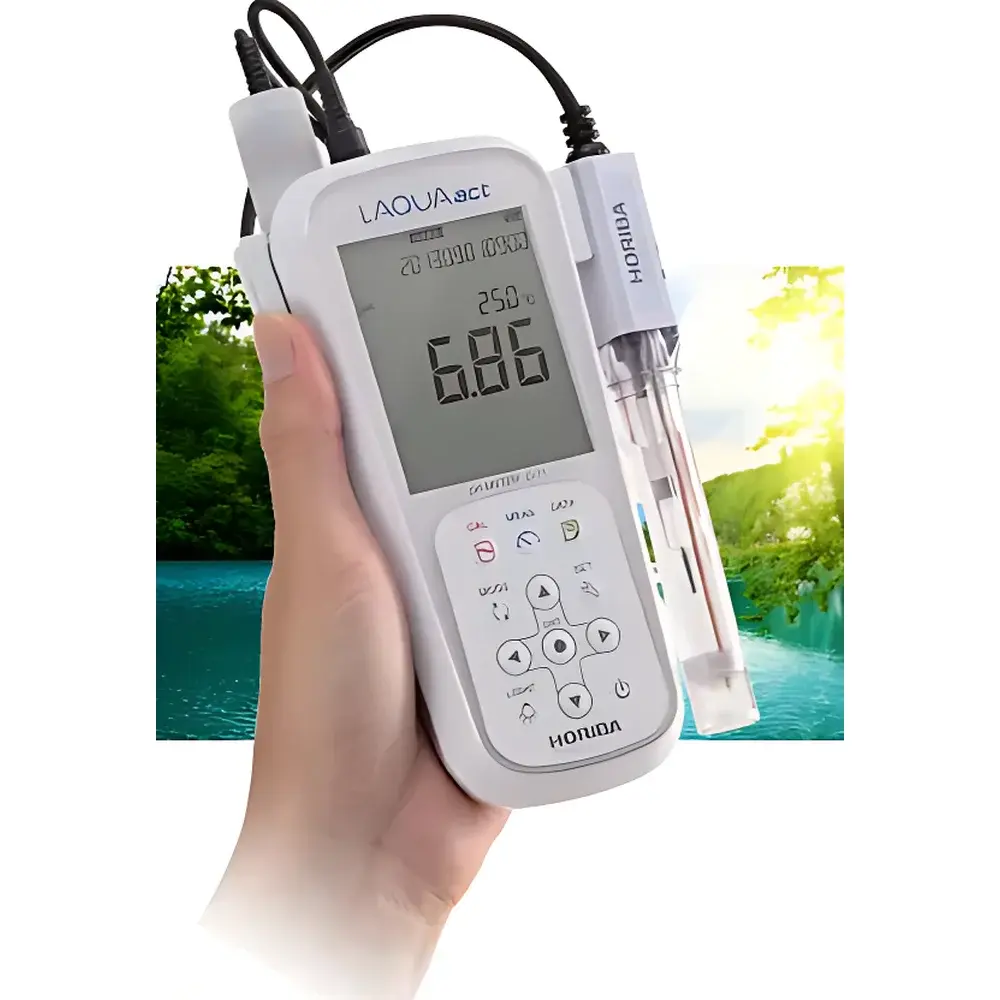
HORIBA LAQUAact D-71 Portable pH Meter
| Brand | HORIBA |
|---|---|
| Origin | Japan |
| Model | D-71 |
| Instrument Type | Portable pH Meter |
| pH Range | 0–14 |
| Temperature Range | 0–100 °C |
| IP Rating | IP67 |
| Housing Material | Impact-Resistant Polycarbonate |
| Battery Life | Approx. 1000 hours |
| Data Storage | 1000 measurements |
| Compliance | GLP/GMP-ready (data traceability supported in compatible models |
| Electrode Mounting | Adjustable single-hand electrode holder with 360° rotation |
| Display | Backlit LCD (D-71 model: non-backlit) |
| Cleaning Compatibility | Alcohol, weak acids/bases, oils (chemically inert surface) |
Overview
The HORIBA LAQUAact D-71 is a rugged, field-deployable portable pH meter engineered for high-reliability routine water quality assessment in environmental monitoring, wastewater treatment, aquaculture, and field-based regulatory sampling. It operates on the potentiometric principle, measuring the hydrogen ion activity difference between a glass pH sensing electrode and a stable reference electrode—typically Ag/AgCl in double-junction configuration—to deliver NIST-traceable pH values across the full aqueous range of 0 to 14. Designed explicitly for demanding real-world conditions, the D-71 integrates metrological stability with ergonomic portability: its compact form factor (158 × 80 × 35 mm), lightweight construction (<300 g without electrode), and IP67-rated enclosure ensure operational integrity after immersion in 1 m of water for 30 minutes or exposure to dust-laden, chemically aggressive outdoor environments. Unlike benchtop analyzers, the D-71 prioritizes rapid deployment, intuitive operation, and long-term autonomy—making it ideal for technicians conducting sequential site surveys where instrument downtime, battery constraints, or mechanical fragility are critical failure vectors.
Key Features
- IP67-certified housing constructed from high-impact polycarbonate—exhibiting ≈2× greater impact resistance than legacy ABS enclosures and chemical resistance to ethanol, dilute acids/bases, and hydrocarbon oils.
- Large, high-contrast monochrome LCD display (1.4× larger than predecessor models) enabling simultaneous readout of pH and temperature—critical for real-time compensation and data validation in variable-temperature field conditions.
- Ergonomic three-button interface optimized for single-hand operation: dedicated keys for measurement start/stop, mode selection, and calibration—eliminating menu navigation delays during time-sensitive sampling.
- Adjustable 360° rotational electrode holder with integrated cable management hook—enabling stable tabletop use or handheld measurement without accessory dependency.
- Ultra-low-power architecture delivering up to 1000 hours of continuous operation on standard AA alkaline batteries—validated under ISO 8655-5 power consumption testing protocols for portable electrochemical instruments.
- Onboard memory storing 1000 timestamped measurement records with automatic date/time stamping—supporting basic audit trails aligned with GLP documentation requirements.
Sample Compatibility & Compliance
The D-71 is validated for direct immersion measurement in freshwater, seawater (with appropriate salt-bridge electrodes), wastewater effluents, and process streams meeting standard aqueous matrix specifications (TDS < 10,000 µS/cm, suspended solids < 50 mg/L). It complies with JIS Z 8401 (Japanese Industrial Standard for accuracy of pH meters) and conforms to IEC 60529 for IP67 ingress protection. While the instrument itself does not include built-in data export hardware (USB/RS-232), its stored datasets are structured to support manual transcription into LIMS or ELN systems compliant with 21 CFR Part 11 when paired with validated SOPs. Calibration verification follows ASTM D1293 and ISO 10523 guidelines using certified NIST-traceable buffer solutions (pH 4.01, 7.00, 10.01 at 25 °C).
Software & Data Management
The D-71 operates as a standalone measurement terminal without firmware-updatable software or embedded connectivity. All data reside in non-volatile memory and are accessible only via manual review on-device. While D-73/D-74/D-75 variants support USB data transfer and optional thermal printer output for GLP-compliant hardcopy generation, the D-71 intentionally omits these interfaces to maximize mechanical robustness, reduce component failure points, and extend service life in uncontrolled environments. Users requiring electronic data capture must implement secondary documentation workflows—e.g., voice-recorded annotations synchronized with timestamped readings or photographic logging of screen displays—consistent with ISO/IEC 17025 Clause 7.5.2 on result reporting integrity.
Applications
- Regulatory field monitoring of surface water bodies (rivers, lakes, estuaries) per EPA Method 150.1 and EU WFD Annex V requirements.
- Routine QA/QC checks in municipal wastewater treatment plants—particularly influent screening, aeration basin control, and final effluent compliance verification.
- Aquaculture pond management, including pH drift tracking during diurnal cycles and post-aeration stabilization assessment.
- Industrial pretreatment system verification for electroplating, food processing, and pharmaceutical manufacturing facilities subject to local discharge permits.
- Educational field laboratories where student-operated instrumentation must withstand frequent transport, accidental drops, and solvent-based cleaning protocols.
FAQ
Does the D-71 support temperature-compensated pH measurement?
Yes. It incorporates an integrated Pt1000 thermistor for automatic temperature compensation (ATC) across 0–100 °C, applying the Nernst equation with slope correction per IUPAC recommendation.
Can the D-71 connect to a computer or printer?
No. Unlike D-73/D-74/D-75 models, the D-71 has no physical data port or driver support for external peripherals.
Is the display backlit?
No. The D-71 features a high-contrast reflective LCD without backlighting; ambient light sufficiency is required for optimal readability.
What electrode types are compatible?
Standard BNC-input combination pH electrodes with double-junction reference systems (e.g., HORIBA 9615S-10D) are recommended for chloride-rich or sulfide-containing matrices.
How is calibration performed?
Two-point calibration using certified pH 4.01 and 7.00 buffers at ambient temperature; slope recovery ≥95% and offset ≤±30 mV indicate electrode health per ASTM D1293 Annex A1.







