
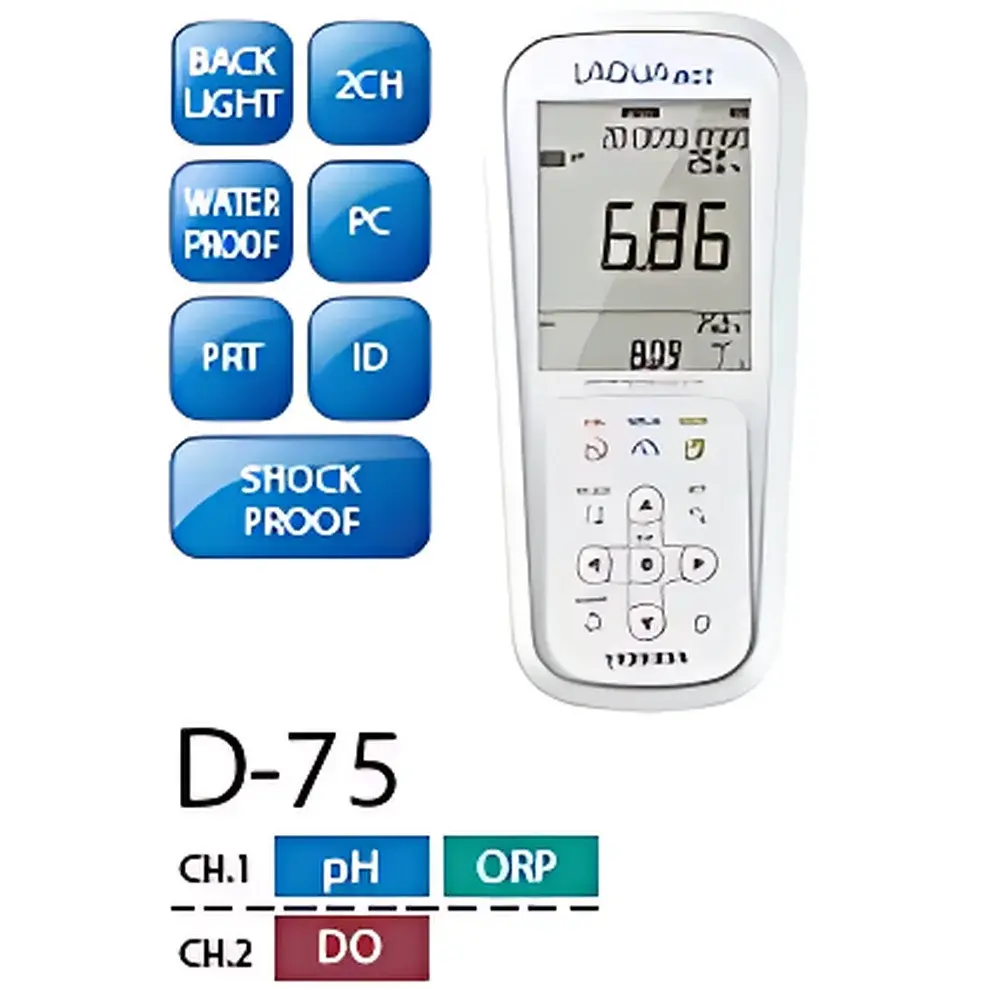
HORIBA LAQUAact D-75 Portable pH/ORP/DO/Conductivity Meter
| Brand | HORIBA |
|---|---|
| Origin | Japan |
| Model | D-75 |
| Instrument Type | Portable/HANDHELD Water Quality Analyzer |
| Measurable Parameters | pH, ORP, Dissolved Oxygen (DO), Conductivity |
| Enclosure Rating | IP67 |
| Display | Backlit LCD (simultaneous dual-parameter display) |
| Data Storage | 1000 measurement records |
| Power Life | Approx. 1000 hours (alkaline batteries) |
| Compliance | GLP/GMP-compliant data output (with optional printer) |
| Connectivity | PC interface via optional USB cable (software available via registered user download) |
| Housing Material | Impact-resistant polycarbonate (2× impact resistance vs. ABS) |
| Cleaning Compatibility | Alcohol-, weak acid/base-, and oil-resistant surface |
Overview
The HORIBA LAQUAact D-75 is a rugged, field-deployable multiparameter water quality meter engineered for high-reliability measurements of pH, oxidation-reduction potential (ORP), dissolved oxygen (DO), and electrical conductivity in diverse environmental and industrial settings. Designed around Couette-flow-based potentiometric and galvanic DO sensing principles—combined with temperature-compensated conductivity cell technology—the D-75 delivers stable, reproducible readings across variable ambient conditions. Its compact, ergonomic form factor supports both handheld operation in open-field sampling and benchtop use with the included adjustable electrode stand. The instrument meets the operational demands of regulatory monitoring programs, wastewater treatment plant QA/QC workflows, and academic field studies where portability, durability, and metrological traceability are critical.
Key Features
- IP67-rated enclosure: Fully dust-tight and submersible to 1 m for 30 minutes—enabling safe operation in rain, humid laboratories, or near splash-prone sampling sites (note: measurements cannot be performed underwater).
- Dual-parameter simultaneous display: High-contrast backlit LCD (1.4× larger than prior-generation models) shows real-time values for two parameters side-by-side—e.g., pH + DO or conductivity + ORP—reducing operator interpretation latency.
- Polycarbonate housing: Chemically inert against 70% ethanol, dilute acids/bases (pH 2–12), and hydrocarbon oils; withstands mechanical shock equivalent to a 1.5 m drop onto concrete (per IEC 60068-2-32).
- Extended battery life: Optimized power management enables ~1000 hours of continuous operation on standard AA alkaline batteries—eliminating frequent battery replacement during extended field campaigns.
- Ergonomic single-hand operation: Three dedicated function keys control calibration, measurement initiation, and mode selection—minimizing procedural errors in glove-compatible or wet-hand scenarios.
- Adjustable electrode stand: Rotating, height- and angle-adjustable mount permits precise vertical alignment of pH, DO, and conductivity probes without secondary fixtures—ideal for standardized lab protocols.
Sample Compatibility & Compliance
The D-75 is validated for aqueous samples ranging from ultrapure water (conductivity < 1 µS/cm) to brackish seawater (up to 80 mS/cm). Electrode compatibility includes HORIBA’s proprietary gel-filled pH electrodes (e.g., 9615S-10D), polarographic DO sensors (e.g., 9551-10D), and graphite-conductivity cells (e.g., 3551-10D), all featuring replaceable sleeves and integrated temperature compensation (NTC 10 kΩ). The instrument adheres to ISO 7888 (conductivity), ISO 5814 (DO), and ASTM D1293 (pH) test methodologies. Data output supports GLP/GMP audit trails when paired with HORIBA’s optional thermal printer (LAQUA Printer LP-10) and complies with FDA 21 CFR Part 11 requirements for electronic records when used with validated software configurations.
Software & Data Management
Internal memory stores up to 1000 timestamped measurement records—including parameter values, temperature, date/time, and user ID—each tagged with calibration status flags. Data export is achieved via optional USB-to-PC interface cable (model UC-10); HORIBA’s LAQUA Connect software (freely downloadable after registration on horiba.com) enables CSV export, calibration history review, trend graphing, and batch report generation. All exported files retain embedded metadata required for ISO/IEC 17025-accredited laboratories. No cloud synchronization or remote firmware updates are supported—ensuring data sovereignty and network isolation per ITAR and NIST SP 800-171 guidelines.
Applications
- Regulatory environmental monitoring: EPA Method 150.1 (conductivity), 365.1 (pH), and 360.1 (DO) compliance verification in surface water, groundwater, and effluent streams.
- Wastewater treatment: Real-time tracking of nitrification/denitrification zones via concurrent pH-ORP profiling and DO saturation mapping across aeration basins.
- Aquaculture and hydroponics: Daily assessment of pond or reservoir stability using pH/DO/conductivity correlation matrices to preempt hypoxic events.
- Drinking water distribution: Field validation of disinfectant residual (via ORP) alongside pH-driven corrosion potential screening in municipal networks.
- Academic field research: Long-duration deployment in remote watersheds with minimal maintenance—leveraging low-power design and chemical resistance for multi-week unattended operation.
FAQ
Does the D-75 support automatic temperature compensation (ATC) for all measured parameters?
Yes—integrated NTC 10 kΩ sensor provides real-time ATC for pH, ORP, DO, and conductivity measurements, with selectable reference temperatures (25°C default) and linear/nonlinear compensation modes per parameter.
Can calibration data be transferred to a PC along with measurement records?
Calibration logs (including buffer values, slope, offset, and date/time stamps) are stored internally and exported alongside measurement data via LAQUA Connect software—enabling full metrological traceability audits.
Is the D-75 compatible with third-party electrodes?
Only HORIBA-certified electrodes with standardized BNC (pH/ORP) and 6-pin DIN (DO/conductivity) connectors are supported; non-OEM electrodes may compromise accuracy, temperature compensation, or GLP compliance.
What is the recommended cleaning protocol for the instrument body and electrode connectors?
Wipe housing and connector pins with lint-free cloth dampened with 70% isopropyl alcohol; avoid submerging connectors or applying solvents to O-rings—refer to HORIBA Technical Bulletin TB-LAQUA-02 for validated cleaning agents.
Does the D-75 meet explosion-proof or intrinsically safe certification requirements?
No—the D-75 is not certified for Class I, Division 1 hazardous locations; it is rated for general-purpose industrial and environmental use only (IEC 60529 IP67, not ATEX/IECEx).
Related Products







