
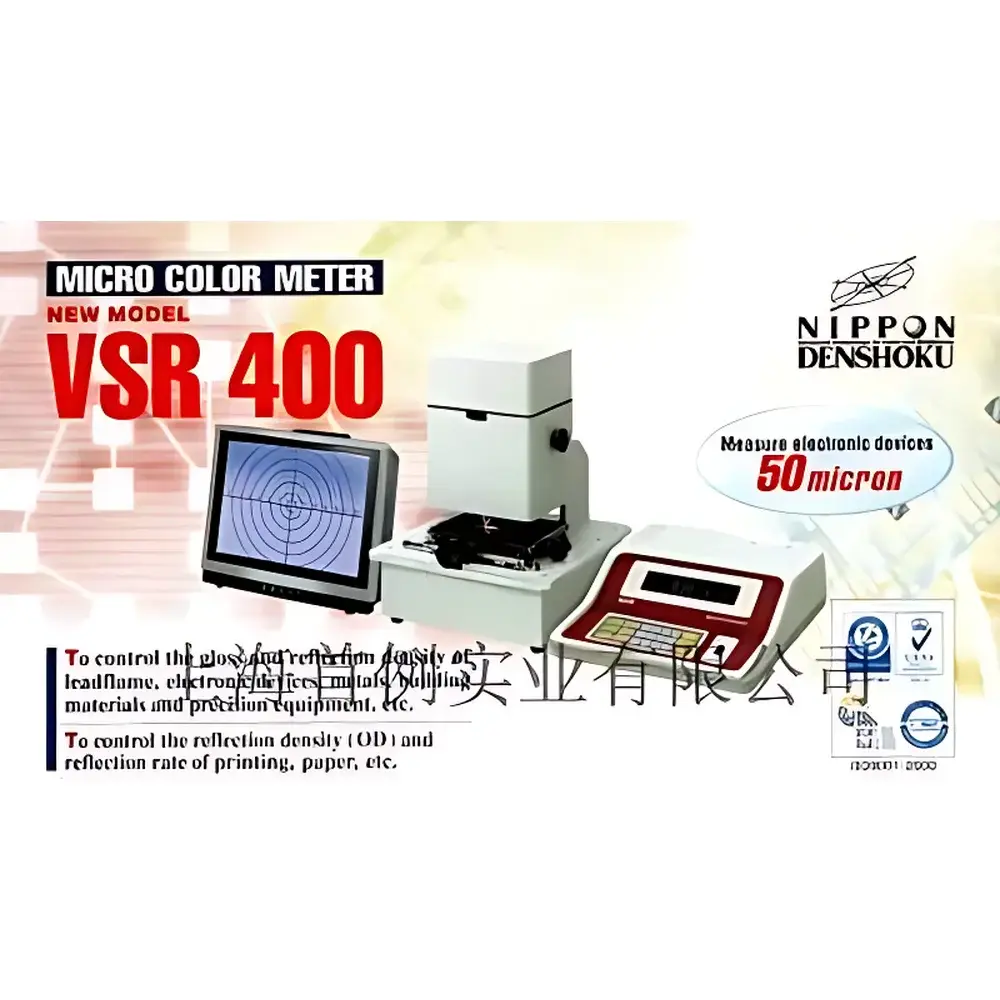
NIPPON DENSHOKU VSR400 Desktop Micro-Area Color Difference Meter
| Brand | NIPPON DENSHOKU |
|---|---|
| Origin | Japan |
| Model | VSR400 |
| Instrument Type | Benchtop |
| Optical Geometry | 45°/0° |
| Light Source | 12 V, 50 W Halogen Lamp |
| Measurement Spot Sizes | Ø0.05 mm, Ø0.1 mm, Ø0.2 mm, Ø0.5 mm |
| Sample Stage | 200 mm × 150 mm (X: 120 mm, Y: 90 mm, Z: 50 mm) |
| Detector | Tristimulus RGB-optimized CCD with X, Y, Z, and B-440 filters |
| Display | 13″ color LCD monitor |
| Data Interface | RS-232C |
| Compliance | Designed for ISO 13655 (M0/M1/M2/M3), ASTM E308, CIE No. 15, JIS Z 8722 |
Overview
The NIPPON DENSHOKU VSR400 is a high-precision benchtop micro-area color difference meter engineered for non-contact spectral reflectance analysis of ultra-small surface features—particularly critical in precision plating, thin-film coating, semiconductor packaging, and decorative metallization processes. Unlike conventional integrating sphere-based colorimeters, the VSR400 employs a fixed 45°/0° illumination–detection geometry compliant with ISO 13655 M1 (D65 simulation via halogen + filter) and optimized for specular component excluded (SCE) measurement. Its core optical architecture integrates a stabilized 12 V, 50 W halogen source with a multi-band tristimulus filter set (X, Y, Z, B-440), enabling accurate calculation of CIE 1931 XYZ, CIELAB L*a*b*, and derived metrics—including yellow index (YI), whiteness (W, WB), and electroplating-specific luminance parameters (YLW, BLK). The system’s defining capability lies in its sub-0.1 mm spot size selection (Ø0.05–Ø0.5 mm), achieved through precision aperture masking and collimated beam delivery at a fixed 7 mm working distance—eliminating parallax error and ensuring reproducible spatial registration across heterogeneous substrates.
Key Features
- Non-contact micro-area measurement with selectable apertures: Ø0.05 mm, Ø0.1 mm, Ø0.2 mm, and Ø0.5 mm—ideal for evaluating localized plating uniformity, solder mask defects, or PVD sputter zones.
- Dedicated electroplating mode supporting YLW (gold luster density) and BLK (black anodized density) quantification per JIS H 8601 and ASTM B456.
- Integrated high-resolution color CCD camera with real-time on-screen targeting—enabling visual confirmation of measurement location prior to acquisition.
- Motorized XYZ stage (120 mm × 90 mm × 50 mm travel) with fine manual vernier adjustment for repeatable positioning of irregular or oversized samples up to 200 mm × 150 mm.
- 16-bit A/D conversion with internal 18-bit self-calibration circuitry and low-drift amplification—ensuring long-term photometric stability (<0.05 ΔE* per 8-hour operation under controlled lab conditions).
- Onboard thermal printer (80 mm paper width, 256 × 8 dots/line, 1.1 sec/line) with bidirectional feed and timestamped output including sample ID, date/time, and full metric set.
Sample Compatibility & Compliance
The VSR400 accommodates rigid, semi-rigid, and textured surfaces without physical contact—making it suitable for fragile electroplated PCB traces, anodized aluminum housings, vacuum-deposited optical filters, and matte-finish automotive trim. Its 45°/0° geometry suppresses directional gloss interference, aligning with ISO 13655 M2 (Tungsten lamp) and M3 (polarized) measurement protocols where required. All colorimetric calculations adhere strictly to CIE 15:2018 and ASTM E308-23 standards. The instrument supports user-defined standard references and batch-level tolerance limits (ΔL*, Δa*, Δb*, ΔE*ab, ΔE*00) for pass/fail reporting. Data integrity meets GLP/GMP documentation requirements: audit trail logging (via external PC), RS-232C timestamped export (sample name, operator ID, measurement sequence), and lithium-backed parameter retention.
Software & Data Management
While the VSR400 operates as a standalone unit with intuitive front-panel navigation and a 13″ color LCD interface, it fully supports external data integration via RS-232C serial communication. Exported datasets include raw XYZ, L*a*b*, YI, W, WB, and plating-specific YLW/BLK values alongside metadata (date, time, aperture size, reference ID). The system supports up to 99-point averaging per sample with selective printout of mean ± SD. Internal memory retains calibration coefficients, user presets, and up to 200 sample names (alphanumeric, uppercase only). For regulated environments, third-party software packages (e.g., NIPPON DENSHOKU’s optional ColorLink Pro) provide 21 CFR Part 11-compliant electronic signatures, role-based access control, and automated PDF report generation with embedded spectral plots and statistical process control (SPC) charts.
Applications
- Quantitative assessment of gold, silver, nickel, and chromium plating thickness uniformity via correlated YLW/BLK density trends.
- In-line verification of color consistency in automotive interior trim, medical device housings, and consumer electronics bezels with micro-textured or brushed finishes.
- Quality control of printed electronics—measuring hue shift across conductive ink traces narrower than 100 µm.
- Failure analysis of oxidation-induced discoloration on copper alloy contacts or solder joints.
- Validation of anti-reflective coating performance on optical lenses and display cover glass using narrow-spot Yxy and whiteness indices.
FAQ
What is the smallest measurable area supported by the VSR400?
The minimum spot size is Ø0.05 mm (50 µm diameter), achieved using a precision-machined aperture and collimated halogen illumination at 7 mm working distance.
Does the VSR400 comply with FDA or ISO color measurement standards?
Yes—it conforms to ISO 13655 (M0–M3), CIE 15:2018, ASTM E308-23, and JIS Z 8722 for colorimetric accuracy; its data handling supports GLP/GMP traceability when paired with validated software.
Can the instrument measure metallic or pearlescent coatings?
It is optimized for SCE (specular component excluded) measurement under 45°/0° geometry, making it suitable for metallic paints and plated surfaces—but not recommended for gonioapparent effects requiring multi-angle goniophotometry.
Is calibration traceable to national standards?
Factory calibration uses NIST-traceable ceramic tile standards; users may perform routine verification with supplied calibration tiles (certified L*a*b* values).
What operating environment is required?
Ambient temperature: 0–40 °C; relative humidity: 30–80 % RH (non-condensing); stable vibration-free bench surface recommended.




