
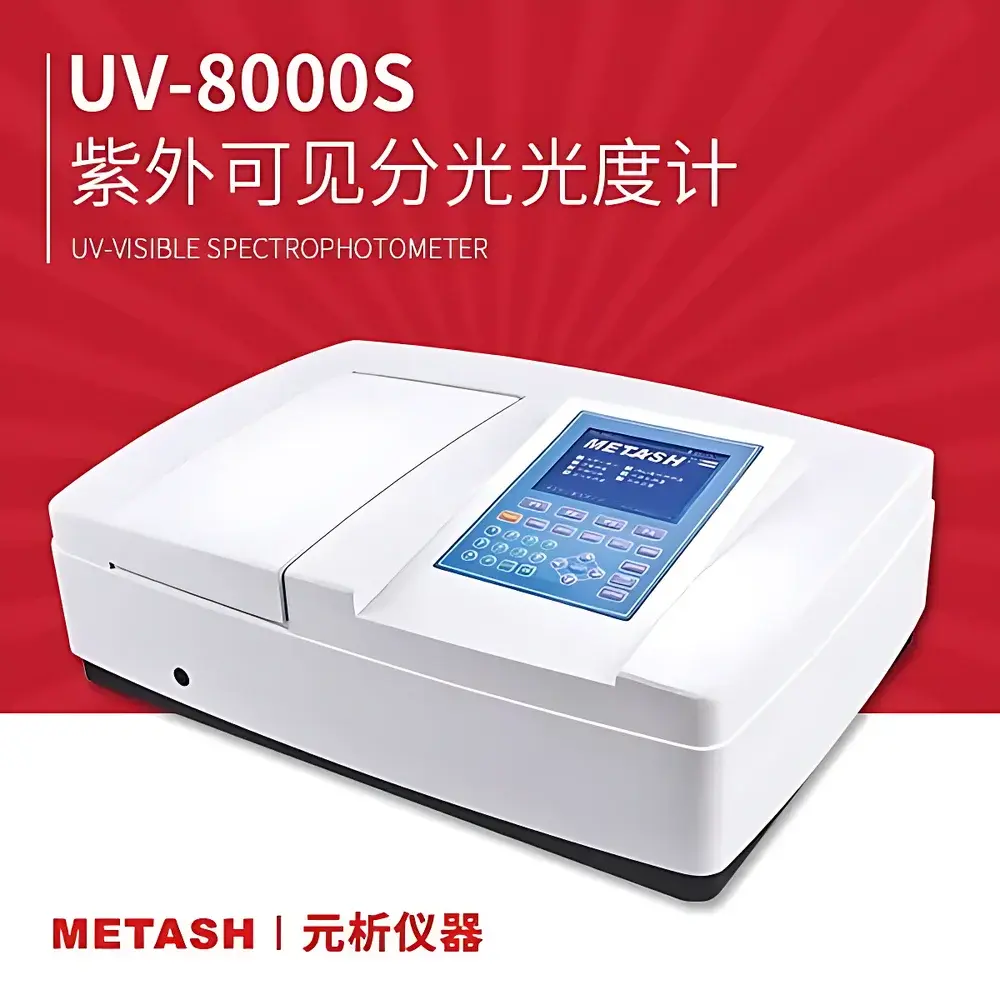
Metash UV-8000S Dual-Beam Ultraviolet-Visible Spectrophotometer
| Brand | Metash Instruments |
|---|---|
| Origin | Shanghai, China |
| Manufacturer Type | Original Equipment Manufacturer (OEM) |
| Model | UV-8000S |
| Optical System | Dual-Beam |
| Detector Type | Photocell |
| Wavelength Range | 190–1100 nm |
| Wavelength Accuracy | ±0.1 nm at D₂ line (656.1 nm), ±0.3 nm across full range |
| Wavelength Repeatability | ≤0.1 nm |
| Spectral Bandwidth | 0.5 / 1.0 / 2.0 / 4.0 / 5.0 nm (selectable) |
| Stray Light | ≤0.05% T |
| Display | 6-inch LED color LCD |
| Data Interface | USB port |
| Software | PC-based analytical software compliant with GLP/GMP data integrity requirements |
Overview
The Metash UV-8000S is a high-performance dual-beam ultraviolet-visible (UV-Vis) spectrophotometer engineered for precision absorbance and transmittance measurements across the 190–1100 nm spectral range. Its dual-beam optical architecture continuously splits incident light into sample and reference paths, enabling real-time compensation for source drift, lamp fluctuations, and environmental perturbations—critical for long-duration kinetic studies or temperature-sensitive assays. The instrument employs a robust suspended optical design, where all optical components—including the monochromator, beam splitter, and detector—are rigidly mounted on a 16 mm thick aerospace-grade aluminum optical baseplate. This mechanical isolation minimizes sensitivity to floor vibration and thermal expansion-induced misalignment, ensuring measurement stability over extended operational cycles. The system integrates imported deuterium and tungsten-halogen lamps, a high-efficiency holographic grating, and a calibrated silicon photocell detector—components selected for long-term photometric consistency and low signal noise.
Key Features
- Dual-beam optical configuration with real-time reference compensation for enhanced baseline stability and reduced photometric drift
- Selectably adjustable spectral bandwidth (0.5, 1.0, 2.0, 4.0, or 5.0 nm) to balance resolution and signal-to-noise ratio per application requirement
- High-fidelity 6-inch color LED display supporting standalone operation—enabling direct execution of photometric, quantitative, spectral scanning, kinetic, DNA/protein A260/A280, and multi-wavelength analyses without external PC
- Stray light performance ≤0.05% T (at 220 nm and 340 nm), achieved via optimized grating efficiency and double-monochromator-like optical path design
- Wavelength accuracy of ±0.1 nm at the deuterium emission line (656.1 nm) and ±0.3 nm across the full 190–1100 nm range, verified against NIST-traceable standards
- Comprehensive accessory compatibility—including automated 8-cell changer, micro-volume cuvette holders (down to 50 µL), Peltier-controlled temperature modules, integrating sphere for diffuse reflectance, and specular reflection attachments
Sample Compatibility & Compliance
The UV-8000S accommodates standard 10 mm pathlength quartz, glass, or plastic cuvettes, as well as specialized formats including microcells, flow cells, and solid-sample reflectance accessories. It supports compliance with internationally recognized analytical standards including ASTM E275, ISO 6425, and USP for spectrophotometric system suitability testing. Instrument firmware and bundled PC software adhere to GLP and GMP data integrity principles: user access levels are role-defined (Administrator, Analyst, Reviewer), all method changes and measurement events are time-stamped and immutable in audit trails, raw spectral data files are stored with metadata (operator ID, timestamp, instrument serial, calibration status), and electronic signatures meet FDA 21 CFR Part 11 requirements when configured with validated software deployment.
Software & Data Management
The included PC-based analytical software provides a modular interface for method development, data acquisition, and regulatory reporting. Core modules include photometric quantitation (single- and multi-point calibration with error propagation), full-spectrum scanning (up to 3200 data points per scan), time-resolved kinetics (with customizable sampling intervals from 0.1 s to 60 min), nucleic acid and protein concentration calculation (using built-in extinction coefficients and pathlength correction), and multi-wavelength ratio analysis (e.g., A260/A280, A260/A230). All data exports support CSV, XML, and PDF formats; spectral overlays, derivative plots, and baseline correction algorithms are embedded. Audit trail logs record every parameter change, file export, and calibration event—retained for ≥36 months by default and exportable for internal audit or regulatory inspection.
Applications
The UV-8000S serves routine and research-grade applications across pharmaceutical QC (active ingredient assay, dissolution testing, excipient identification), environmental analysis (nitrate, phosphate, COD determination), biochemical laboratories (enzyme kinetics, ligand binding, oligonucleotide purity assessment), food & beverage QA (color index, antioxidant capacity, preservative quantification), and academic teaching (Beer-Lambert law validation, spectral deconvolution exercises). Its low stray light and sub-nanometer wavelength repeatability make it suitable for high-absorbance measurements (>3.0 AU) and narrow-bandwidth applications such as transition metal complex characterization or organic chromophore fingerprinting.
FAQ
What is the minimum detectable absorbance change supported by the UV-8000S?
The instrument achieves photometric noise ≤±0.0003 AU at 0.0 AU (500 nm, 1.0 nm bandwidth, 1 sec response), enabling reliable detection of absorbance changes below 0.001 AU in optimized conditions.
Is the software validated for use in regulated environments?
Yes—the software package includes IQ/OQ documentation templates and supports 21 CFR Part 11-compliant electronic signatures and audit trail review when deployed on validated Windows OS platforms with controlled user access.
Can the UV-8000S perform scanning in kinetic mode?
Yes: users may define wavelength ranges and time intervals to acquire sequential spectra over time, generating 3D contour plots (wavelength × time × absorbance) for reaction monitoring.
Does the system require annual recalibration by the manufacturer?
While factory recalibration is recommended every 12–24 months depending on usage intensity, the instrument includes user-accessible wavelength and photometric calibration routines using certified holmium oxide and neutral density filters.
Are third-party cuvettes compatible with the automatic 8-cell changer?
The changer accepts standard 12.5 × 12.5 mm square cuvettes meeting ISO 10912 specifications; custom cell dimensions require mechanical adapter verification prior to integration.





