
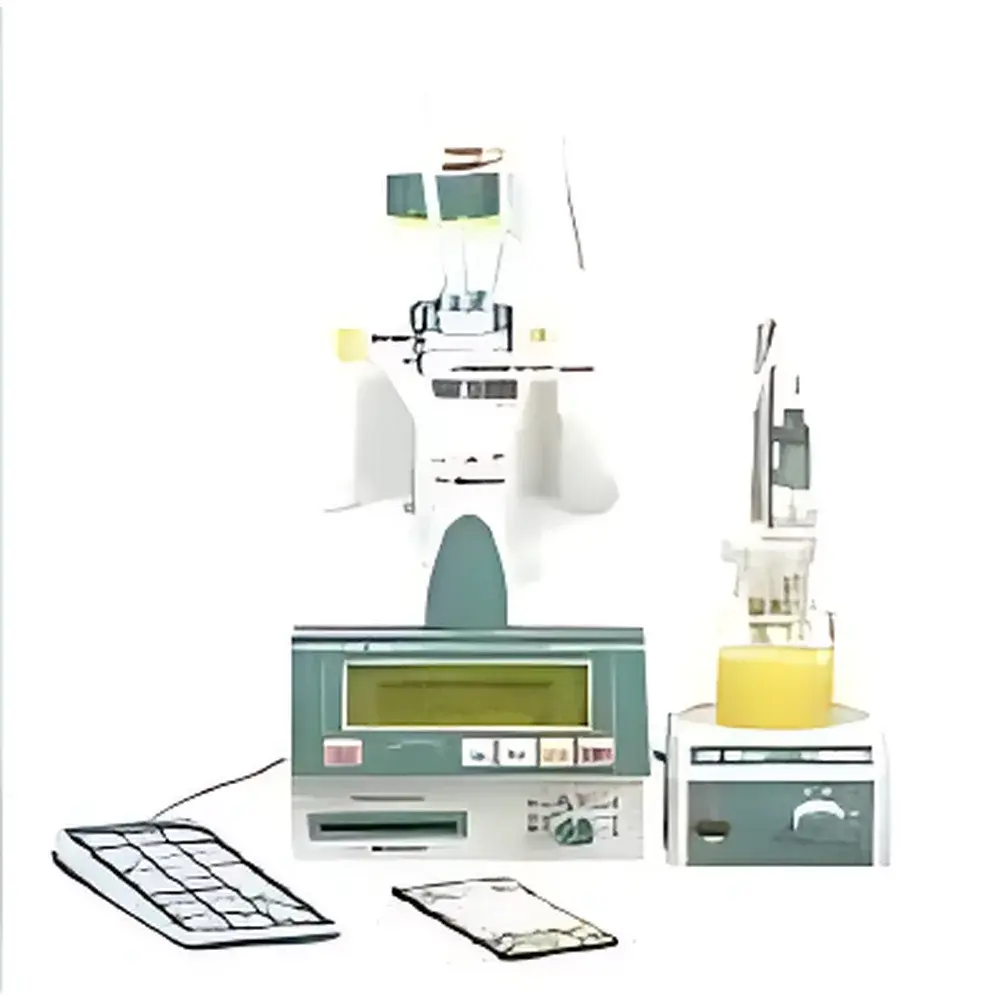
Metrohm 785 Universal Automatic Potentiometric Titrator
| Origin | Switzerland |
|---|---|
| Type | Imported Instrument |
| Model | 785 Universal |
| Pricing | Upon Request |
| Measurement Range | pH 0 to ±20.00 |
| Potential | ±2000 mV |
| Current | ±200.0 µA |
| Temperature | −150.0 to +450.0 °C |
| Burette Volumes | 1, 5, 10, 20, or 50 mL |
| Resolution | 1/10,000 of burette volume |
| Absolute Accuracy | ±0.02 mL (with 10 mL burette) |
| Relative Accuracy | ±0.2% (with 10 mL burette) |
| Input Impedance | >10¹³ Ω |
| Polarization Current | ±127 µA |
| Polarization Potential | ±1270 mV (10 mV steps) |
| Electrode Inputs | 2 high-impedance indicator electrodes, 1 reference electrode, 1 polarization electrode, 1 temperature sensor |
Overview
The Metrohm 785 Universal Automatic Potentiometric Titrator is a precision-engineered electrochemical platform designed for robust, reproducible potentiometric titrations in regulated and research-intensive laboratory environments. Operating on the fundamental principle of detecting the inflection point in potential (E) versus titrant volume (V) curves—typically at the equivalence point—the instrument supports classical redox, acid–base, precipitation, and complexometric titrations with high signal fidelity and minimal drift. Its architecture integrates a low-noise, high-impedance analog front-end (>10¹³ Ω input impedance), thermally compensated potential measurement (±15 µV/K), and real-time current compensation (<3.1 × 10⁻¹³ A), ensuring metrological integrity across extreme pH (0 to ±20.00), potential (±2000 mV), and temperature (−150.0 to +450.0 °C) ranges. As part of Metrohm’s legacy in titration instrumentation—spanning four generations from early manual systems through Titrino to Titrando—the 785 represents a dedicated universal variant optimized for flexibility without compromising traceability or compliance readiness.
Key Features
- High-resolution graphical LCD display showing real-time titration curves (E vs. V, dE/dV vs. V, or second derivative plots) with on-screen step-by-step guidance for method execution
- Multi-mode operation supporting DET (Direct Endpoint Titration), MET (Measure Equivalence Point), SET (Set Endpoint), MEAS (Continuous Measurement), and CAL (Electrode Calibration)
- Modular electrode interface accommodating two high-impedance indicator electrodes, one reference electrode, one polarization electrode, and one Pt1000 or NTC temperature sensor input
- Polarization capability with programmable current (0 to ±127 µA) and potential (0 to ±1270 mV in 10 mV increments) for controlled amperometric or coulometric applications
- Burette compatibility with five standardized volumes (1, 5, 10, 20, and 50 mL), delivering resolution of 1/10,000 of full scale and absolute accuracy of ±0.02 mL (10 mL burette)
- Embedded method memory card containing pre-validated titration protocols aligned with ASTM E2087, ISO 8655-3, and USP , enabling rapid deployment of pharmacopeial or industrial standard methods
Sample Compatibility & Compliance
The 785 accommodates aqueous, non-aqueous, viscous, and suspended-phase samples via compatible electrode configurations—including glass pH, Ag/AgCl, Pt, redox, ion-selective, and gas-sensing electrodes—and interfaces seamlessly with Metrohm’s 800 Dosino dosing modules and 867 Autosampler for unattended batch analysis (up to 192 positions). All hardware and firmware comply with IEC 61000-4 electromagnetic compatibility standards and meet essential requirements of the EU Machinery Directive 2006/42/EC. When operated with validated software and documented SOPs, the system supports GLP and GMP workflows, including full audit trail generation, electronic signature enforcement (in alignment with FDA 21 CFR Part 11 when paired with tiamo™ software), and calibration certificate traceability to NIST or PTB standards.
Software & Data Management
The instrument operates natively with Metrohm’s tiamo™ software suite (v3.3+), which provides method development, sequence programming, live data visualization, statistical reporting (RSD, recovery %, confidence intervals), and export to CSV, PDF, or LIMS-compatible XML formats. Raw measurement data—including timestamped potential, current, temperature, and burette position—is stored with metadata (operator ID, method version, calibration history) and protected against unauthorized modification. The software supports multi-user role-based access control, automated backup to network drives, and integration with enterprise quality management systems (QMS) via OPC UA or ODBC drivers. All data files are digitally signed and retain full chain-of-custody metadata required for regulatory submissions.
Applications
The 785 delivers quantitative results across diverse sectors requiring certified titrimetric accuracy: determination of free fatty acids in edible oils (AOCS Cd 3d-63), chloride in drinking water (ISO 9297), peroxide value in pharmaceutical excipients (EP 2.5.3), total alkalinity in boiler feedwater (ASTM D1067), residual oxidants in disinfectant solutions, and acid number in transformer oils (ASTM D974). It is routinely deployed in QC labs for raw material release testing, stability-indicating assays in pharmaceutical development, environmental monitoring of anions/cations in wastewater, and academic research involving equilibrium constant derivation or kinetic titration modeling.
FAQ
Does the 785 support non-aqueous titrations such as Karl Fischer or perchloric acid titrations?
Yes—it accepts specialized electrodes (e.g., double-junction reference electrodes, solvent-resistant pH electrodes) and supports titrant delivery in anhydrous solvents; however, Karl Fischer requires dedicated coulometric or volumetric KF modules (e.g., 852 Titrando with Hydromat), not the base 785 configuration.
Can the 785 be integrated into a fully automated lab workflow with robotic sample handling?
Yes—via RS232/USB/Ethernet communication and standardized command syntax (Tiamo API), it interoperates with third-party LIMS, SCADA, and robotic platforms compliant with ASTM E1578 or ISO/IEC 17025 digital lab frameworks.
Is temperature compensation mandatory for all titration types?
Temperature input is optional but strongly recommended for pH and redox titrations where electrode response exhibits thermal drift; the built-in Pt1000 sensor enables automatic Nernst correction per ISO 3696 and IUPAC recommendations.
What documentation is provided for IQ/OQ/PQ validation?
Metrohm supplies a comprehensive validation package including Factory Acceptance Test (FAT) reports, User Requirement Specification (URS) templates, test protocols for Installation Qualification (IQ), Operational Qualification (OQ), and Performance Qualification (PQ), plus calibration certificates traceable to national metrology institutes.





