
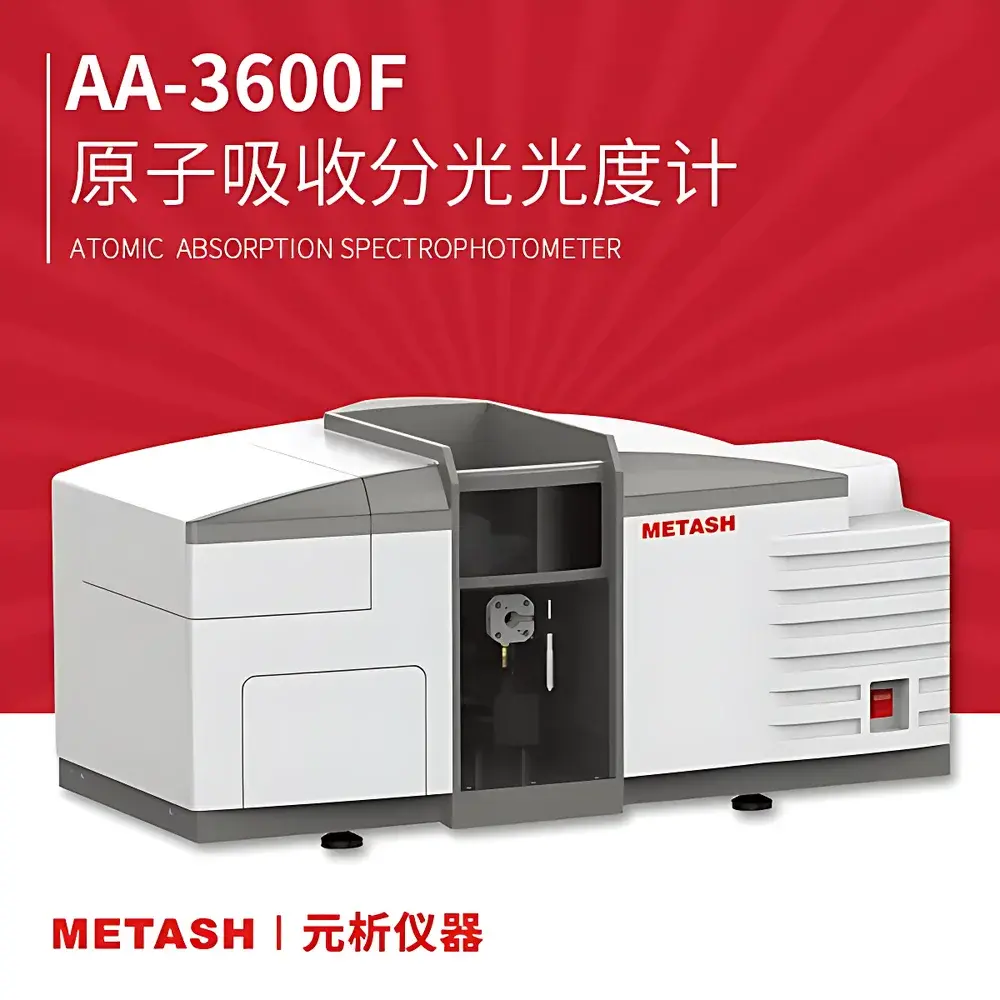
Metash AA-3600F Flame Atomic Absorption Spectrometer
| Brand | Metash Instruments |
|---|---|
| Origin | Shanghai, China |
| Manufacturer Type | Direct Manufacturer |
| Instrument Type | Flame AAS |
| Model | AA-3600F |
| Monochromator | Plane Grating (1800 grooves/mm) |
| Optical System | Single-Beam |
| Detector | Photomultiplier Tube (PMT) |
| Background Correction | D₂ Lamp + Self-Reversal Method |
| Spectral Bandwidth | 0.2 / 0.4 / 1.0 / 2.0 nm (auto-switchable) |
| Wavelength Range | 190–900 nm |
| Wavelength Accuracy | ±0.1 nm |
| Wavelength Repeatability | 0.1 nm |
| Resolution | 0.1 nm |
| Characteristic Concentration (Cu) | 0.02 µg/mL per 1% absorption |
| Detection Limit (Cu) | 0.002 µg/mL |
| Baseline Drift | ≤0.004 A/30 min |
| Background Correction Capability | >30× at 1 A |
| RSD (Precision) | ≤1.0% |
| Atomizer | Air-Acetylene Flame |
| Lamp Turret | 6-position Auto-rotating Holder |
| Beam Splitting | Semi-reflective/Semi-transmissive Device for D₂ Background Balance |
Overview
The Metash AA-3600F Flame Atomic Absorption Spectrometer is a benchtop analytical instrument engineered for precise, routine quantification of trace metal elements in liquid samples using flame atomization and line-source absorption spectroscopy. Based on the Beer–Lambert law, the system measures the attenuation of narrow-band radiation emitted by element-specific hollow cathode lamps as it passes through a thermally atomized sample vapor in an air-acetylene flame. Its single-beam optical architecture—featuring a high-line-density plane grating (1800 grooves/mm), photomultiplier tube detection, and dual-mode background correction (deuterium lamp and self-reversal)—ensures robust signal-to-noise performance and reliable baseline stability (<0.004 A over 30 minutes). Designed and manufactured in Shanghai under ISO-aligned quality management procedures, the AA-3600F complies with fundamental requirements of ASTM E1997, ISO 11170, and USP , making it suitable for regulated environments where method reproducibility and instrument traceability are essential.
Key Features
- 6-position automatic lamp turret enabling rapid, software-controlled switching among up to six hollow cathode or electrodeless discharge lamps without manual realignment.
- Intelligent wavelength scanning and peak search algorithm that automatically locates optimal emission lines, adjusts slit width (0.2/0.4/1.0/2.0 nm), optimizes PMT high voltage, and sets lamp current—reducing setup time and operator dependency.
- Automated flame ignition sequence with integrated safety interlocks: real-time flame monitoring, acetylene leak detection, automatic gas cutoff upon flame extinction, and emergency power disconnection during abnormal thermal or electrical events.
- Dual-background correction architecture: deuterium lamp correction for broadband absorption (e.g., matrix molecular absorption), complemented by self-reversal correction for structured background near atomic lines—achieving >30× correction efficiency at 1 A absorbance.
- Semi-reflective/semi-transmissive beam combiner ensures balanced energy distribution between sample and background beams during D₂ correction, minimizing photometric error and improving accuracy at low absorbance levels.
- Compact footprint and modular electronics design facilitate integration into QC laboratories with space constraints, while maintaining full compliance with IEC 61010-1 safety standards for laboratory electrical equipment.
Sample Compatibility & Compliance
The AA-3600F supports aqueous and dilute acid-digested samples compatible with standard flame AAS protocols (e.g., EPA Method 7000B, ISO 11885). It accommodates common matrices from environmental water, soil extracts, pharmaceutical excipients, cosmetic raw materials, and geological leachates. The instrument’s hardware and firmware support audit-trail-capable operation when paired with compliant LIMS or validated data acquisition software—enabling adherence to GLP and GMP documentation requirements. All calibration and measurement records can be timestamped, user-identified, and exported in CSV or PDF formats for regulatory submission. While not natively 21 CFR Part 11 compliant, its architecture permits integration with third-party electronic signature and data integrity modules meeting FDA and EMA expectations.
Software & Data Management
The embedded control software provides intuitive workflow navigation for method setup, calibration curve generation (linear, quadratic, or forced-zero), QC sample verification (spike recovery, duplicate analysis), and report generation. Raw absorbance/time and absorbance/concentration datasets are stored with full metadata (lamp ID, slit width, flame condition, operator ID, date/time stamp). Export functions support direct transfer to Excel-compatible formats and optional cloud synchronization via secure HTTPS endpoints. Software updates are delivered via authenticated firmware packages with SHA-256 hash verification to ensure integrity and version control across multi-instrument deployments.
Applications
- Environmental testing: Quantification of Cu, Zn, Fe, Mn, Pb, Cd, and Cr in drinking water, wastewater, and sediment digests per ISO 11885 and EPA 200.7.
- Pharmaceutical quality control: Elemental impurity screening (ICH Q3D Class 1 & 2 elements) in active pharmaceutical ingredients and excipients.
- Cosmetic safety assessment: Lead and arsenic determination in pigments and base formulations following ASEAN Cosmetics Directive Annex III guidelines.
- Geological exploration: Rapid multi-element analysis of rock and ore digestates for exploration-grade assay support.
- Food and feed safety: Monitoring of essential (Ca, Mg, Zn) and toxic (As, Cd) metals in fortified foods and animal feedstuffs per AOAC 984.27.
FAQ
What atomization method does the AA-3600F support?
The AA-3600F is configured exclusively for flame atomization using air-acetylene combustion. It does not include graphite furnace or hydride generation accessories in the base configuration.
Is the instrument compatible with hydrogen-based flames?
No—the AA-3600F is optimized for air-acetylene flame operation only. Hydrogen-air or nitrous oxide-acetylene systems require hardware modifications not supported by this model.
Can background correction be disabled during method development?
Yes. Background correction mode (D₂, self-reversal, or off) is fully configurable per element and measurement step within the method editor.
What is the maximum number of calibration standards supported per curve?
Up to eight calibration points—including blank, low, mid, high, and QC check standards—can be defined and measured sequentially with automated dilution factor application.
Does the software support multi-user login with role-based permissions?
The standard firmware includes operator-level access control; however, granular permission tiers (e.g., admin, analyst, reviewer) require integration with external authentication servers or validated third-party LIMS platforms.






