
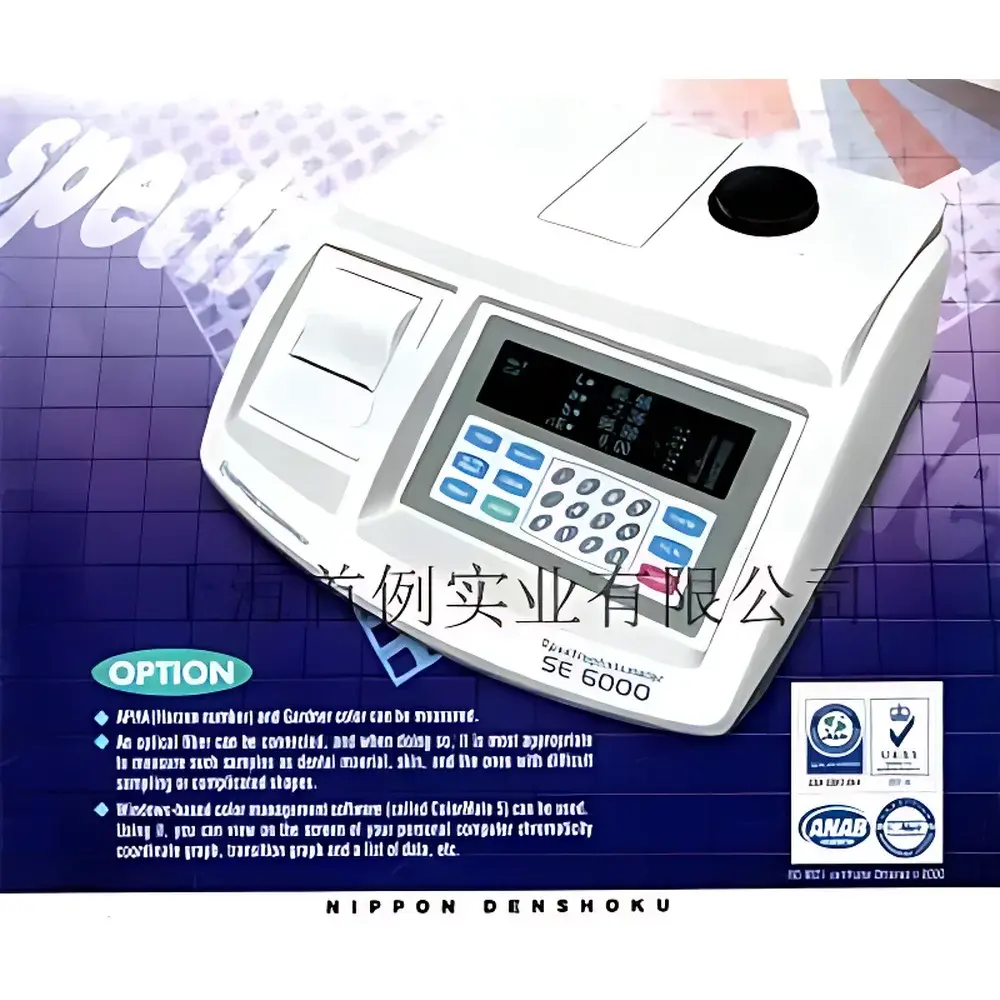
NIPPON DENSHOKU SE6000 Benchtop Spectrophotometric Color Difference Meter
| Brand | NIPPON DENSHOKU |
|---|---|
| Origin | Japan |
| Model | SE6000 |
| Instrument Type | Benchtop |
| Optical Geometry | 0°/45° Integrating Sphere |
| Light Source | 12 V, 50 W Halogen Lamp |
| Spectral Range | 380–780 nm (10 nm Interval) |
| Measurement Apertures | 3 mm, 6 mm, 10 mm, 30 mm (reflectance) |
| Repeatability | ΔE* ≤ 0.02 (after 30 min warm-up, 30 consecutive readings at 10 s intervals) |
| Compliance | JIS Z 8722, ASTM E 308, ASTM E 313 |
| Display | 256 × 64 dot matrix LCD (166.25 mm × 41.45 mm active area) |
| Interface | RS-232C |
| Operating Environment | 15–40 °C, 30–80 % RH (non-condensing) |
Overview
The NIPPON DENSHOKU SE6000 is a precision benchtop spectrophotometric color difference meter engineered for high-reproducibility color measurement across diverse material forms—including solids, liquids, powders, films, and spherical samples. It operates on the principle of double-beam post-spectroscopy wavelength-synchronized compensation, ensuring stable photometric response under variable ambient conditions. Its 0°/45° integrating sphere optical architecture conforms to JIS Z 8722 for reflectance (condition d, n-d) and transmittance (condition e, n-d) measurements, enabling traceable, geometry-controlled evaluation of both surface color and bulk optical properties. The instrument employs a thermally stabilized 12 V, 50 W halogen lamp with spectral output spanning 380–780 nm at 10 nm resolution—covering the full CIE standard observer visible range—and utilizes fast-response silicon photodiodes for accurate spectral reflectance and transmittance acquisition.
Key Features
- Benchtop dual-mode operation: simultaneous reflectance and transmittance measurement without hardware reconfiguration
- Multi-aperture capability: selectable measurement areas (3 mm, 6 mm, 10 mm, and 30 mm diameter) optimized for tablets, coatings, textiles, and translucent films
- Comprehensive color space support: CIE XYZ, xyY, L*a*b*, L*u*v*, L*C*h* (ab/uv), Hunter Lab, Munsell HVC (with C/2° and D65/2° options), CMC (l:c), CIE94, CIEDE2000, and whiteness/yellowness indices
- Onboard statistical processing: real-time calculation of mean, standard deviation (σ), and tolerance-based pass/fail judgment using ΔL*a*b*, ΔE*, ΔL*u*v*, or custom thresholds
- Integrated graphical display: 256 × 64 dot-matrix LCD supporting simultaneous visualization of spectral curves, chromaticity diagrams (Lab, Yxy), deviation heatmaps, and spectral reflectance/transmittance data
- Foot-switch compatibility: hands-free triggering for production-line or glove-box environments where manual actuation is impractical
- RS-232C serial interface: direct communication with Windows-based color management software for audit-trail-capable data export, batch reporting, and GLP/GMP-aligned record retention
Sample Compatibility & Compliance
The SE6000 accommodates heterogeneous sample geometries—flat solids, curved surfaces, granular powders, viscous liquids in cuvettes, and thin polymer films—without requiring auxiliary fixtures for most routine applications. Its 3 mm aperture option satisfies pharmaceutical tablet color uniformity testing per USP and JP guidelines, while the 30 mm transmittance port meets ISO 11475 for transparent packaging materials. All optical calibrations are traceable to NIST-traceable standards, and measurement protocols align with JIS Z 8722 (Japanese Industrial Standard), ASTM E 308 (computing color from spectral data), and ASTM E 313 (yellowness index). The system supports observer angles of 2° and 10°, and illuminants A, C, D50, D55, D65, D75, F2, F6, F7, F8, F11, and F12—enabling cross-standard comparisons required in global supply chain quality control.
Software & Data Management
Data generated by the SE6000 is structured for regulatory compliance and long-term archival integrity. Each measurement file stores up to 500 spectra with embedded metadata (timestamp, operator ID, aperture, illuminant, observer, calibration status). The optional Windows color management software provides FDA 21 CFR Part 11–compliant user authentication, electronic signatures, and immutable audit trails for all data modifications. Export formats include CSV and TXT—directly importable into Excel or LIMS platforms—supporting automated trend analysis, SPC charting, and multi-instrument correlation studies. Internal memory retains 20 reference standards and supports arithmetic operations (e.g., batch average of 99 readings), reducing dependency on external spreadsheet tools for preliminary QC assessment.
Applications
- Paint & coating formulation: batch-to-batch color consistency verification against master standards
- Plastics & polymers: monitoring thermal degradation-induced hue shifts during extrusion or molding
- Pharmaceuticals: tablet coating uniformity assessment per ICH Q5C stability protocols
- Food & beverage: objective quantification of browning (ΔE*), yellowness (YI), or whiteness (WI) in dairy, cereals, and beverages
- Textiles & printing: spectral match prediction for dye lots and inkjet proofing validation
- Automotive interiors: gloss-independent color evaluation of dashboards, seat fabrics, and trim under multiple illuminants
FAQ
What is the minimum measurable sample size for the SE6000?
The smallest supported aperture is 3 mm in diameter, suitable for pharmaceutical tablets, small electronic components, or micro-coated substrates.
Does the SE6000 comply with FDA 21 CFR Part 11 requirements?
While the instrument itself does not embed Part 11 controls, its RS-232C interface and companion Windows software provide full electronic signature, audit trail, and role-based access functionality when deployed in validated environments.
Can the SE6000 measure both opaque and translucent materials in a single workflow?
Yes—its dual-mode optical path allows seamless switching between reflectance (for solids/powders) and transmittance (for solutions/films) without recalibration or mechanical repositioning.
How is thermal drift mitigated during extended operation?
The halogen lamp and detector subsystem undergo a 30-minute stabilization protocol; repeatability specifications (ΔE* ≤ 0.02) assume this warm-up period and ambient temperature control within 15–40 °C.
Is spectral data export available in raw format?
Yes—full-resolution reflectance (%) and transmittance (%) values at 10 nm intervals (380–780 nm) are exportable as ASCII text files, preserving original instrument response for third-party spectral analysis or custom color model development.




