
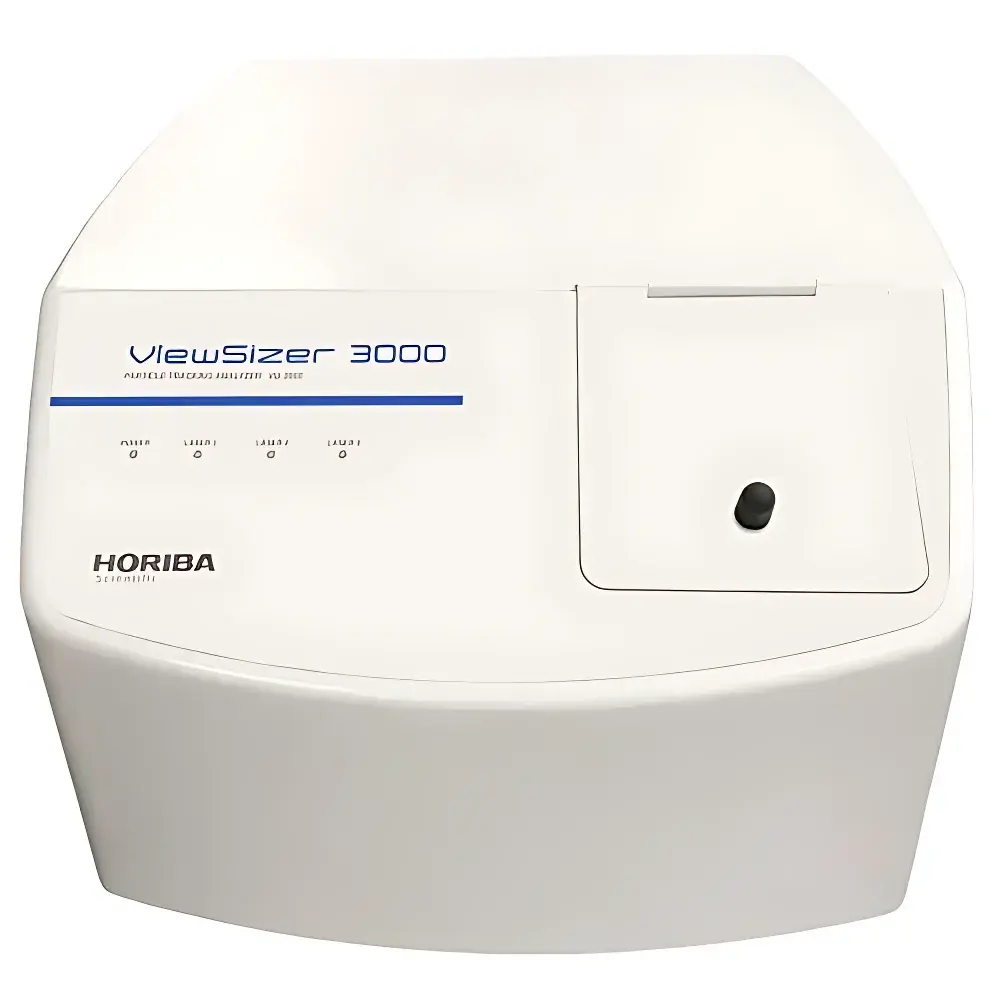
HORIBA ViewSizer 3000 Multi-Laser Nanoparticle Tracking Analyzer
| Brand | HORIBA |
|---|---|
| Origin | Japan |
| Model | ViewSizer 3000 |
| Dispersion Method | Dry & Wet Dispersion |
| Instrument Type | Laboratory NTA System |
| Measurement Range | 10 nm – 15 µm |
| Concentration Range | 5 × 10⁶ – 2 × 10⁸ particles/mL |
| Sample Volume | 350 µL – 1.25 mL |
| Temperature Control Range | 10 °C – 50 °C (±0.1 °C) |
| Dimensions | 55 cm W × 66 cm D × 35 cm H |
| Weight | 27 kg |
| Operating Environment | 15 °C – 30 °C, < 85% RH |
Overview
The HORIBA ViewSizer 3000 is a high-precision multi-laser nanoparticle tracking analyzer engineered for quantitative characterization of heterogeneous colloidal systems across an exceptionally broad size range—from exosomes and viral vectors to polymeric nanoparticles and protein aggregates. Unlike conventional single-laser NTA instruments, the ViewSizer 3000 employs three independently controlled lasers (405 nm, 488 nm, and 640 nm) operating simultaneously within a single optical path. This multi-wavelength architecture enables real-time, intensity-matched particle tracking across disparate scattering regimes, thereby overcoming the fundamental dynamic range limitations inherent in traditional NTA. Each laser is optimized for specific size-dependent scattering efficiency: shorter wavelengths enhance sensitivity to sub-30 nm particles (e.g., small exosomes), while longer wavelengths minimize signal saturation for larger aggregates (>1 µm). The system applies physics-based signal routing—automatically selecting the optimal laser channel per particle trajectory based on detected photon flux—ensuring accurate hydrodynamic diameter assignment and concentration quantification without manual threshold tuning or post-acquisition binning artifacts.
Key Features
- Triple-laser illumination (405 nm / 488 nm / 640 nm) with synchronized camera acquisition for concurrent multi-scattering-channel analysis
- Dynamic laser power modulation and intelligent signal routing to prevent detector saturation and extend lower detection limit
- Fully detachable, autoclavable quartz flow cell with zero dead-volume design—enabling rapid disassembly, chemical cleaning, and full validation of cross-contamination control
- Integrated Peltier temperature control (10–50 °C ±0.1 °C) with real-time thermal feedback for reproducible Brownian motion analysis under physiologically relevant conditions
- Automated focus stabilization and drift compensation algorithms to maintain optical alignment over extended acquisition periods (up to 60 s per video)
- Compliance-ready audit trail logging, user access levels, and electronic signature support aligned with FDA 21 CFR Part 11 and GLP/GMP documentation requirements
Sample Compatibility & Compliance
The ViewSizer 3000 accommodates aqueous suspensions, buffered saline solutions, serum-containing media, and low-viscosity organic solvents—making it suitable for biologics development, nanomedicine QC, and academic virology research. Its open-flow cell geometry supports both batch and low-volume microsampling protocols (350 µL minimum), minimizing sample waste during method development. All wetted components are chemically inert (quartz, PEEK, stainless steel 316), ensuring compatibility with aggressive cleaning agents (e.g., 0.1 M NaOH, 70% ethanol, Piranha solution) required for stringent biocontainment workflows. The instrument meets ISO 22412:2017 for nanoparticle size analysis by NTA and supports traceable calibration using NIST-traceable polystyrene and silica reference standards. Full compliance documentation—including IQ/OQ/PQ templates, risk assessments, and raw data export in HDF5 format—is provided for regulated environments.
Software & Data Management
Acquisition and analysis are performed via HORIBA’s proprietary ViewSizer Software v4.x, a validated desktop application built on a modular, extensible architecture. It provides automated particle identification using adaptive contrast segmentation, non-linear trajectory reconstruction, and Mie-scattering-corrected size calculation. Batch processing supports up to 96 samples with customizable pass/fail criteria, statistical summarization (D10/D50/D90, PDI, modal distribution), and export to CSV, PDF, or LIMS-integrated XML schemas. Raw video files (AVI/H.264) and metadata (laser power, temperature, exposure time, gain) are stored with SHA-256 checksums for forensic data integrity verification. The software includes built-in tools for inter-instrument comparison, long-term stability trending, and automated report generation compliant with ISO/IEC 17025 reporting guidelines.
Applications
- Exosome isolation process monitoring and lot-release testing in regenerative medicine manufacturing
- Characterization of AAV, lentiviral, and mRNA-LNP formulations during preclinical development
- Stability assessment of monoclonal antibody aggregates under thermal, pH, and shear stress conditions
- Quality control of metal-organic frameworks (MOFs), quantum dots, and lipid nanoparticles in nanomaterial synthesis
- Environmental nanoparticle fate studies in wastewater effluents and surface water matrices
- Method transfer between R&D, QC, and CMC laboratories under ICH Q5E comparability frameworks
FAQ
How does the ViewSizer 3000 differ from conventional single-laser NTA instruments?
It eliminates the need for manual laser selection or sequential acquisitions by capturing scattering signals from all three wavelengths simultaneously—enabling true multi-size-class resolution in a single measurement without trade-offs in sensitivity or dynamic range.
Can the system quantify particle concentration without external calibration?
Yes—the instrument calculates absolute concentration (particles/mL) directly from tracked trajectories and calibrated effective detection volume, corrected for size-dependent scattering cross-section using Mie theory.
Is the flow cell compatible with high-salt or viscous biological matrices?
The quartz cell and PEEK fluidic pathway resist corrosion and clogging; however, samples >15 cP viscosity require dilution or syringe-pump-assisted flow to maintain laminar regime and avoid sedimentation artifacts.
Does the software support 21 CFR Part 11 compliance for pharmaceutical use?
Yes—role-based access control, electronic signatures, immutable audit trails, and data integrity safeguards are embedded at the firmware and application layers.
What maintenance is required to ensure long-term measurement reproducibility?
Quarterly optical alignment verification, annual laser power calibration using NIST-traceable photodiodes, and routine cleaning validation using 100 nm polystyrene standard suspensions are recommended per HORIBA’s PQ protocol.
Related Products



