
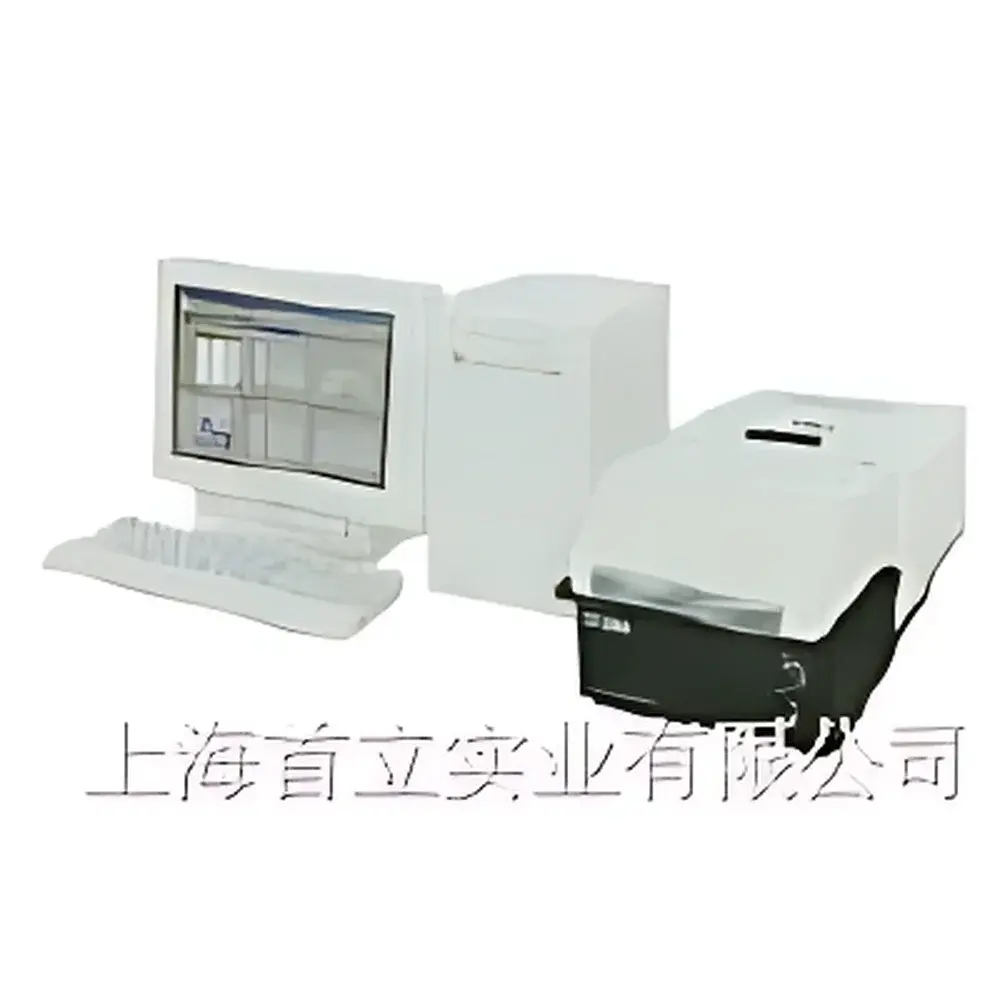
GC-5000 Two-Dimensional Spectral Goniospectrophotometer
| Origin | Japan |
|---|---|
| Manufacturer Type | Authorized Distributor |
| Origin Category | Imported |
| Model | GC-5000 |
| Pricing | Upon Request |
| Light Source | 12 V / 50 W Halogen Lamp (≈6000 h Lifetime) |
| Optical Calibration | Full-Wavelength Continuous Correction |
| Sample Size Range | 30 × 30 mm (min) to 180 × 220 mm (max) |
| Illumination Angle | Reflectance Mode: 0°–80° (5° increments) |
| Transmittance Mode | 180° |
| Receiving Angle Range | −80° to +80° (excl. ±10° around incident angle in reflectance mode) |
| Angular Resolution | 5° motorized rotation of detector arm |
| Detector | Silicon Photodiode |
| Spectral Bandpass | Interference Filters, 400–700 nm, 20 nm step |
| Sensitivity Settings | Four-step gain control (Reflectance: Std, 1/4, 1/10, 1/200 |
| Transmittance | ×20, ×50, ×200) |
| Interface | RS-232C Serial Communication |
| Dimensions (W × D × H) | 340 × 520 × 310 mm |
Overview
The GC-5000 Two-Dimensional Spectral Goniospectrophotometer is a precision optical measurement instrument engineered for quantitative characterization of angular-dependent spectral reflectance and transmittance properties of solid and planar materials. Operating on the principle of goniospectrophotometry, it systematically acquires bidirectional reflectance distribution function (BRDF) and bidirectional transmittance distribution function (BTDF) data by synchronizing controlled variation of illumination angle (0°–80° in reflectance, fixed 180° in transmittance) with high-resolution angular scanning of the detection path (−80° to +80°, excluding ±10° around the specular direction in reflectance mode). The system employs a stabilized 12 V / 50 W halogen lamp with an estimated operational lifetime of 6000 hours, coupled with interference filters spanning 400–700 nm at 20 nm intervals to deliver spectrally resolved measurements across the visible spectrum. Its fully motorized, 5°-incremental detector rotation enables reproducible acquisition of spatially resolved spectral response—critical for evaluating appearance attributes such as gloss, sheen, sparkle, and metamerism in coatings, plastics, textiles, and printed media.
Key Features
- Motorized dual-angle scanning architecture supporting independent control of illumination and reception geometry in reflectance mode, enabling BRDF mapping with 5° angular resolution.
- Full-wavelength continuous optical calibration routine ensures traceable spectral fidelity across all filter bands and angular configurations.
- Dual-mode operation: configurable for directional-hemispherical reflectance (DHR) or directional-directional (specular-included/excluded) measurements, plus normal-incidence transmittance at 180°.
- Four-step programmable sensitivity adjustment for both reflectance and transmittance channels, accommodating high-reflectivity metals and low-reflectance dark pigments without saturation or noise floor limitations.
- Robust mechanical design with precision-ground rotational stages and thermally stabilized optical housing to minimize drift during extended measurement sequences.
- RS-232C serial interface compliant with standard industrial communication protocols, facilitating integration into automated QA/QC workflows and legacy laboratory systems.
Sample Compatibility & Compliance
The GC-5000 accommodates flat, rigid samples ranging from 30 × 30 mm up to 180 × 220 mm, making it suitable for standard test plaques, production coupons, and printed calibration targets. Its non-contact, non-destructive measurement methodology complies with core principles outlined in ISO 13655:2017 (Graphic technology — Spectral measurement and colorimetric computation for graphic arts images), ASTM E308-22 (Standard Practice for Computing the Colors of Objects by Using the CIE System), and JIS Z 8722 (Methods of color measurement). While not inherently 21 CFR Part 11–compliant, audit-trail functionality—including timestamped raw spectral logs, operator ID tagging, and configuration metadata—can be implemented via external software validation per GLP/GMP requirements.
Software & Data Management
The GC-5000 is operated via Windows-compatible control software that provides real-time graphical display of spectral reflectance curves, angular scattering profiles, and derived colorimetric values (e.g., CIE L*a*b*, ΔE₀₀, Yellowness Index, Gloss Units at 20°/60°/85° equivalents). Measurement sequences are scriptable, allowing batch execution of multi-angle, multi-wavelength acquisitions with automated file naming, directory structuring, and CSV/TXT export. Raw spectral data (wavelength vs. intensity per angle pair) is stored in open-format ASCII files for post-processing in MATLAB, Python (NumPy/Pandas), or third-party BRDF modeling tools. Software supports user-defined calculation templates aligned with internal quality specifications or customer-facing reporting standards.
Applications
- Automotive OEMs and Tier-1 suppliers use the GC-5000 to quantify angular color shift (flop) in effect coatings and evaluate spatial uniformity of pearlescent and metallic finishes.
- Paper and packaging laboratories apply it to assess ink trapping, substrate show-through, and gloss differential between coated/uncoated surfaces under variable viewing geometries.
- R&D teams in display and optical film development rely on its BTDF capability to characterize diffusion films, anti-glare layers, and microstructured brightness enhancement films.
- Academic researchers utilize its BRDF output for validating physics-based rendering models and calibrating hyperspectral imaging systems.
- Standards laboratories deploy it for inter-laboratory comparison studies supporting revision of CIE Technical Reports on appearance metrology.
FAQ
What is the minimum measurable sample size?
The GC-5000 requires a minimum sample area of 30 × 30 mm to ensure full coverage of the measurement aperture and avoid edge diffraction artifacts.
Can the instrument measure curved or textured surfaces?
It is designed exclusively for flat, planar specimens. Curved, rough, or highly scattering surfaces introduce uncontrolled path-length variance and violate the assumptions of its geometric calibration model.
Is spectral irradiance calibration traceable to NIST or other national standards?
The system supports user-performed calibration using optional NIST-traceable reflectance standards (e.g., Spectralon® SRM 2020); factory calibration is performed against internal reference tiles verified annually against primary standards.
Does the software support automated pass/fail evaluation against tolerance limits?
Yes—customizable acceptance criteria can be defined per parameter (e.g., ΔE₀₀ < 1.5, Rspec at 20° > 85%), with visual alerts and log-file annotation upon deviation.
Is firmware upgrade capability available remotely?
Firmware updates are delivered via secure download and installed through the host PC software; no field service visit is required for version maintenance.




