
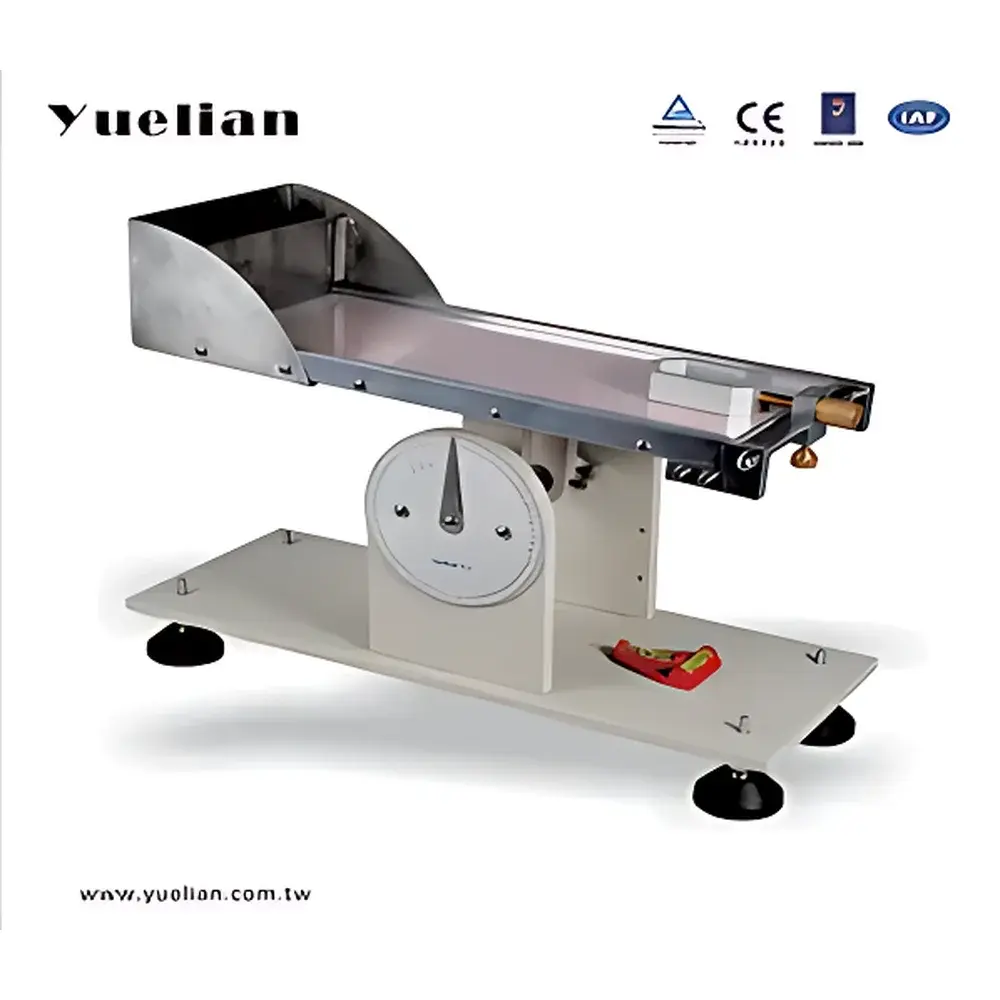
Yuelian YL-8801A GB/T 4852 Initial Adhesion Tester (Rolling Ball Method)
| Brand | Yuelian |
|---|---|
| Origin | Guangdong, China |
| Manufacturer Type | Authorized Distributor |
| Country of Origin | China |
| Model | YL-8801A |
| Pricing | Upon Request |
| Standard Compliance | GB/T 4852–2002, CNS 11888 |
| Test Method | Rolling Ball (Method A & B) |
| Inclination Angle Range | 0°–40° (adjustable, standard 30°) |
| Steel Ball Set | ISO 3290 Grade 10, 2–32 ball numbers (1 set) |
| Test Distance | 100 mm |
| Dimensions (W×D×H) | 45 × 27 × 26 cm |
| Weight | Approx. 15 kg |
Overview
The Yuelian YL-8801A Initial Adhesion Tester is a precision mechanical instrument engineered for quantitative evaluation of the initial tack—i.e., the instantaneous adhesive strength developed upon brief, light contact—of pressure-sensitive adhesives (PSAs), including tapes, labels, and transfer adhesives. It operates strictly in accordance with the rolling ball method defined in GB/T 4852–2002 (“Test Method for Initial Tack of Pressure-Sensitive Adhesives — Rolling Ball Method”) and aligned with CNS 11888 (Chinese National Standard equivalent to JIS Z 0237). The principle relies on gravitational acceleration of standardized steel balls down an inclined plane onto a horizontally mounted adhesive specimen; the largest ball number that stops completely within a defined 100 mm test zone—without rebound or roll-off—serves as the empirical tack index. This method delivers high inter-laboratory reproducibility for comparative ranking and QC pass/fail assessment, particularly where rapid, low-cost screening of batch-to-batch consistency is required.
Key Features
- Compliant dual-mode configuration supporting both Method A (fixed-angle, variable-ball) and Method B (fixed-ball, variable-angle) per GB/T 4852–2002, enabling flexible test protocol selection based on material sensitivity and regulatory requirements.
- Precision-machined aluminum alloy frame with anodized surface finish ensures dimensional stability, corrosion resistance, and long-term repeatability under routine laboratory conditions.
- Continuously adjustable inclination angle (0°–40°, ±0.5° resolution) via calibrated micrometer dial, allowing fine-tuning to accommodate low-tack films or high-viscosity hot melts.
- Included full set of 31 ISO 3290 Grade 10 hardened steel balls (ball numbers 2 through 32), traceable to NIST-traceable calibration certificates, each individually inspected for sphericity (≤0.5 µm deviation) and surface roughness (Ra ≤ 0.05 µm).
- Integrated stop-block mechanism and optical alignment guide ensure consistent 100 mm rolling distance and perpendicular ball release, minimizing operator-induced variability.
- Compact footprint (45 × 27 × 26 cm) and lightweight design (~15 kg) facilitate placement on standard lab benches or mobility between production line QC stations and R&D labs.
Sample Compatibility & Compliance
The YL-8801A accommodates flat, rigid or semi-flexible PSA specimens up to 100 mm width and ≥150 mm length, mounted on standardized backing substrates (e.g., stainless steel, PET, or specified release liner). It supports testing of acrylic, rubber-based, silicone, and hybrid PSAs used in medical tapes, packaging labels, automotive masking tapes, and electronic die-cut components. All operational procedures and reporting outputs are fully compatible with GLP documentation workflows. While the instrument itself does not generate electronic audit trails, its manual test record format aligns with Annex 11 and FDA 21 CFR Part 11 principles when integrated into paper-based or validated LIMS-controlled environments. Test reports may be structured to include operator ID, ambient temperature/humidity (recommended 23 ± 2°C / 50 ± 5% RH per ISO 293/ISO 279), substrate type, ball number, stopping position, and pass/fail determination per pre-defined acceptance criteria.
Software & Data Management
The YL-8801A is a manually operated, non-electronic mechanical tester and does not incorporate embedded firmware, touchscreen interface, or digital data output. All measurements are recorded manually using standardized test sheets compliant with internal QA templates or external standards such as ASTM D3330 Annex A3 (for comparative tack referencing). Users may digitize results via integration with third-party LIMS or ELN platforms using barcode-scanned test IDs or CSV import. Optional accessories include a calibrated digital inclinometer (±0.1° accuracy) and certified steel ball verification kit for periodic performance verification per ISO/IEC 17025 clause 6.5.2.
Applications
- Quality control of pressure-sensitive adhesive tapes during incoming raw material inspection and final product release.
- R&D formulation screening for tackifier/resin ratio optimization in acrylic and SIS-based PSAs.
- Batch consistency monitoring across manufacturing shifts, especially for high-volume labeling and protective film production.
- Technical support for customer complaints related to insufficient “instant grab” performance in application-critical scenarios (e.g., medical device fixation, temporary signage).
- Training platform for laboratory personnel on fundamental adhesion metrology principles and standard test method execution.
FAQ
Is the YL-8801A compliant with international standards beyond GB/T 4852?
Yes—the test geometry, ball specifications, and procedural logic conform equivalently to JIS Z 0237 (Japan), ASTM D3330 Method A (USA), and ISO 293 (adhesive tape conditioning requirements), enabling cross-border technical equivalence.
Can the instrument be used for non-tape PSA materials such as adhesive-coated foams or films?
Yes, provided the specimen is flat, dimensionally stable over the 100 mm test path, and affixed to a rigid backing plate meeting GB/T 4852’s substrate requirements.
Does the unit include calibration documentation?
Each shipment includes a factory verification report confirming angle scale linearity and ball set conformity to ISO 3290 Grade 10 tolerances; full ISO/IEC 17025 calibration is available upon request through accredited third-party providers.
What maintenance is required to ensure long-term measurement fidelity?
Monthly cleaning of the inclined track with isopropyl alcohol, visual inspection of ball surfaces for pitting or deformation, and annual re-verification of angle scale accuracy using a certified digital inclinometer.



