
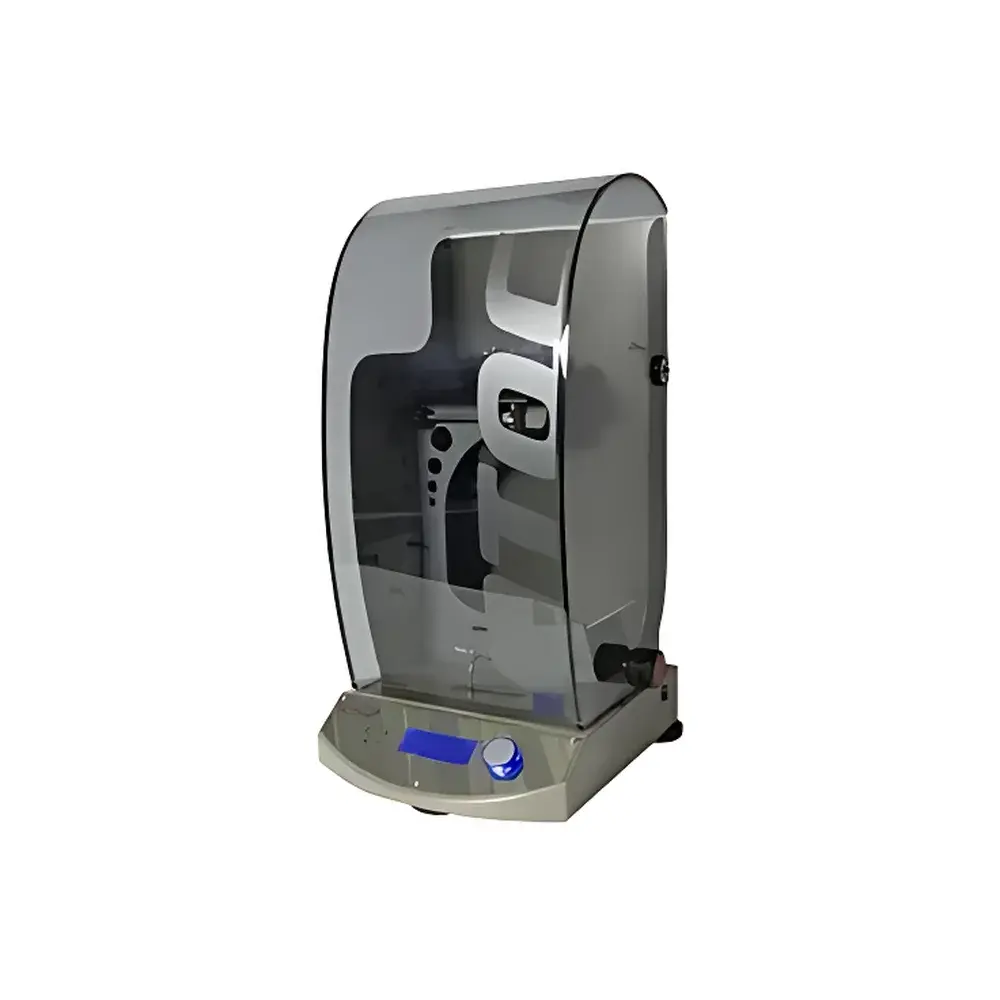
TQC Sheen SP0500/SP0501 Konig & Persoz Pendulum Hardness Tester
| Origin | Netherlands |
|---|---|
| Manufacturer Type | Authorized Distributor |
| Origin Category | Imported |
| Model | SP0500 (230 V) / SP0501 (115 V) |
| Instrument Type | Pendulum Damping Hardness Tester |
| Compliance | ISO 1522:2005, NBN T22-105, BS 3900-E5 |
| Pendulum Options | SP0505 (Konig), SP0510 (Persoz) |
| Base Plate | VF2063 tempered glass (6 mm thick) |
| Dimensions (closed) | 740 × 430 × 430 mm |
| Dimensions (open) | 960 × 430 × 650 mm |
| Weight | 26 kg |
| Construction | Stainless steel front panel & components |
| Pendulum Pivot Balls | 2 × tungsten carbide, Ø8 mm (Konig), 2 × tungsten carbide, Ø5 mm (Persoz) |
| Pivot Spacing | 50 mm (Konig), 30 mm (Persoz) |
| Oscillation Period | 1.0 s (Konig), 1.4 s (Persoz) |
| Adjustable Mass | 500 g / 200 g stainless steel pendulum weights |
Overview
The TQC Sheen SP0500 and SP0501 Pendulum Hardness Testers are precision-engineered instruments for non-destructive, quantitative evaluation of the surface hardness of organic coatings—including paints, varnishes, lacquers, and polymer films—based on mechanical damping principles. These testers operate in strict accordance with ISO 1522:2005, which defines two standardized pendulum methods: the Konig (SP0505) and Persoz (SP0510) configurations. Both rely on the physical principle that a freely oscillating pendulum loses amplitude at a rate inversely proportional to the elastic recovery and viscoelastic resistance of the underlying substrate. As the pendulum swings across the coated surface, energy dissipation occurs through micro-deformation and internal friction within the film; harder surfaces yield less damping and longer oscillation decay times, while softer or tacky films rapidly attenuate motion. The instrument measures the time required for the pendulum’s amplitude to decay from 6° to 3° (Konig) or from 12° to 4° (Persoz), expressed in seconds—a direct, traceable, and repeatable metric of surface rigidity.
Key Features
- Modular dual-voltage design: SP0500 (230 V AC, 50 Hz) and SP0501 (115 V AC, 60 Hz) accommodate global laboratory power infrastructure without external transformers.
- Interchangeable, certified pendulum assemblies: SP0505 (Konig) and SP0510 (Persoz) feature precision-machined stainless steel arms, calibrated tungsten carbide pivot balls (Ø8 mm for Konig, Ø5 mm for Persoz), and adjustable mass configurations (500 g or 200 g) to ensure compliance with ISO-defined inertial parameters.
- Rigid, vibration-damped mechanical architecture: Constructed with stainless steel front panels, powder-coated structural steel housing, anodized aluminum side panels, and a transparent Perspex acrylic lid for real-time visual monitoring without compromising measurement integrity.
- Standardized test base: Includes VF2063 tempered glass reference plate (6 mm thickness), mounted on a stable, level-adjustable platform to eliminate substrate variability and meet ISO 1522 flatness and rigidity requirements.
- Ergonomic operational layout: Hinged lid with gas-spring assist enables safe, one-handed access; clearly marked angular scale (±12°) and digital stopwatch interface (not included—user-supplied Class 0.1 s timer recommended per ISO) support GLP-compliant manual timing procedures.
Sample Compatibility & Compliance
The SP0500/SP0501 system is validated for use on flat, rigid substrates—including metal panels, glass slides, and plastic sheets—coated with single- or multi-layer organic films up to 200 µm dry film thickness. It is unsuitable for highly textured, porous, or flexible substrates (e.g., paper, fabric, rubber) where energy coupling deviates from ISO assumptions. All measurements adhere to ISO 1522:2005 Annex A (Konig method) and Annex B (Persoz method), with full alignment to national equivalents including BS 3900-E5 (UK), NBN T22-105 (Belgium), and ASTM D4366 (referenced for comparative correlation). The instrument supports audit-ready documentation when used within a GLP or GMP framework—timing records, environmental logs (temperature 23 ± 2 °C, RH 50 ± 5 %), and calibration verification of pendulum geometry and pivot wear are essential for regulatory submission.
Software & Data Management
While the SP0500/SP0501 is a manually timed, analog-based instrument (no embedded electronics or firmware), it integrates seamlessly into digital QA workflows. Users commonly pair it with validated stopwatch applications compliant with FDA 21 CFR Part 11 (e.g., NIST-traceable timers with electronic audit trails), or export timing data into LIMS via CSV templates. Calibration certificates for pendulum mass, pivot ball geometry, and glass plate flatness are supplied with each accessory set (SP0505, SP0510, VF2063) and must be renewed annually or after 10,000 cycles. TQC Sheen provides ISO/IEC 17025-accredited calibration services upon request, including uncertainty budgets per GUM (JCGM 100:2008).
Applications
This pendulum hardness tester is routinely deployed in R&D laboratories and QC departments across the coatings value chain: formulation optimization (crosslink density assessment), batch release testing (cure verification), accelerated aging studies (UV/thermal/humidity exposure), and supplier qualification audits. In automotive OEM environments, it validates clearcoat hardness prior to polishing and robotic application; in coil coating plants, it monitors line-speed cure profiles; and in ink manufacturing, it correlates drier performance with surface set time. Its simplicity, reproducibility (within ±0.3 s repeatability under controlled conditions), and direct linkage to ISO standards make it a cornerstone for specification-driven quality control—not a screening tool, but a definitive pass/fail metrology endpoint.
FAQ
What is the difference between Konig and Persoz pendulum methods?
The Konig method (ISO 1522 Annex A) uses a shorter pivot spacing (50 mm), higher mass (500 g), and faster oscillation period (1.0 s), yielding greater sensitivity for hard, brittle films. The Persoz method (Annex B) employs 30 mm spacing, 200 g mass, and 1.4 s period, offering enhanced resolution for softer, more viscoelastic systems such as air-dry alkyds or UV-curable acrylates.
Can I use this tester on curved or irregular surfaces?
No. ISO 1522 requires a planar, rigid substrate with minimum dimensions of 100 × 100 mm and surface flatness ≤0.02 mm/m. Curved or flexible substrates invalidate damping assumptions and introduce unquantifiable error.
How often must the tungsten carbide pivot balls be replaced?
Under normal usage (≤50 tests/day), pivot balls require inspection every 500 cycles and replacement if surface roughness exceeds Ra 0.05 µm or diameter deviation exceeds ±0.005 mm—verified via optical profilometry or calibrated micrometry.
Is automatic timing available?
TQC Sheen does not supply automated optical or magnetic timing modules for this model. Manual timing with a Class 0.1 s stopwatch remains the ISO-prescribed method; automated alternatives require full validation per ISO/IEC 17025 and are not covered under standard warranty or compliance certification.
Does the instrument include calibration documentation?
Yes—each SP0505 and SP0510 pendulum is supplied with a manufacturer’s certificate of conformance detailing mass, center-of-gravity offset, pivot ball geometry, and dimensional tolerances. The VF2063 glass plate includes flatness certification per ISO 10110-7.



