
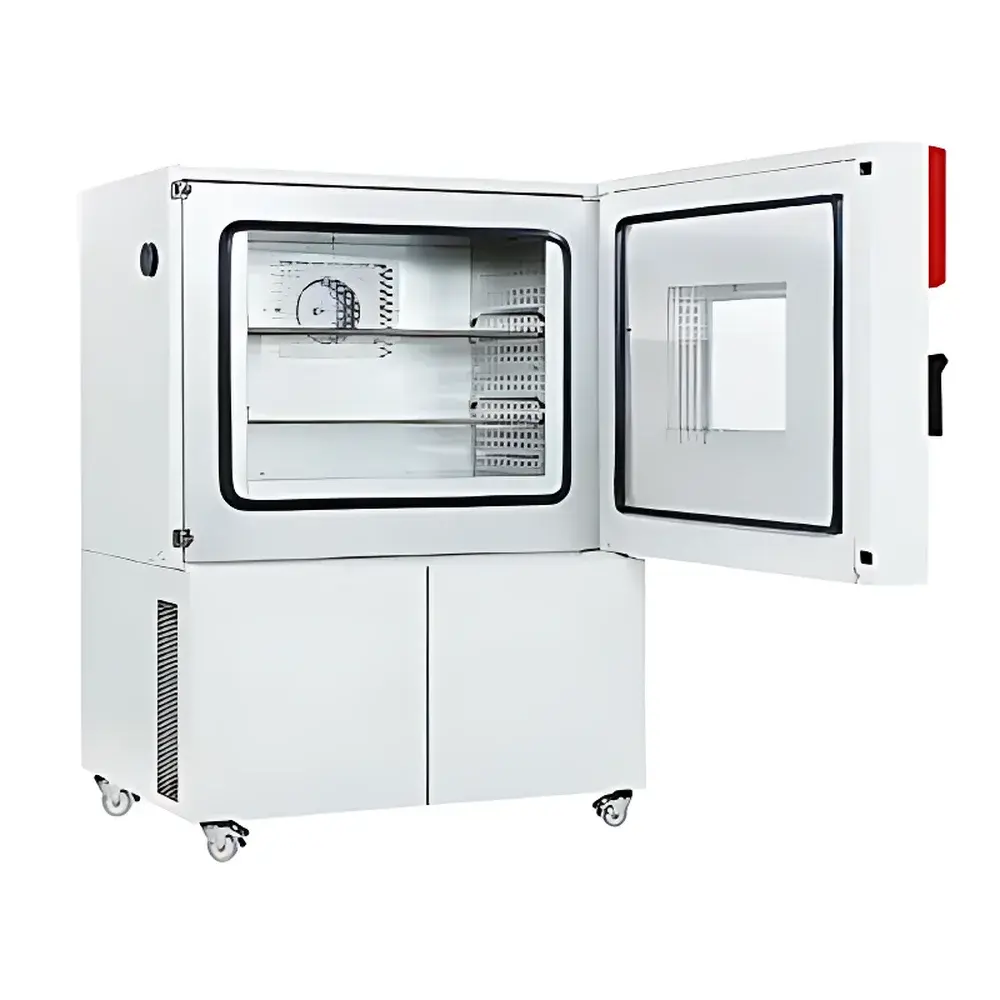
BINDER MK Series Environmental Simulation Chambers
| Brand | BINDER |
|---|---|
| Origin | Germany |
| Model Series | MK |
| Temperature Range (Standard) | −40 °C to +180 °C |
| Temperature Range (Low-Temp Variant, MKT/MKFT) | −70 °C to +180 °C |
| Humidity Range (MKF/MKFT) | 10 %RH to 98 %RH |
| Humidity-Enabled Temp Range | +10 °C to +95 °C |
| Available Interior Volumes | 53 L, 115 L, 240 L, 720 L |
| Control System | MCSE microprocessor controller with APT.line® preheating technology |
| Programmability | 25 stored programs, up to 100 segments per program (max. 500 total segments) |
| Interface Options | Ethernet or RS-422 (APT-COM software compatible) |
| Safety | Dual-stage temperature safety device (DIN 12880), audible/visual alarm |
| Refrigerant | R404A (environmentally compliant) |
| Standard Accessories | 1 stainless steel shelf, heated observation window with interior lighting, built-in electronic chart recorder, condensation protection for test specimens |
Overview
The BINDER MK Series Environmental Simulation Chambers are precision-engineered climate test systems designed for rigorous thermal and climatic validation in research laboratories, quality assurance departments, and industrial R&D facilities. Built in Tuttlingen, Germany, these chambers implement a robust forced-air convection architecture combined with BINDER’s proprietary APT.line® preheating technology — an electronically controlled inner chamber wall heating system that eliminates thermal gradients and ensures exceptional temperature uniformity (±0.3 °C typical across working volume) and stability (±0.1 °C over time). The MK platform encompasses four distinct subfamilies — MK (dry thermal cycling), MKF (temperature + humidity), MKT (ultra-low-temperature), and MKFT (ultra-low-temperature + humidity) — each engineered to meet the stringent requirements of international standards including DIN EN 60068-2, IEC 60068-3, ISO 16750-4, and ASTM D4329 for accelerated aging and environmental stress screening.
Key Features
- APT.line® preheated inner chamber walls ensure rapid thermal equilibration and minimize vertical/horizontal temperature deviations — critical for repeatable material response testing.
- MCSE microcontroller with intuitive color LCD interface, multilingual menu navigation, and real-time graphical display of temperature, humidity, and ramp profiles.
- Dual-stage independent temperature safety system (DIN 12880-compliant) with configurable setpoints and integrated acoustic-optical alarm for process integrity monitoring.
- Capacitive humidity sensor with PID-controlled steam humidification and refrigerative dehumidification (MKF/MKFT models), enabling precise RH regulation from 10 %RH to 98 %RH within defined temperature bands.
- Environmentally optimized refrigeration circuit using R404A refrigerant, validated for long-term reliability at extreme low-temperature setpoints down to −70 °C (MKT/MKFT).
- Programmable condensation protection logic prevents moisture accumulation on sensitive test specimens during cooling ramps or humidity transitions.
- Built-in electronic chart recorder with timestamped data logging; exportable via APT-COM software through Ethernet or RS-422 interface for audit-ready documentation.
- Heated, double-glazed observation window with LED interior lighting enables non-intrusive visual monitoring without thermal disturbance.
Sample Compatibility & Compliance
The MK Series accommodates diverse sample geometries and material classes — including polymer composites, electronic assemblies, automotive components, pharmaceutical packaging, and aerospace-grade alloys — across standardized test volumes (53 L to 720 L). All models comply with essential electrical safety directives (IEC 61010-1), electromagnetic compatibility (EN 61326-1), and are supplied with factory-issued BINDER calibration certificates traceable to national standards. For regulated environments, optional IQ/OQ documentation packages support GLP and GMP compliance; APT-COM software supports 21 CFR Part 11–compliant user access control, electronic signatures, and audit trail generation when deployed in FDA-regulated labs.
Software & Data Management
APT-COM software provides full remote configuration, real-time monitoring, and post-test analysis capabilities. Users can define complex multi-segment profiles — including variable ramp rates, dwell times, and humidity transitions — with full version history and parameter locking. Data export is supported in CSV, PDF, and XML formats; trend plots include overlay comparisons across multiple test runs. The system logs all operator actions, alarm events, and environmental deviations with ISO 8601 timestamps, satisfying traceability requirements under ISO/IEC 17025 and internal QA protocols.
Applications
- Accelerated aging of plastics and elastomers per ISO 188 and ASTM D573.
- Thermal shock testing of PCBs and microelectronics (JEDEC JESD22-A104).
- Stability testing of medical devices and sterile packaging (ISO 11607-1).
- Validation of battery thermal management systems under dynamic charge/discharge cycles.
- Corrosion resistance evaluation of coated metals (ISO 9227 salt spray correlation studies).
- Pre-conditioning of optical sensors and MEMS devices prior to functional testing.
FAQ
What is the difference between MKF and MKFT models?
MKF chambers operate from −40 °C to +180 °C with humidity capability (10–98 %RH); MKFT extends the low-temperature limit to −70 °C while retaining full humidity functionality.
Can the chamber be integrated into a central laboratory monitoring system?
Yes — standard Ethernet or RS-422 interfaces enable seamless integration with LIMS, SCADA, or building management systems using Modbus TCP or ASCII protocol.
Is validation support available for GxP environments?
BINDER offers optional IQ/OQ documentation kits and on-site qualification services aligned with Annex 15 and USP analytical instrument qualification principles.
How is temperature uniformity verified across the working volume?
Uniformity is validated per DIN EN 60068-3-5 using nine calibrated PT100 sensors placed at standardized locations; results are documented in the出厂 certificate.
What maintenance intervals are recommended for optimal performance?
Compressor oil and filter replacement every 24 months; humidity sensor recalibration annually; door gasket inspection quarterly — all procedures detailed in the technical manual and supported by BINDER’s global service network.



