
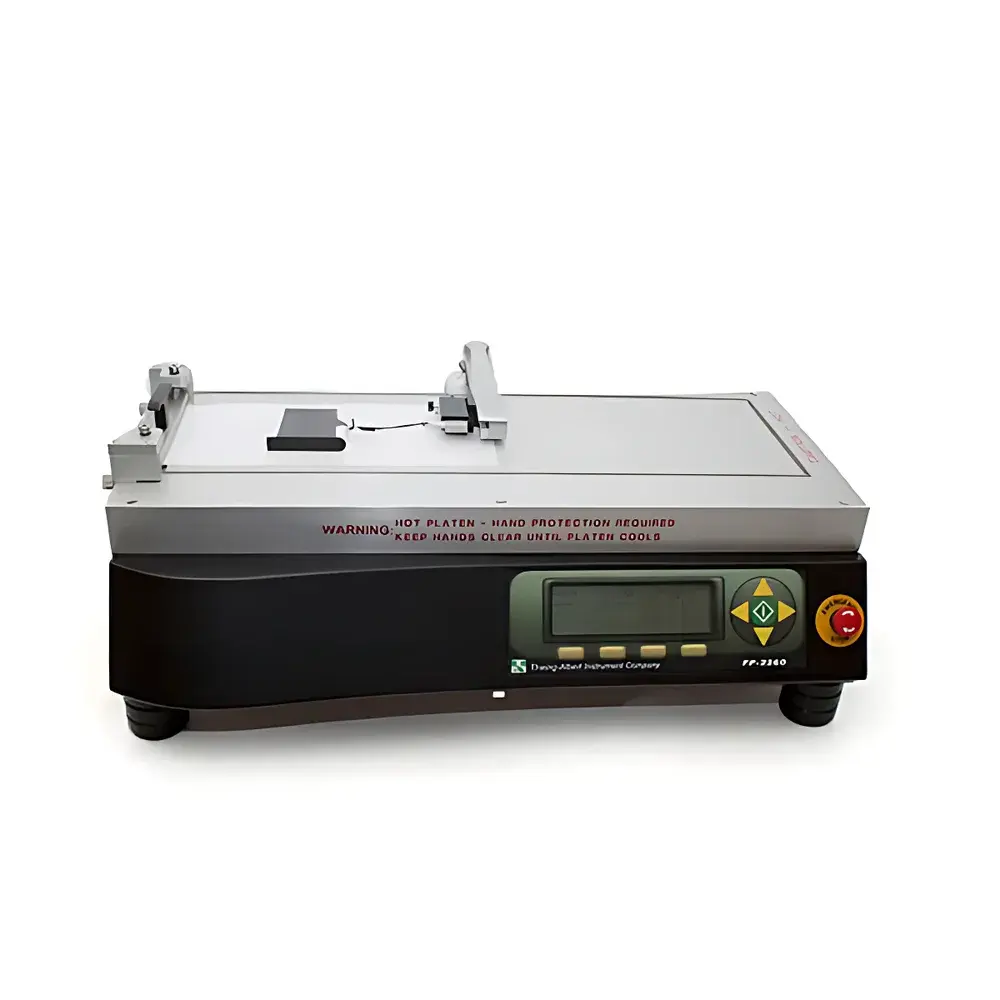
Thwing-Albert FP-2260 Heated Coefficient of Friction and Peel Tester
| Origin | USA |
|---|---|
| Manufacturer Type | Authorized Distributor |
| Origin Category | Imported |
| Model | FP-2260 |
| Price Range | USD 42,000 – 70,000 |
| Instrument Type | Electromechanical Universal Testing System |
| Temperature Range | 21–176.7 °C (70–350 °F) |
| Maximum Load Capacity | 10 kgf (22 lbf) |
| Crosshead Travel | 355 mm (14 in) |
| Test Area | 225 mm × 350 mm |
| Load Cell Options | 1, 2, 5, and 10 kgf |
| Display | 240 × 64 pixel LCD |
| Data Storage | 128 test records |
| Communication Interfaces | USB & RS-232 |
| Compliant Standards | ASTM D1894, D4521, D2534, D6862, D6252, D3330, D1876, F88 |
Overview
The Thwing-Albert FP-2260 is a benchtop electromechanical testing system engineered for precision measurement of coefficient of friction (COF), peel adhesion, seal strength, and light-duty tensile properties of flexible packaging materials and thin substrates. Its core architecture implements a servo-controlled crosshead drive with load cell–based force transduction and integrated heated platens—enabling controlled thermal conditioning during dynamic mechanical testing. Unlike general-purpose universal testers, the FP-2260 is purpose-built for standardized tribological and interfacial adhesion evaluation per globally recognized test methods, including ASTM, ISO, TAPPI, and PSTC protocols. The system operates on a fixed-frame, single-column design with vertically adjustable platen spacing and programmable crosshead speed (0.1–1200 mm/min), ensuring repeatability across COF sliding, 90°/180°/T-peel, and heat-seal strength measurements under defined thermal and mechanical boundary conditions.
Key Features
- Heated upper platen with precise temperature control from 21 °C to 176.7 °C (70–350 °F), enabling simulation of real-world processing and storage conditions for thermoplastic films, laminates, and coated substrates.
- Modular load cell system supporting interchangeable transducers (1, 2, 5, and 10 kgf) with automatic recognition—eliminating manual calibration offsets and ensuring traceable force resolution across test ranges.
- Dual-axis crosshead adjustment (vertical and lateral) for accurate specimen alignment and consistent contact geometry during COF and peel tests.
- Integrated electronic over-travel protection and programmable auto-return functionality to safeguard instrumentation and ensure repeatable start positions between tests.
- High-contrast monochrome LCD display (240 × 64 pixels) with intuitive membrane keypad interface—designed for glove-compatible operation in production or QC lab environments.
- Onboard data logging for up to 128 complete test records, including peak force, average force, standard deviation, and time-stamped event markers.
- Multi-unit force reporting (g, kgf, lbf, ozf, N) and preloaded industry-standard test templates—including ASTM D1894 (plastic film COF), ASTM F88 (seal strength), and ISO 8295—reducing method setup time and operator error.
Sample Compatibility & Compliance
The FP-2260 accommodates a broad spectrum of thin, flexible materials used in packaging, labeling, and converting industries: biaxially oriented polypropylene (BOPP), polyester (PET), polyethylene (PE), metallized films, paperboard laminates, pressure-sensitive adhesives (PSAs), wax-coated corrugated board, textile nonwovens, and leather substrates. Its 225 mm × 350 mm test surface area supports full-width web samples and standardized strip specimens per ASTM and ISO dimensions. All mechanical and thermal subsystems are designed and validated to meet GLP-relevant operational integrity requirements. While not inherently 21 CFR Part 11–compliant out-of-the-box, the system’s deterministic test execution, timestamped data capture, and audit-ready parameter logging provide foundational traceability for regulated environments when paired with validated third-party software solutions.
Software & Data Management
The FP-2260 operates as a standalone instrument with embedded firmware governing motion control, thermal regulation, force acquisition, and statistical calculation. Raw and processed data are exportable via USB mass-storage mode or RS-232 serial protocol to external PCs running spreadsheet applications or LIMS-integrated data ingestion tools. Test parameters—including speed profile, dwell time, temperature setpoint, and pass/fail thresholds—are stored locally and recalled by user-defined ID. For laboratories requiring electronic signatures, audit trails, or automated report generation, Thwing-Albert offers optional PC-based software packages that extend functionality to include real-time graphing, multi-curve overlay, batch statistical analysis (X̄/R charts), and PDF/CSV report templating aligned with ISO/IEC 17025 documentation expectations.
Applications
- Static and kinetic COF characterization of plastic films under elevated temperature—critical for high-speed packaging line performance validation.
- 90° and 180° peel adhesion assessment of pressure-sensitive label stocks per ASTM D6252 and PSTC 101.
- T-peel strength evaluation of laminated flexible barrier structures (e.g., PET/Alu/PE pouches) per ASTM D1876.
- Hot-tack and seal strength quantification of heat-sealed polymer interfaces using ASTM F88-compliant fixtures and thermal ramp profiles.
- Light-load tensile testing (≤10 kgf) of narrow-width tapes, ribbons, and thin gauge foils where conventional UTM fixtures introduce excessive bending moments.
- Quality conformance verification for suppliers operating under TLMI, FINAT, or AFERA technical specifications in global packaging supply chains.
FAQ
Does the FP-2260 support both static and dynamic coefficient of friction measurements?
Yes—the system executes ASTM D1894-compliant sliding protocols with programmable dwell time, traverse speed, and load application to differentiate static (breakaway) and kinetic (sliding) friction values.
Can the heated platen operate at ambient temperature without activation?
Yes—the platen remains mechanically functional at room temperature; heating is an optional, independently controlled subsystem.
Is calibration traceable to NIST or other national metrology institutes?
Load cells are supplied with individual calibration certificates traceable to NIST standards; thermal calibration is performed using certified RTD probes per ASTM E74 and ISO 17025 guidelines.
What maintenance is required for long-term accuracy?
Annual verification of force transduction linearity and thermal uniformity across the platen surface is recommended; no routine lubrication or mechanical adjustment is required due to the sealed crosshead drive and solid-state actuation.
Are custom fixtures available for non-standard test geometries?
Yes—Thwing-Albert provides engineering support for application-specific fixture design, including modified peel jigs, seal bar configurations, and multi-point COF sleds compliant with internal or customer-defined specifications.
Related Products



