
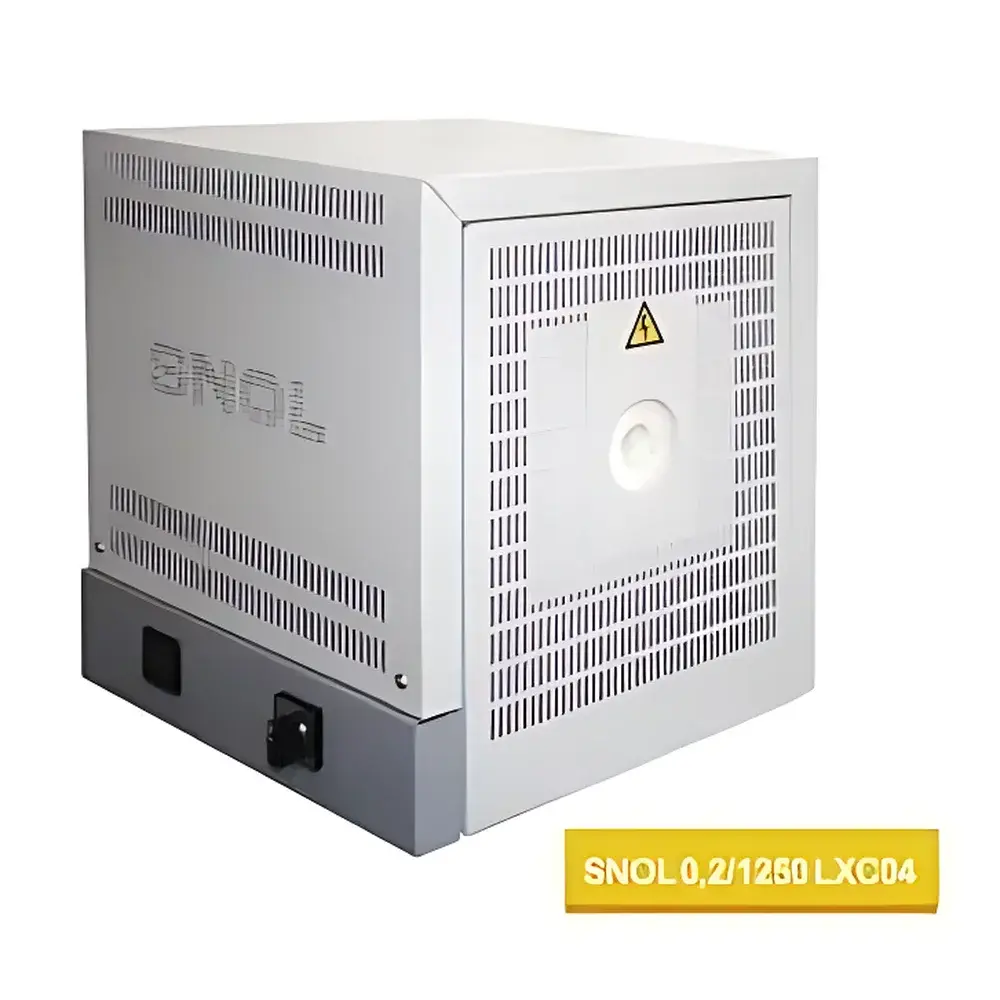
SNOL LXC04 1250 Series Horizontal Tube Furnace
| Origin | Imported |
|---|---|
| Manufacturer Type | Authorized Distributor |
| Model | SNOL LXC04 1250 Series |
| Instrument Type | Horizontal Tube Furnace |
| Max Operating Temperature | 1250 °C |
| Chamber Volume | 0.2–0.5 L |
| Tube Inner Diameter | 35–58 mm |
| Tube Length (Heated Zone) | 190 mm |
| External Dimensions (W×D×H) | 500×550×525 mm |
| Power Rating | 3.7 kW |
| Net Weight | 38 kg |
| Control Interface | RS232 / RS-485 / USB |
| Temperature Uniformity | ±5 °C (within heated zone) |
| Heating/Cooling Rate | Programmable, up to 20 °C/min (heating), natural convection cooling |
| Thermal Insulation | High-purity alumina fiber ceramic insulation |
| Temperature Sensor | Type S thermocouple (calibration traceable to NIST standards) |
| Compliance | CE-marked, conforms to IEC 61000-6-3 (EMC), IEC 61000-6-2 (immunity), EN 60519-1 (safety for industrial electroheating equipment) |
Overview
The SNOL LXC04 1250 Series is a precision-engineered horizontal tube furnace designed for controlled high-temperature thermal processing in research laboratories, academic institutions, pharmaceutical development labs, and advanced materials manufacturing facilities. Operating up to 1250 °C, it employs resistive heating elements embedded within a multi-layer ceramic fiber insulation structure—ensuring exceptional thermal efficiency, rapid heat-up (≤20 °C/min typical), and stable temperature maintenance (<±1 °C drift over 8 h at 1100 °C). The furnace utilizes a high-purity alumina-tube chamber (ID: 35–58 mm; heated length: 190 mm), optimized for inert, reducing, or vacuum atmospheres (compatible with standard quartz or recrystallized alumina tubes). Its horizontal orientation enables reproducible sample placement, uniform axial temperature gradients, and seamless integration with gas delivery systems (e.g., mass flow controllers, purge lines) and in-situ monitoring accessories.
Key Features
- Microprocessor-based PID controller with dual-loop regulation (setpoint + thermocouple feedback), supporting ramp-soak programming with up to 32 segments
- Ceramic fiber insulation (density: 128 kg/m³, service temperature: 1300 °C) minimizing thermal mass and enabling low energy consumption (~3.7 kW nominal)
- Integrated over-temperature protection via independent safety thermocouple and cut-off relay (EN 60519-1 compliant)
- Digital timer with auto-shutdown function and audible alarm for process completion or fault conditions
- RS232, RS-485, and USB interfaces for bidirectional communication with LabVIEW™, MATLAB®, or custom SCADA platforms
- NIST-traceable temperature calibration certificate (optional, includes as-found/as-left data per ISO/IEC 17025 requirements)
- Electrostatically applied RAL 7035 light gray powder coating on steel housing—resistant to thermal oxidation and lab chemical splashes
- Modular design: furnace body mounts securely to optional heavy-duty steel support table (included in full system configurations)
Sample Compatibility & Compliance
The LXC04 accommodates cylindrical samples up to 58 mm in diameter and 190 mm in length within its uniformly heated zone. Compatible with standard quartz, fused silica, or high-purity alumina tubes (OD ≤ 60 mm), it supports atmospheric control via flanged end-caps with Swagelok®-type fittings. All electrical and thermal safety architecture complies with CE directives, including EN 61000-6-2 (electromagnetic immunity), EN 61000-6-3 (emission limits), and EN 60519-1 (safety of industrial electroheating equipment). Optional data logging meets FDA 21 CFR Part 11 requirements when paired with validated software—enabling audit trails, electronic signatures, and ALCOA+ data integrity principles for GMP/GLP environments.
Software & Data Management
Furnace operation is managed via SNOL’s proprietary FurnaceControl Suite (Windows-based), supporting real-time temperature profiling, remote parameter adjustment, and automated report generation (PDF/CSV). The software records timestamped thermocouple readings at user-defined intervals (1 s–60 min), stores calibration logs, and exports raw data compatible with ASTM E230/E2022-compliant thermal analysis workflows. When configured with the optional data logger module, all measurements are stored internally (SD card) with battery-backed memory—ensuring continuity during power interruption. Audit trail functionality includes operator ID, parameter changes, alarm events, and calibration history—fully aligned with ISO 17025 clause 7.7 and USP analytical instrument qualification protocols.
Applications
- Sintering of ceramic powders (e.g., ZrO₂, Al₂O₃, SiC) under controlled oxygen partial pressure
- Thermal annealing of thin-film photovoltaic substrates (CIGS, perovskites) and semiconductor wafers
- Calcination of catalyst precursors (e.g., Ni/Al₂O₃, Co-Mo/Al₂O₃) prior to sulfidation
- Heat treatment of metallic alloys (Ti-6Al-4V, Inconel® 718) for microstructural homogenization
- Pyrolysis studies of polymers and biomass feedstocks under nitrogen or argon
- Pre-oxidation of graphite crucibles and high-temperature sensor housings
- Material stability testing per ASTM E1131 (TGA coupling) and ISO 11358 (thermogravimetric analysis)
FAQ
What atmosphere types can be used with the LXC04 series?
The furnace is rated for operation under inert (N₂, Ar), reducing (H₂/N₂ mixtures), and vacuum conditions (down to 10⁻² mbar with optional pump integration). Quartz tubes are standard; recrystallized alumina tubes enable extended use above 1100 °C.
Is the temperature uniformity validated across the heated zone?
Yes—uniformity is characterized per ASTM E220 and documented in the factory acceptance test (FAT) report: ±5 °C over the central 190 mm length at 1250 °C, measured using a 5-point traversing thermocouple array.
Can the furnace be integrated into an automated production line?
Absolutely—the RS-485 Modbus RTU interface supports PLC-level integration for sequence control, interlock signaling, and status monitoring within Industry 4.0 architectures.
What maintenance is required for long-term reliability?
Annual verification of thermocouple accuracy and insulation integrity is recommended. No routine element replacement is needed—SiC heating elements exhibit >5,000 h lifetime at 1200 °C under continuous operation.
Does SNOL provide IQ/OQ documentation packages?
Yes—validated installation qualification (IQ) and operational qualification (OQ) protocols are available upon request, compliant with ISO 9001:2015 and EU Annex 15 guidelines for regulated laboratories.



