
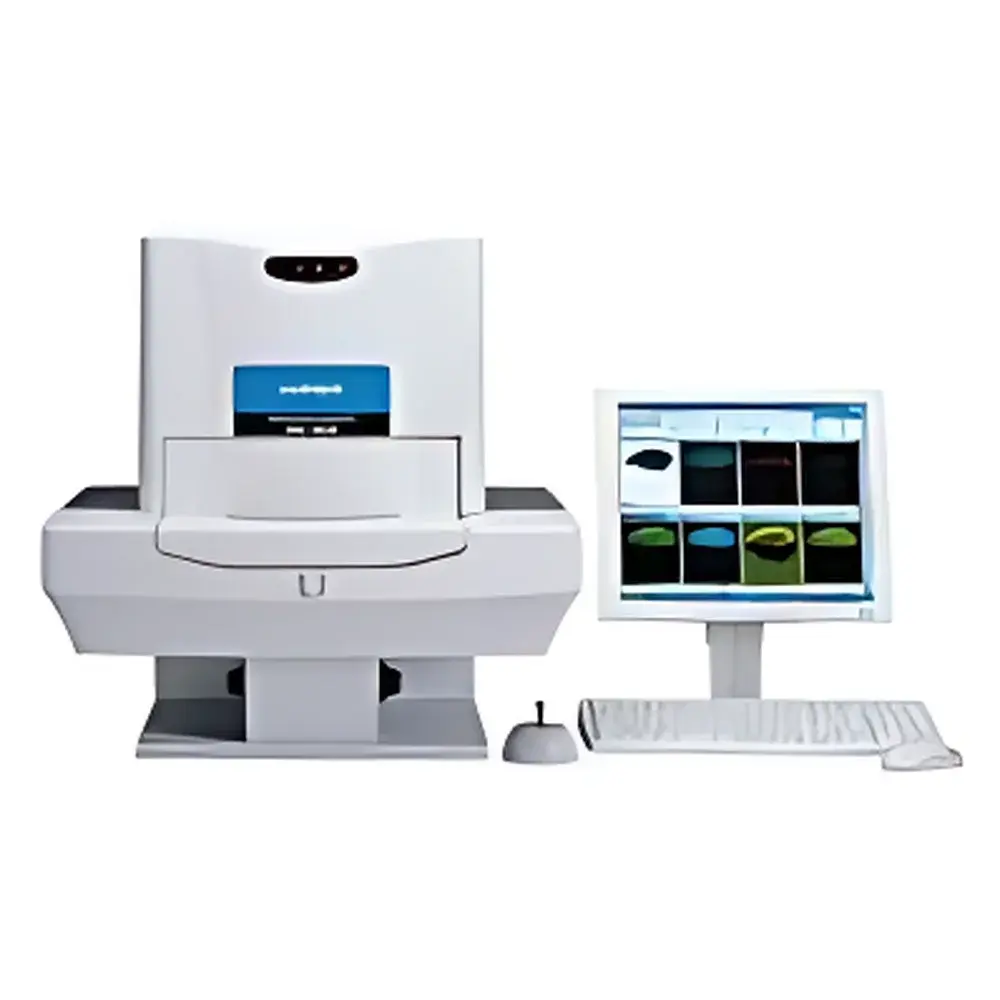
Horiba XGT-5200 Energy-Dispersive X-Ray Fluorescence Microscope
| Origin | Japan |
|---|---|
| Manufacturer Type | Authorized Distributor |
| Origin Category | Imported |
| Model | XGT-5200 |
| Price Range | USD 42,000–70,000 (FOB) |
| Instrument Type | Scanning Micro-XRF |
| X-Ray Tube Power | 50 kV / 1 mA |
| Target Material | Rhodium (Rh) |
| Detectable Elements | Na (Z=11) to U (Z=92) |
| Primary Beam Spot Sizes | 10, 50, 100, 400 µm, 1.2 mm, 3 mm |
| Detector | Silicon Drift Detector (SDD) |
| Sample Stage | 100 × 100 mm (standard), up to 200 × 200 mm (optional) |
| Sample Chamber Dimensions | 400 × 350 × 40 mm (customizable) |
| Optical Imaging | Macro-view 100 × 100 mm (400K pixels standard |
| Analysis Modes | Qualitative (auto-identification, ROI color mapping, background subtraction, spectral matching) and Quantitative (Fundamental Parameters Method, calibration curve, Cl/thickness/wire compensation) |
| Data Export | Excel®-compatible reporting module |
| Power Supply | AC 100/120/220/240 V, 50/60 Hz |
| Weight | ~280 kg |
| Dimensions (W×D×H) | 680 × 833 × 670 mm |
Overview
The HORIBA XGT-5200 is a high-resolution energy-dispersive X-ray fluorescence (ED-XRF) microscope engineered for non-destructive, spatially resolved elemental analysis at the microscale. Unlike wavelength-dispersive systems (WDXRF), the XGT-5200 employs a high-brightness Rh-target microfocus X-ray tube (50 kV / 1 mA) coupled with a large-area silicon drift detector (SDD) to deliver rapid, high-count-rate spectral acquisition across the full detectable range—from sodium (Na, Z = 11) to uranium (U, Z = 92). Its core architecture integrates confocal micro-XRF scanning with synchronized optical microscopy, enabling simultaneous morphological observation and quantitative elemental mapping under ambient atmospheric conditions—eliminating the need for vacuum or inert gas purging in most routine applications. Designed for materials science laboratories, electronics failure analysis, RoHS/REACH compliance screening, and geological sample characterization, the XGT-5200 operates as a benchtop analytical platform that bridges the performance gap between conventional ED-XRF spectrometers and synchrotron-based microprobes.
Key Features
- Multi-scale excitation: Six selectable X-ray beam spot sizes (10 µm to 3 mm) support both high-spatial-resolution microanalysis and macro-area survey scans without hardware reconfiguration.
- Coaxial optical imaging system: Integrated 100× magnification lens aligned with the X-ray optic axis ensures precise correlation between visual features and elemental distribution—critical for defect localization and phase identification.
- Large-format motorized stage: Standard 100 × 100 mm XY travel enables automated raster scanning of industrial samples (e.g., PCBs, coated foils, thin-film substrates); optional 200 × 200 mm stage accommodates larger specimens.
- Atmospheric operation: Full-element analysis (Na–U) performed in air—no vacuum pump required—reducing operational overhead and increasing throughput for routine QA/QC workflows.
- Advanced SDD detector: High-energy resolution (50 mm²), and liquid-nitrogen-free Peltier cooling ensure stable count rates and low detection limits (sub-ppm achievable for heavy elements on optimized matrices).
- Rh anode X-ray source: Optimized for enhanced sensitivity across mid-Z to high-Z elements (e.g., Cr, Ni, Cu, Zn, Pb, Cd), with minimal Bremsstrahlung background and superior signal-to-noise ratio compared to W or Mo targets.
Sample Compatibility & Compliance
The XGT-5200 accepts heterogeneous solid and liquid samples—including polymers, metals, paper, paints, biological tissues (fixed or frozen), and coated substrates—without destructive preparation. Liquid samples are analyzed using optional sealed sample cups compatible with ISO 18562-3 and ASTM E1621 protocols. The instrument’s atmospheric chamber (400 × 350 × 40 mm internal volume) supports custom fixtures for irregular geometries, and its modular design permits integration into GLP/GMP environments. Software includes audit-trail logging compliant with FDA 21 CFR Part 11 requirements when paired with validated Excel® data management modules. All quantitative methods (FPM and calibration curve) adhere to ISO 22085, IEC 62321-5, and JIS Z 3211 standards for restricted substance testing in electrical and electronic equipment.
Software & Data Management
HORIBA’s proprietary XGT Analysis Studio provides intuitive workflow-driven operation—from condition setup and auto-focus alignment to multi-layered elemental mapping and statistical overlay. Qualitative analysis leverages library-matched peak identification with background-subtracted spectra and region-of-interest (ROI) color assignment for immediate visual interpretation. Quantitative modules implement matrix-corrected Fundamental Parameters Method (FPM) with optional Cl-compensation for halogen-rich polymers, thickness compensation for layered structures (e.g., plating on PCBs), and wire geometry correction for stranded conductors. All measurement parameters, spectra, maps, and reports are timestamped and stored in a relational database. Optional Excel® export supports automated report generation compliant with internal QA templates and external regulatory submissions (e.g., IPC-1752A, EU Declaration of Conformity).
Applications
- RoHS/REACH screening of electronic components for regulated elements (Pb, Cd, Hg, Cr⁶⁺, Br, Cl) at trace levels in solder joints, connectors, and conformal coatings.
- Failure analysis of corrosion products, intermetallic phases, and contamination layers on semiconductor packaging and MEMS devices.
- Elemental stratigraphy of cross-sectioned battery electrodes, catalyst layers, and thin-film photovoltaic stacks.
- Forensic material comparison of paint chips, ink formulations, and polymer additives via spectral fingerprinting and spatial correlation.
- Geochemical mapping of mineral inclusions in ore samples and sediment cores without carbon coating or vacuum exposure.
- Quantitative depth profiling of electroplated alloys (e.g., Ni–Au, Sn–Cu) using variable-spot-size step-scan mode and iterative matrix correction.
FAQ
Can the XGT-5200 analyze light elements below sodium (e.g., C, N, O)?
No—the instrument’s atmospheric operation and Be-window SDD limit reliable detection to Na (Z=11) and heavier elements. Light element analysis requires vacuum or He-purged environments not supported by this configuration.
Is spectral deconvolution automated during qualitative analysis?
Yes—peak identification uses iterative least-squares fitting with interference correction based on fundamental atomic parameters and empirical line-shape models. Users may manually refine peak assignments using spectrum overlay tools.
Does the system support automated calibration verification?
Yes—predefined check standards (e.g., NIST SRM 2711a, certified multielement reference materials) can be scheduled for periodic verification. Results are logged with pass/fail criteria configurable per element and concentration range.
What sample height tolerance does the stage accommodate?
The Z-axis focus range spans ±5 mm around the nominal focal plane, with auto-focus capability across surface variations up to 2 mm peak-to-valley—suitable for rough castings, textured coatings, and multi-level PCBs.
Are method transfer files compatible across XGT-series instruments?
Yes—analysis methods (.xgtm files), including beam conditions, ROI definitions, and quantification parameters, are fully portable between XGT-5200, XGT-9000, and XGT-9100 platforms running version 4.2 or later firmware.





