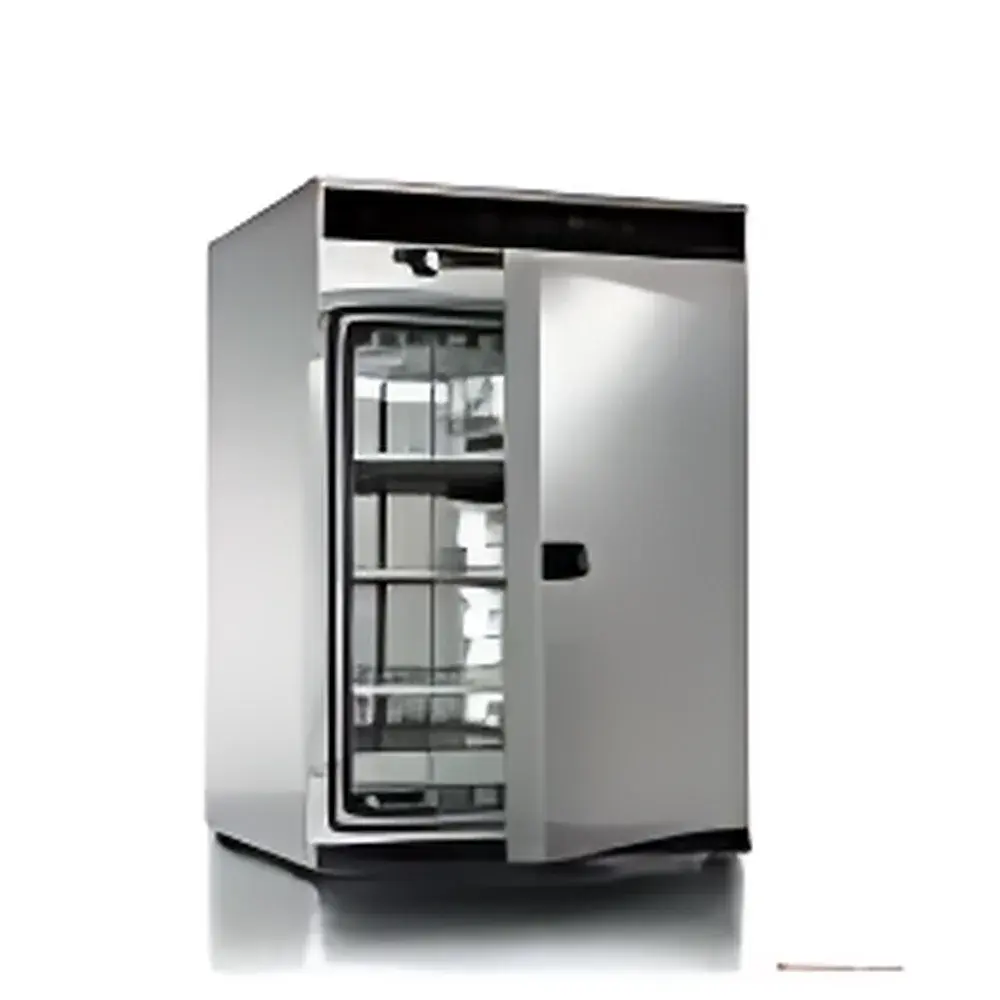
MEMMERT INC153 Carbon Dioxide Incubator
| Origin | Germany |
|---|---|
| Manufacturer Type | Authorized Distributor |
| Origin Category | Imported |
| Model | INC153 |
| Pricing | Upon Request |
Overview
The MEMMERT INC153 Carbon Dioxide Incubator is a precision-engineered, high-reliability cell culture environment system designed for demanding life science laboratories requiring strict control of temperature, CO₂ concentration, and relative humidity. Built upon MEMMERT’s decades-long heritage in German engineering excellence, the INC153 employs an advanced gas-tight chamber architecture with a mineral wool-insulated double-wall jacket — a thermally optimized hybrid solution that combines the thermal stability of traditional water-jacketed incubators with the lightweight, low-maintenance advantages of air-jacketed systems. Its core measurement and regulation system utilizes infrared (IR) CO₂ sensing technology, enabling continuous, drift-compensated monitoring with automatic zero calibration every 12 hours. Temperature is maintained via a five-sided (top, bottom, left, right, and door) uniform heating system, ensuring exceptional spatial homogeneity — critical for reproducible mammalian cell proliferation, stem cell expansion, and sensitive primary culture work.
Key Features
- Infrared (IR) CO₂ sensor with automatic zero calibration cycle every 12 hours, supporting programmable CO₂ setpoints from 0–20% (v/v) with high long-term stability
- Mineral wool-insulated double-wall jacket: delivers superior thermal inertia (>3× faster recovery after door opening vs. standard air-jacketed units), eliminates water maintenance, and prevents microbial growth inherent to water jackets
- Five-directional heating system (including door-back heating) minimizes cold spots and condensation; achieves internal temperature uniformity of ±0.3°C at 37°C and stability of ±0.1°C
- Integrated, fully automated dry-heat decontamination cycle at +160°C — sterilizes all internal surfaces, sensors (CO₂, humidity, temperature), fan assembly, and water pan without chemical agents or disassembly
- Active humidity control (88–97% RH adjustable) via electromagnetic valve and external desiccated air intake; prevents condensation during extended unattended operation (e.g., weekends)
- Dual CO₂ cylinder connection with automatic switchover and door-interlocked gas cutoff to prevent CO₂ waste and ensure operator safety
- Electropolished stainless steel interior (1.4301 / ASTM 304), fully welded, seamless chamber; corrosion-resistant, non-porous, and compliant with ISO 14644-1 Class 5 cleanroom-compatible cleaning protocols
- Triple-layer insulated stainless steel door with four-point leveling adjustment, dual mechanical locks, and integrated 8 mm sampling port in inner glass panel for real-time atmospheric analysis
Sample Compatibility & Compliance
The INC153 supports a broad range of biological samples including adherent and suspension mammalian cell lines, human embryonic stem cells (hESCs), induced pluripotent stem cells (iPSCs), primary neurons, and co-culture systems. Its sealed chamber design, HEPA-filtered air circulation (optional), and validated dry-heat sterilization protocol meet key regulatory expectations for GLP and GMP-aligned workflows. While not certified as medical devices, the system complies with IEC 61010-1 (Safety Requirements for Electrical Equipment for Measurement, Control, and Laboratory Use) and EN 61326-1 (EMC for Laboratory Equipment). Its traceable +37°C temperature calibration certificate supports audit readiness per FDA 21 CFR Part 11 when paired with compliant data logging software.
Software & Data Management
The INC153 features an intuitive, menu-driven digital interface with simultaneous on-screen display of temperature, CO₂ concentration, and relative humidity. All operational parameters — including setpoints, sterilization cycles, alarm thresholds, and calibration logs — are stored internally with time-stamped records. Optional Ethernet or RS485 connectivity enables integration into centralized lab management systems. When used with MEMMERT’s optional *memmertLink* software (Windows-based), users gain full audit-trail functionality, electronic signature support, configurable alarm notifications (email/SMS), and exportable CSV/Excel reports — facilitating compliance with ALCOA+ data integrity principles and routine quality system reviews.
Applications
- Mammalian cell culture under physiologically relevant CO₂ (5–10%) and humidified conditions
- Stem cell maintenance and differentiation studies requiring ultra-stable microenvironments
- Long-term viability assays, cytotoxicity screening, and transfection optimization
- Microbiology applications involving capnophilic organisms (e.g., Neisseria gonorrhoeae, Haemophilus influenzae)
- Regulatory-compliant bioproduction support in preclinical development labs
- Teaching and research laboratories requiring robust, low-downtime incubation platforms
FAQ
Does the INC153 require regular water refills or maintenance of a water jacket?
No — the mineral wool-insulated jacket is completely dry and maintenance-free. Unlike water-jacketed models, it eliminates risks of microbial contamination, evaporation loss, and periodic draining/filling.
How does the IR CO₂ sensor maintain accuracy over time?
The built-in IR sensor performs automatic zero calibration every 12 hours using ambient air reference, compensating for baseline drift without user intervention or external calibration gases.
Can the incubator be validated for GxP environments?
Yes — its documented temperature uniformity, CO₂ linearity, humidity repeatability, and integrated sterilization cycle support IQ/OQ/PQ protocol development. Full validation documentation packages are available upon request.
Is remote monitoring supported out of the box?
Standard configuration includes local display and event logging. Remote access requires optional hardware interface (Ethernet module) and memmertLink software license.
What safety protections are included?
Overtemperature cut-off, CO₂ overpressure relief, door-open gas shutoff, real-time fault diagnostics, and audible/visual alarms for sensor failure, temperature deviation, or humidity excursion.
Related Products