
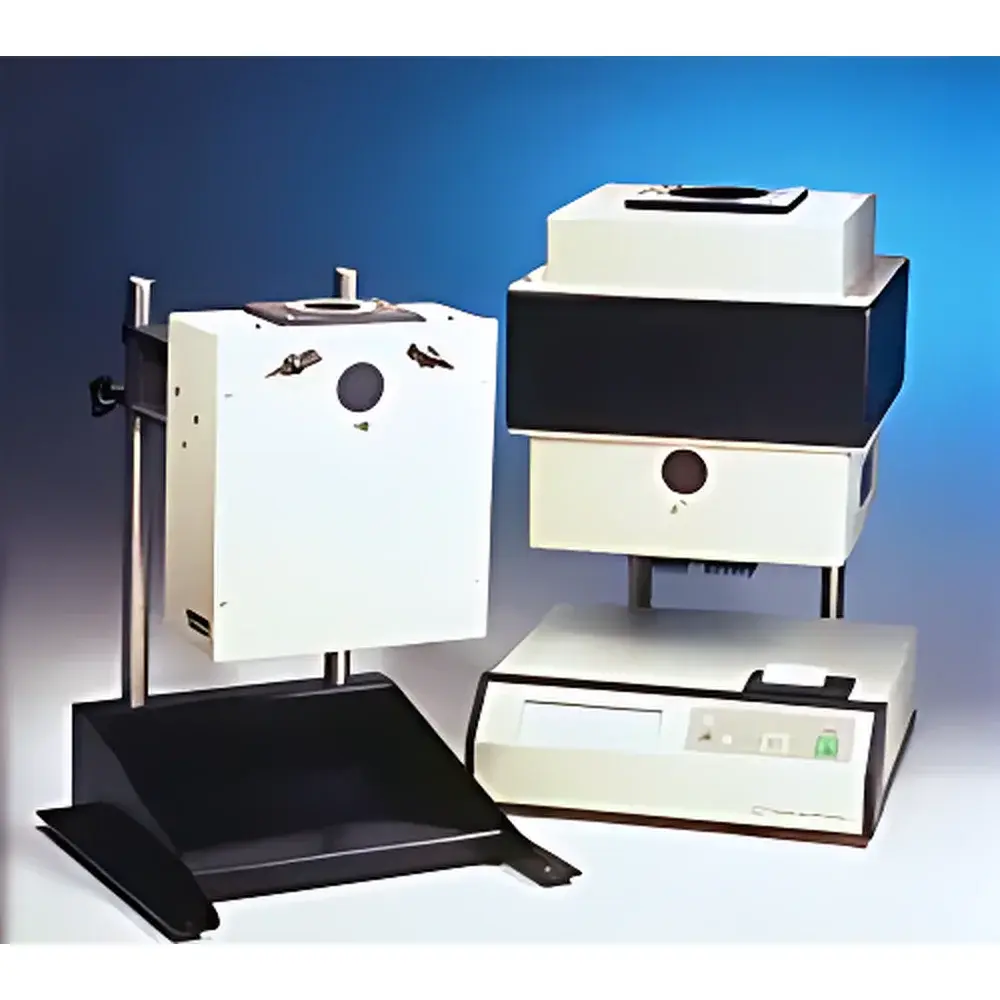
HunterLab D25/DP-9000 Benchtop Colorimeter
| Origin | USA |
|---|---|
| Manufacturer Type | Authorized Distributor |
| Origin Category | Imported |
| Model | D25/DP-9000 |
| Pricing | Upon Request |
Overview
The HunterLab D25/DP-9000 Benchtop Colorimeter is a rugged, industrial-grade color measurement system engineered for high-reproducibility reflectance color analysis under demanding production-floor conditions. Based on the 45°/0° (or 0°/45°) geometry—compliant with ASTM E308, ISO 5-4, and CIE Publication No. 15—the instrument delivers traceable, spectrophotometrically derived tristimulus values using a stabilized tungsten-halogen light source and precision optical filtering. Unlike portable or desktop-only spectrophotometers, the D25/DP-9000 architecture integrates a dedicated color processor with embedded firmware optimized for real-time calculation of CIE-compliant color spaces (e.g., CIE L*a*b*, L*C*h°), whiteness/yellowness indices (WI E313, YI D1925), and industry-specific metrics including TAPPI brightness, tomato color grade, and opacity. Its dual-test-head design (D25A and D25L) enables method-specific optical configuration without recalibration, supporting both flat, opaque substrates and textured, heterogeneous surfaces—critical for quality control in coatings, paper, food, textiles, and plastics manufacturing.
Key Features
- Ruggedized benchtop enclosure rated for continuous operation in ambient temperatures from 14 °C to 50 °C (50 °F–122 °F) and up to 85% non-condensing relative humidity
- Dual interchangeable test heads: D25A (45° dual-beam illumination, 50.8 mm Ø measurement area, adjustable down to 3.2 mm Ø) and D25L (45° annular illumination, 95.3 mm Ø area, scalable to 50.8 mm Ø) for application-matched geometry selection
- Stabilized tungsten-halogen broadband source with integrated UV cutoff filter for fluorescence-compensated measurements per ISO 11475 and ASTM D6290
- Embedded color processor executing >20 standardized color scales and indices—including CIE L*a*b*, FMC-2, ΔE*ab, ΔEcmc, WI E313, YI E313, TAPPI brightness (T 452), and Z%—in real time
- Backlit 40×8-character LCD with icon-driven menu navigation; multilingual UI supporting English, Spanish, German, French, and Italian
- Onboard memory storing up to 300 sample readings and 99 product configurations with battery-backed retention
- Integrated thermal printer (40-column) and bidirectional RS-232C interface supporting ASCII, DIF, and WK1 data export formats
Sample Compatibility & Compliance
The D25/DP-9000 accommodates a broad range of physical sample types without requiring external accessories: opaque solids (e.g., painted panels, plastic pellets), powders (e.g., pigments, pharmaceutical excipients), semi-transparent liquids (e.g., syrups, solvents), and textured surfaces (e.g., baked goods, woven fabrics, carpet). The D25A head meets ASTM D2244 (color difference), ASTM D313 (whiteness/yellowness), and TAPPI T 452 (brightness) requirements for flat, uniform materials. The D25L head satisfies ASTM D6290 (fluorescent whitening agents) and ISO 11475 (textile color evaluation) via its annular illumination, minimizing directional bias on irregular topographies. All optical paths are calibrated against NIST-traceable standards, and the system supports GLP/GMP documentation workflows through timestamped audit trails, user-access-level controls, and configurable pass/fail tolerancing per CMC (2:1) or user-defined symmetric limits.
Software & Data Management
While the D25/DP-9000 operates autonomously via its front-panel interface, its RS-232C port enables seamless integration into centralized QC databases or LIMS environments. Raw output includes XYZ, L*a*b*, and index values formatted in ASCII for direct ingestion into Excel, LabView, or custom MES platforms. The WK1 format ensures compatibility with legacy HunterLab software suites such as EasyMatch QC and Universal Software. All stored measurements retain full metadata: date/time stamp, operator ID (if configured), test head ID, illuminant/observer setting (C/2° standard), and tolerance status. Statistical reporting—mean, standard deviation, min/max, and range—is computed onboard for up to 30 consecutive readings, eliminating post-acquisition spreadsheet manipulation.
Applications
- Paint & Coatings: Batch-to-batch color consistency verification against master standards; spectral drift monitoring across production shifts
- Paper & Pulp: TAPPI brightness trending, yellowness index tracking during bleaching process optimization
- Food & Beverage: Tomato redness grading (USDA Class A/B/C), baked-good crust color uniformity, syrup clarity assessment
- Plastics & Polymers: Pigment dispersion validation, heat-induced yellowing quantification (YI D1925), recycled-content color matching
- Pharmaceuticals: Tablet coating homogeneity per USP , excipient color stability under accelerated aging protocols
FAQ
What illuminant and observer combination does the D25/DP-9000 use by default?
The system is factory-configured for Illuminant C and the 2° Standard Observer per CIE 1931, but users may select alternative illuminants (e.g., D65) and observers (10°) via firmware update if required for specific regulatory submissions.
Is the instrument compliant with FDA 21 CFR Part 11 for electronic records?
While the standalone D25/DP-9000 lacks built-in electronic signature or audit trail encryption, its timestamped ASCII/WK1 exports and configurable operator ID fields support Part 11 compliance when integrated with validated third-party LIMS or QC software platforms.
Can the D25A and D25L test heads be interchanged without recalibration?
Yes—each test head contains its own calibrated optical module and communicates its unique identification and calibration coefficients to the main processor upon connection, enabling plug-and-play switching with no user recalibration required.
What is the short-term repeatability specification for XYZ values?
Based on 20 consecutive measurements of a stable white tile under controlled conditions, the instrument achieves XYZ standard deviation ≤ 0.02, meeting ISO 13655:2017 repeatability criteria for industrial colorimeters.
Does the system support measurement of fluorescent materials?
Yes—the optional UV cutoff filter can be removed to enable excitation of fluorescent whitening agents (FWAs); measurements are then reported using the CIE 15:2004 two-measurement method (with and without UV) for accurate fluorescence correction.




