
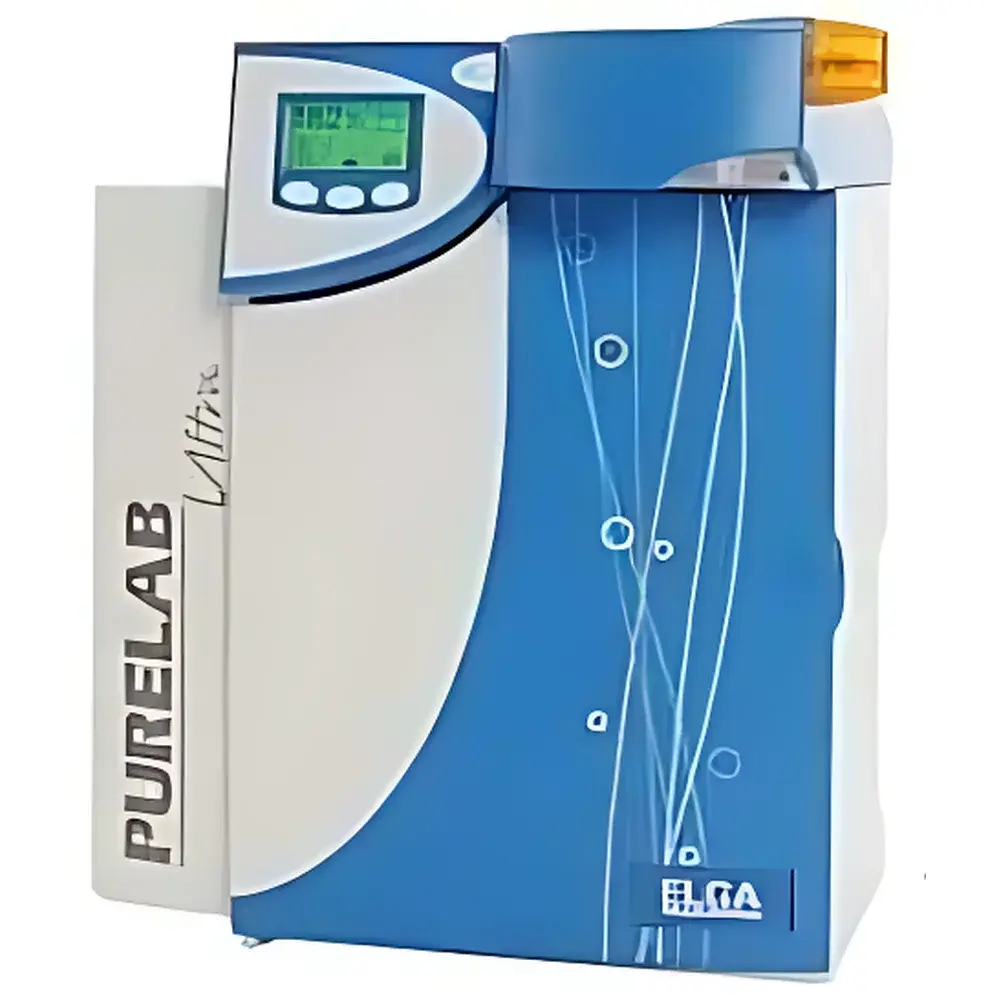
ELGA PURELAB Ultra Series Ultra Pure Water System
| Brand | ELGA (Veolia) |
|---|---|
| Origin | United Kingdom |
| Model | PURELAB Ultra Genetic / Bioscience / Analytic / Ionic / Scientific |
| Purified Water Grade | Type I (ASTM D1193-20) |
| Resistivity | 18.2 MΩ·cm at 25 °C |
| Heavy Metals & Soluble Silica | ≤0.1 ppm |
| Total Organic Carbon (TOC) | 1–3 ppb (Analytic), 1–2 ppb (Genetic), 3–10 ppb (Bioscience/Scientific/Ionic) |
| Microbial Count | <1 CFU/mL |
| Endotoxins | <0.001 EU/mL (Genetic & Bioscience only) |
| Particulates (>0.1 µm) | Removed via ultrafiltration |
| UV Wavelengths | 185 nm (photo-oxidation) and 254 nm (germicidal) |
| Flow Rate | Adjustable from dropwise to 2 L/min, programmable dispensing in 0.1 L increments |
| Data Logging | GLP-compliant column tracking, batch history, audit trail, PIN-secured operation |
| Compliance | Meets ISO 3696:1987, ASTM D1193-20, CLSI EP21-A, USP <1231>, and supports FDA 21 CFR Part 11 readiness |
Overview
The ELGA PURELAB Ultra Series represents a generation of modular, application-optimized ultra pure water systems engineered for laboratories requiring consistent, trace-level purity across diverse analytical, life science, and quality control workflows. Utilizing multi-stage purification architecture—including reverse osmosis pre-treatment, dual-stage ion exchange, integrated 185/254 nm UV photo-oxidation, ultrafiltration, and optional endotoxin-retentive membranes—the system delivers Type I reagent water compliant with ASTM D1193-20, ISO 3696:1987, and USP . Each model is purpose-configured: the Genetic and Bioscience variants incorporate ultrafilters with log reduction value (LRV) >6 for endotoxin removal, enabling cell culture, monoclonal antibody production, and nucleic acid applications; the Analytic and Ionic models emphasize organic and inorganic contaminant suppression for HPLC, GC-MS, ICP-MS, and AAS; while the Scientific variant balances broad-spectrum performance for routine spectroscopic and electrochemical analysis.
Key Features
- Dual-Stage Resistivity Monitoring Architecture: Real-time, independent resistivity sensors placed before and after the final polishing cartridge enable dynamic load balancing between two serially arranged ion exchange columns. This ensures uninterrupted delivery of 18.2 MΩ·cm water even as upstream media approaches exhaustion—minimizing risk of ionic breakthrough and extending consumable service life.
- GLP-Compliant Data Tracking System: Embedded RFID or barcode-enabled purification cartridges store fill material composition, manufacturing lot number, date of activation, cumulative usage time, and regeneration history. All metadata is displayed on the touchscreen interface and exportable in CSV format for audit readiness under FDA 21 CFR Part 11 and ISO/IEC 17025 environments.
- Programmable Dispensing Interface: Supports volumetric delivery from 0.1 mL to 2 L in 0.1 L increments, with three preset volume tiers (low/medium/high) and user-defined PIN authentication. Flow rate is continuously adjustable from drip mode to 2 L/min without compromising pressure stability or purity integrity.
- Integrated Online TOC Monitoring (Analytic & Genetic Models): Non-dispersive UV oxidation followed by conductivity detection provides continuous, real-time TOC measurement with a detection limit of 1 ppb carbon. The sensor monitors 100% of dispensed water—not just bypass streams—ensuring representative data for method validation and QC release.
- UV Photo-Oxidation Dual-Wavelength Configuration: 185 nm UV light generates hydroxyl radicals to mineralize non-volatile organics; 254 nm UV irradiation disrupts microbial DNA replication. Combined with sub-0.1 µm ultrafiltration, this achieves sustained bacterial counts <1 CFU/mL and endotoxin levels <0.001 EU/mL where specified.
Sample Compatibility & Compliance
PURELAB Ultra systems are validated for compatibility with critical laboratory instrumentation including high-performance liquid chromatography (HPLC), gas chromatography–mass spectrometry (GC-MS), inductively coupled plasma mass spectrometry (ICP-MS), atomic absorption spectroscopy (AAS), and capillary electrophoresis. All models meet or exceed the purity specifications defined in ASTM D1193-20 (Type I), ISO 3696:1987 (Grade 1), and CLSI EP21-A for clinical laboratory water. Genetic and Bioscience configurations comply with USP requirements for Water for Injection (WFI)-adjacent applications, particularly where low endotoxin burden is essential for primary cell expansion and hybridoma maintenance. System firmware supports electronic signature capture, event logging, and configurable alarm thresholds aligned with GMP/GLP documentation standards.
Software & Data Management
The PURELAB Ultra operating system features an intuitive 7-inch color touchscreen with multilingual UI support (English, French, German, Spanish, Chinese). All purification events—including cartridge replacement alerts, UV lamp runtime, TOC excursions, and resistivity deviations—are timestamped and stored locally for ≥12 months. Data export options include USB drive transfer and optional Ethernet connectivity for integration into centralized LIMS or MES platforms. Audit trail functionality records operator ID, action type, timestamp, and parameter values prior to and following each change—fulfilling ALCOA+ principles (Attributable, Legible, Contemporaneous, Original, Accurate, Complete, Consistent, Enduring, Available) required by regulatory auditors.
Applications
- Molecular biology workflows: PCR, qRT-PCR, next-generation sequencing library preparation, and CRISPR-Cas9 editing where trace nucleases or endotoxins compromise assay fidelity.
- Cell culture and bioprocessing: Serum-free media formulation, transfection reagent dilution, and monoclonal antibody purification buffers requiring endotoxin-free water.
- High-resolution analytical chemistry: Mobile phase preparation for UHPLC, blank subtraction in LC-MS/MS, and calibration standard dilution for ICP-MS trace metal analysis.
- Pharmaceutical QA/QC: Compendial water testing per USP , EP 2.2.44, and JP 2.05; supporting stability studies and extractables/leachables investigations.
- Materials science: Nanoparticle synthesis, thin-film deposition, and semiconductor wafer rinsing where silica or alkali metal contamination induces defects.
FAQ
What distinguishes the PURELAB Ultra Genetic from the Bioscience model?
The Genetic model includes an additional ultrafilter optimized for nucleic acid applications—delivering enhanced endotoxin removal (LRV >6) and lower TOC (1–2 ppb) to support sensitive enzymatic reactions. Bioscience shares the same filtration architecture but is calibrated for broader cell-based assays.
Is online TOC monitoring available on all Ultra models?
No—integrated TOC monitoring is standard only on the Analytic and Genetic variants. Ionic, Scientific, and Bioscience models may be upgraded with external TOC analyzers compatible with ELGA’s digital I/O interface.
How does the dual-column resistivity monitoring reduce operational cost?
By detecting early-stage ionic breakthrough before it impacts water quality, the system allows full utilization of both cartridges—avoiding premature replacement—and extends total column lifespan by up to 35% compared to single-stage monitoring architectures.
Can PURELAB Ultra systems be connected to building water networks?
Yes—all models accept feed water meeting municipal potable standards (≤50 ppm TDS, <5 ppm chlorine, <1 ppm iron/manganese). Optional pretreatment modules (e.g., activated carbon, softener, or dedicated RO unit) are available for challenging inlet conditions.
Does the system support remote diagnostics or predictive maintenance?
Via optional ELGA Connect module, users can access real-time status dashboards, receive SMS/email alerts for consumable depletion or UV lamp failure, and schedule preventive service visits using cloud-synced usage analytics.



