
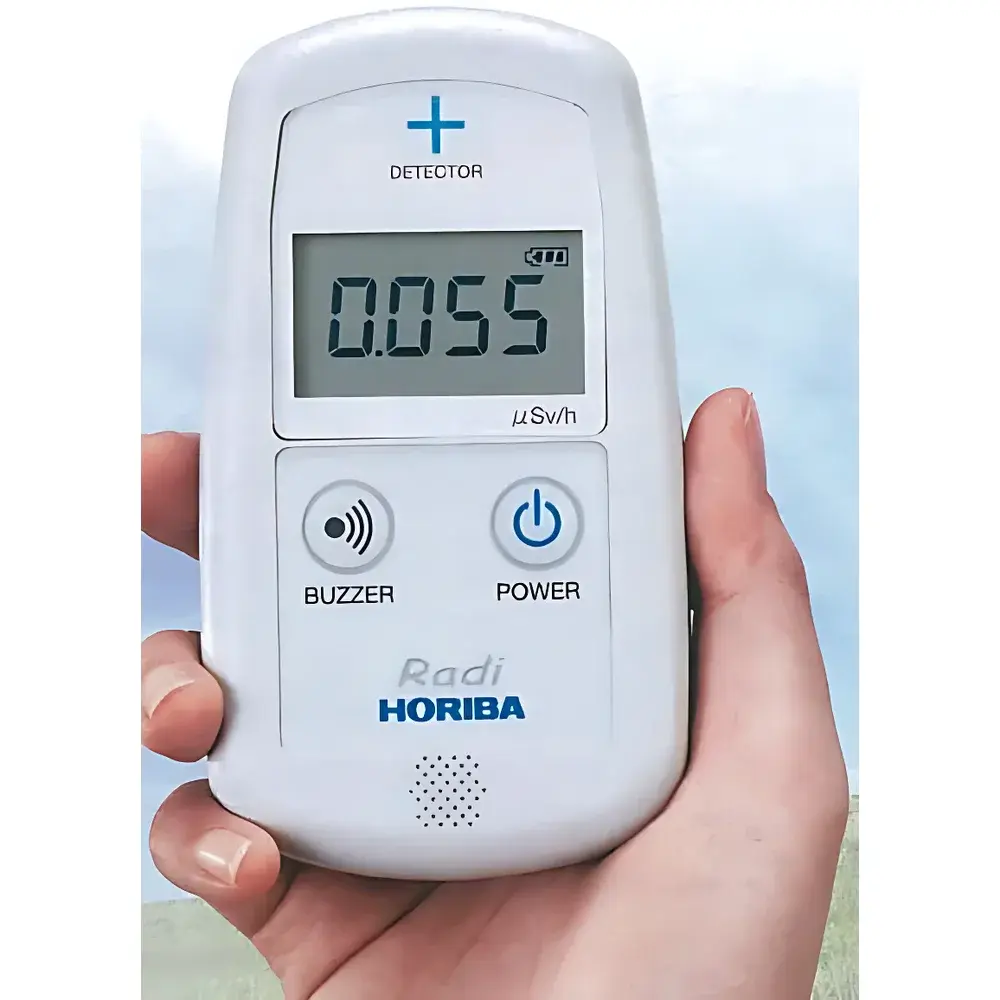
HORIBA PA-1000 Environmental Radiation Monitor
| Brand | HORIBA |
|---|---|
| Origin | Japan |
| Model | PA-1000 |
| Detection Principle | Scintillation Crystal (NaI(Tl)) |
| Radiation Type | Gamma (γ) Rays |
| Sensitivity | ≥1000 cpm at 1 µSv/h (Cs-137 reference) |
| Relative Error | ±10% |
| Energy Range | >150 keV |
| Energy Response | 0.5–3.0 × (150 keV–1250 keV, relative to Cs-137 @ 662 keV) |
| Measurement Range | 0.001–9.999 µSv/h |
| Display | 4-digit LCD, µSv/h unit |
| Averaging Interval | 60-second moving average |
| Update Interval | 10 seconds |
| Dimensions | 68(W) × 28(D) × 121(H) mm |
| Mass | ≤175 g |
| Power | Two AA alkaline batteries |
| Housing Material | Bio-based polymer (plant-derived plastic) |
| Audio Alert | Configurable on/off for dose rate change notification |
| Compliance | Designed for educational and environmental screening use |
Overview
The HORIBA PA-1000 Environmental Radiation Monitor is a compact, handheld gamma radiation survey instrument engineered for reliable, real-time monitoring of ambient gamma dose rates in non-regulated environments. It employs a thallium-doped sodium iodide (NaI(Tl)) scintillation detector—a well-established solid-state detection medium offering high photon detection efficiency across the diagnostic and environmental gamma energy spectrum. Unlike Geiger-Müller counters, the PA-1000 utilizes pulse-height discrimination principles inherent to scintillation spectroscopy to deliver stable, low-drift readings with enhanced signal-to-noise ratio. Its operational design targets educational outreach, citizen science initiatives, environmental awareness programs, and preliminary site screening—where qualitative trend analysis and comparative measurements are prioritized over absolute regulatory-grade traceability. The device does not meet IEC 60846 or ANSI N42.33 requirements for occupational dosimetry or emergency response instrumentation; it is explicitly designated for informational and pedagogical applications per HORIBA’s technical documentation.
Key Features
- NaI(Tl) scintillation detector optimized for gamma sensitivity above 150 keV, delivering consistent response from 137Cs (662 keV) through 60Co (1173 & 1332 keV)
- Low-power, battery-operated architecture (2 × AA) enabling continuous field operation for up to 200 hours under typical usage conditions
- Four-digit LCD display showing dose rate in µSv/h with automatic 60-second moving average calculation updated every 10 seconds
- Configurable audio feedback: user-selectable tone activation triggered by statistically significant changes in measured count rate
- Ergonomic, palm-sized form factor (68 × 28 × 121 mm) weighing ≤175 g, designed for extended handheld use during classroom demonstrations or community surveys
- Housing fabricated from certified bio-based polymer derived from renewable plant sources, aligned with ISO 16620-2 biobased content standards
- Power-on simplicity: single-button operation (POWER key) initiates measurement without menu navigation or calibration steps
Sample Compatibility & Compliance
The PA-1000 is exclusively configured for environmental gamma radiation detection and exhibits no sensitivity to alpha or beta emissions due to its sealed detector geometry and absence of thin entrance windows. It is not suitable for radon progeny assessment, surface contamination mapping, or mixed-field neutron/gamma environments. While compliant with JIS Z 4333:2019 for general-purpose radiation measuring instruments, it carries no CE marking for EU radiation protection devices (Directive 2013/59/Euratom), nor is it listed under FDA 21 CFR Part 1020.10 for radiation-emitting products. HORIBA explicitly states in its user manual that the PA-1000 is not intended for radiological safety evaluation, regulatory reporting, or decision-making related to human exposure limits defined by ICRP, IAEA Safety Standards Series No. GSR Part 3, or national dose constraint frameworks.
Software & Data Management
The PA-1000 operates as a standalone, firmware-embedded instrument with no USB, Bluetooth, or wireless connectivity. All data processing—including pulse counting, energy-weighted dose rate conversion using Cs-137 reference calibration, and 60-second moving average computation—is performed internally by an ASIC-based signal chain. No external software, drivers, or cloud synchronization is required or supported. Measurement history is not stored; the display reflects only the most recent averaged value. This architecture ensures immunity to cybersecurity vulnerabilities, eliminates dependency on proprietary platforms, and maintains full alignment with GLP principles for educational record-keeping where handwritten logs or timed photographic documentation serve as primary data capture methods.
Applications
- Classroom instruction on ionizing radiation fundamentals, including inverse-square law verification and shielding effectiveness studies using common materials (e.g., lead, aluminum, concrete blocks)
- Community-level environmental baseline surveys in urban parks, school grounds, or geological formations with naturally occurring radioactive material (NORM)
- Post-event public information campaigns following nuclear facility incidents or transport-related anomalies—used strictly for contextual orientation, not hazard assessment
- Comparative studies of background variation across elevation gradients, building materials (granite vs. wood), or seasonal atmospheric conditions
- Training modules for non-specialist personnel on radiation terminology, units (Bq vs. Sv), and distinction between activity, exposure, and dose equivalent
FAQ
Can the PA-1000 be used to determine whether a location is “safe” from radiation exposure?
No. The PA-1000 provides indicative gamma dose rate values only. Regulatory safety determinations require instruments traceable to national standards, validated uncertainty budgets, and adherence to protocols such as ISO/IEC 17025. This device lacks audit-ready calibration certificates and does not support uncertainty reporting.
Does it detect radon gas or its decay products?
No. Radon-222 and its short-lived progeny emit alpha particles and low-energy gamma/X-rays below the PA-1000’s effective detection threshold (>150 keV). Dedicated alpha spectrometers or electret ion chambers are required for radon assessment.
Is the bio-based housing certified to any international sustainability standard?
Yes. The polymer matrix complies with ISO 16620-2:2017, confirming ≥30% biobased carbon content via ASTM D6866 testing. Full material safety data sheets (MSDS) are available upon request from HORIBA’s Environmental Product Stewardship Group.
What is the recommended recalibration interval?
HORIBA specifies no routine recalibration for the PA-1000. Users are advised to perform functional checks using a verified 137Cs check source (e.g., 10 kBq) annually. Any deviation exceeding ±15% from baseline reading warrants return to an authorized HORIBA service center.
Can measurement data be exported to Excel or LIMS systems?
No. The PA-1000 has no data output interface. Quantitative results must be manually recorded or documented visually for integration into laboratory information management systems.







