
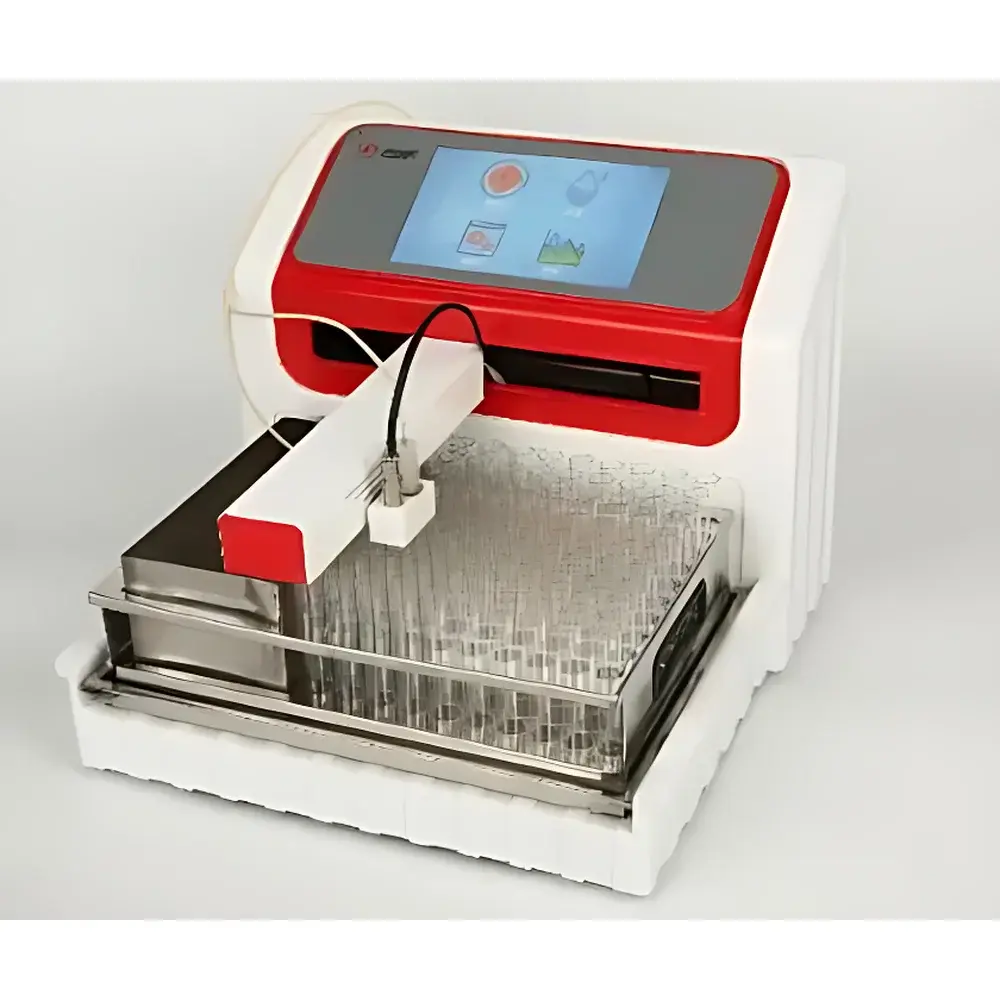
JP-KeebioFC Fraction Collector
| Brand | JiaPeng |
|---|---|
| Origin | Shanghai, China |
| Manufacturer Type | Authorized Distributor |
| Region of Manufacture | Domestic (China) |
| Model | JP-KeebioFC |
| Instrument Type | Mixed-Mode Fraction Collector |
| Collection Mechanism | Suspended X-Y Robotic Movement |
| Display | 8.5-inch HD Touchscreen |
| Tube Capacity Options | 100 × 12 mL (standard), 16 × 100 mL (optional), 36 × 50 mL (optional), 169 × 5 mL (optional) |
| Timing Range | 1 s – 999 h 59 min 59 s |
| Drop Counting Range | 1–9999 drops |
| Peak Threshold Range | 1–200 mV |
| Programmable Segments | 1–10 segments |
| Power Supply | AC 220 V, 50/60 Hz |
| Dimensions (W×D×H) | 385 × 390 × 310 mm |
| Weight | 14 kg |
| Continuous Operation Time | >200 hours |
| Data Retention (Power Loss) | Up to 10 years |
| Valve Actuation | 12 V DC Solenoid |
| Tube Tray Design | Modular Square Rack with Integrated Waste Channel |
| Corrosion Resistance | Compatible with aqueous and common organic solvents (e.g., methanol, acetonitrile, chloroform, ethyl acetate) |
Overview
The JP-KeebioFC Fraction Collector is an automated, microprocessor-controlled chromatography accessory engineered for precise, reproducible fractionation in preparative and analytical liquid chromatography workflows. It operates on a suspended X-Y robotic carriage system that positions collection tubes beneath the column effluent with sub-millimeter accuracy—eliminating mechanical drift and ensuring consistent drop placement across high-throughput runs. Unlike basic timer- or drop-triggered collectors, the JP-KeebioFC integrates multi-modal triggering logic: users may define collection events based on elapsed time, discrete drop count, analog UV/Vis peak signal amplitude (1–200 mV input range), or programmable multi-segment sequences (up to 10 independent steps per method). This flexibility supports both classical column chromatography and modern gradient-based separations where retention windows vary across elution profiles. Designed for integration into regulated environments, its hardware architecture complies with IEC 61010-1 safety standards for laboratory electrical equipment and features non-volatile memory capable of retaining method parameters and run logs for up to ten years—even after unexpected power loss.
Key Features
- Suspended X-Y motion system with belt-driven precision positioning—minimizes vibration transfer to column and detector, preserving baseline stability during collection.
- 8.5-inch capacitive touchscreen interface with intuitive Chinese/English bilingual menu navigation; supports real-time parameter adjustment, method recall, and live status monitoring.
- Multi-trigger collection logic: time-based, drop-counted, peak-threshold (analog voltage input), and program-segmented modes—each configurable independently per run.
- Modular tube rack design accommodates four standard configurations: 100 × 12 mL (default), 16 × 100 mL, 36 × 50 mL, or 169 × 5 mL—enabling seamless adaptation to analytical, semi-preparative, or high-resolution screening applications.
- Chemically resistant fluid path components—including PTFE-coated solenoid valves and stainless-steel mounting hardware—validated for compatibility with water, buffers, alcohols, ketones, esters, and halogenated solvents used in normal- and reverse-phase chromatography.
- Remote operation capability via Bluetooth-enabled mobile devices (iOS/Android) using the optional Blupad 1.0 companion app—supports method upload, real-time progress tracking, and emergency pause/resume functions without physical access to the instrument.
Sample Compatibility & Compliance
The JP-KeebioFC is routinely deployed in academic core facilities, biopharmaceutical QC labs, and natural product isolation workflows where solvent diversity and sample integrity are critical. Its analog input channel accepts standardized 0–200 mV signals from third-party UV-Vis detectors (e.g., Agilent G1365, Waters 2489, Shimadzu SPD-20A), enabling direct peak-triggered collection without proprietary interface licensing. The unit meets CE marking requirements under Directive 2014/30/EU (EMC) and 2014/35/EU (LVD), and its firmware architecture supports audit-ready operation when paired with validated chromatography data systems (CDS). While not inherently 21 CFR Part 11 compliant out-of-the-box, it generates timestamped, immutable collection logs (including trigger source, tube index, and elapsed time) that can be imported into compliant CDS platforms for full traceability in GLP/GMP environments.
Software & Data Management
Standalone operation requires no external PC—method storage, execution, and event logging occur entirely onboard via embedded flash memory. For advanced automation, the JP-KeebioFC communicates bidirectionally with Blupad 1.0 software (Windows 10/11) over USB or RS-232. Blupad enables volume-based collection (using calibrated flow rate inputs), dynamic threshold adjustment during runs, and export of CSV-formatted collection metadata—including tube ID, start/stop times, trigger type, and integrated peak area. All method files include digital signatures and version stamps, supporting revision control in ISO 17025-accredited laboratories. System logs retain full operational history (power cycles, valve actuations, error codes) with millisecond timestamps—essential for root-cause analysis during method troubleshooting.
Applications
- Protein purification via FPLC or AKTA systems—collecting eluate fractions across salt-gradient or pH-gradient washes.
- Natural product isolation from crude plant extracts using silica or C18 columns, with UV-triggered pooling of bioactive zones.
- Metabolite fractionation in LC-MS sample prep workflows—reducing matrix complexity prior to high-sensitivity detection.
- Quality control of oligonucleotide synthesis batches, where size-based separation on ion-exchange resins demands precise timed collection.
- Educational chromatography labs—teaching principles of retention time, resolution, and fraction pooling with reproducible, hands-off operation.
FAQ
What types of chromatography systems is the JP-KeebioFC compatible with?
It interfaces with any HPLC, FPLC, or gravity-fed column system delivering analog voltage output (0–200 mV) or TTL-level pulse signals for drop counting. No proprietary drivers are required.
Does the collector support method validation per regulatory guidelines?
While the hardware itself does not provide electronic signatures or user access controls, its deterministic behavior, non-volatile logging, and deterministic tube indexing meet foundational ALCOA+ criteria when integrated into a validated CDS environment.
Can collection parameters be modified mid-run?
Yes—via touchscreen or Blupad 1.0, users may adjust next-tube thresholds, pause/resume collection, or switch between trigger modes without interrupting column flow or compromising fraction integrity.
Is the tube rack design adaptable for custom tube formats?
The square modular tray uses standardized M4 mounting holes and includes alignment guides—third-party adapters for 96-well plates or cryovials can be mechanically integrated with minor bracket modifications.
What maintenance is required for long-term reliability?
Annual verification of X-Y positional accuracy (±0.2 mm tolerance) and solenoid valve response time (500,000 actuation cycles.







