
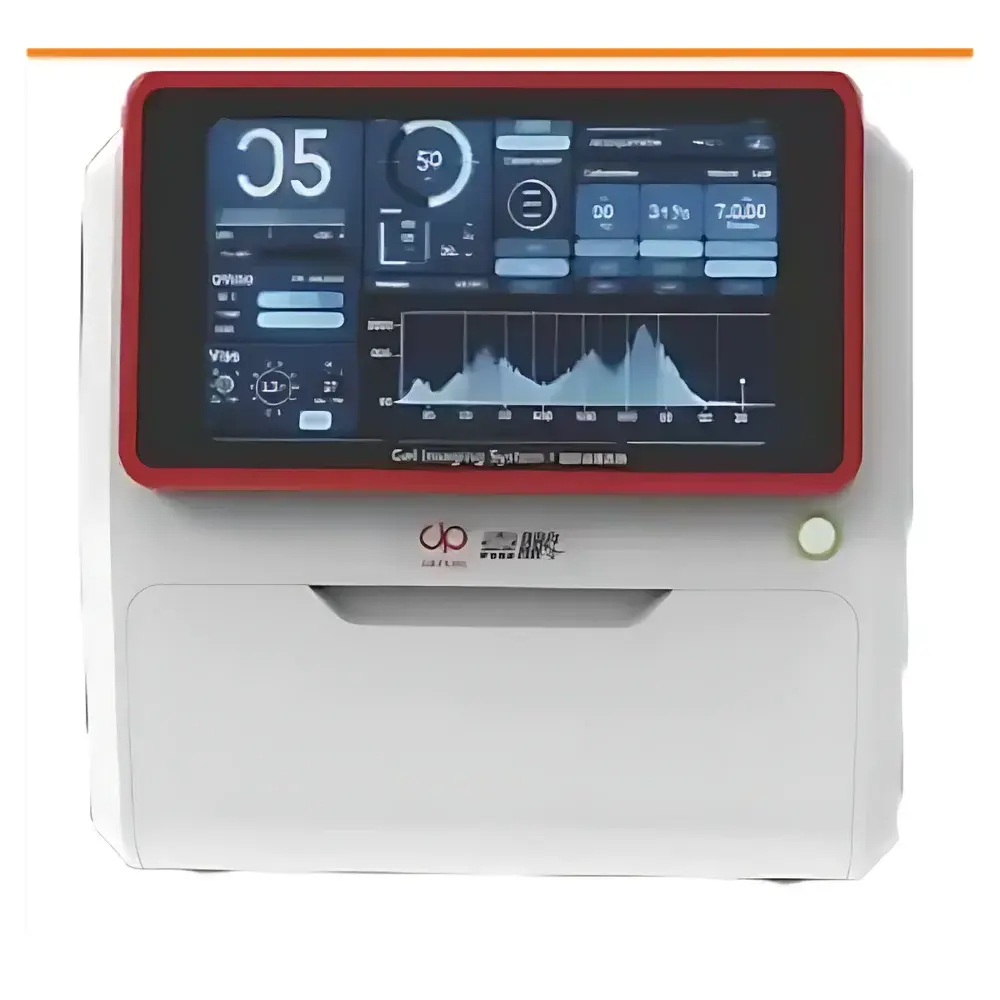
Jiapeng JP-388Plus Gel Imaging System
| Brand | Jiapeng |
|---|---|
| Origin | Shanghai, China |
| Model | JP-388Plus |
| CCD Resolution | 20 MP (5472 × 3660) |
| Bit Depth | 16-bit |
| Dynamic Range | 4.5 OD |
| CCD Sensor Size | 1-inch |
| Signal-to-Noise Ratio | ≥42 dB |
| Lens | Motorized Zoom Lens, 8–48 mm (6× optical zoom), f/1.2 aperture |
| UV Excitation | Transmitted 300 nm |
| UV Transilluminator Area | 210 × 260 mm |
| Blue/White Light Converter Plate | 210 × 300 mm |
| Standard Emission Filter | 590 nm |
| Software | JP-GEL 1D & JP Analysis 3.3 |
| Power Supply | AC 220 V, 50/60 Hz |
| Dimensions (W×D×H) | 440 × 430 × 460 mm |
| Weight | 19 kg |
Overview
The Jiapeng JP-388Plus Gel Imaging System is a fully automated, high-sensitivity digital imaging platform engineered for quantitative analysis of nucleic acid and protein electrophoresis gels, Southern/Northern/Western blots, and fluorescence-stained membranes. Based on scientific-grade CCD imaging technology with motorized optical control, the system captures high-fidelity luminescent and fluorescent signals across ultraviolet (UV), blue-light, and white-light excitation modes. Its core measurement principle relies on photon detection via a cooled 1-inch monochrome CCD sensor with 16-bit analog-to-digital conversion, enabling precise densitometric quantification of band intensity within a 4.5 optical density (OD) dynamic range — sufficient to resolve faint bands as low as 0.01 ng of ethidium bromide (EB)-stained double-stranded DNA. Designed for routine molecular biology laboratories, the JP-388Plus integrates hardware automation and software-driven workflow standardization to support reproducible, audit-ready documentation under GLP-compliant environments.
Key Features
- Motorized 6× optical zoom lens (8–48 mm, f/1.2) with programmable focus, iris, and exposure control — operated either via touch-panel interface or JP Analysis 3.3 software
- Scientific-grade 20-megapixel CCD sensor (5472 × 3660 pixels, 5.7 × 4.28 µm pixel size) delivering high spatial resolution and superior signal fidelity
- Dual-mode illumination system: Transmitted 300 nm UV for gel visualization; reflected 254 nm and 365 nm UV for membrane hybridization; plus switchable blue/white light converter plate (210 × 300 mm) for SYBR Safe®, GoldView™, and other non-UV dyes
- Integrated 13.3-inch industrial-grade touchscreen display with dedicated function keys — eliminating external PC dependency for basic acquisition and preview
- Real-time sample monitoring through UV-shielded observation window, enabling safe visual assessment without interrupting exposure cycles
- Auto-shutdown protocol: All light sources deactivate after 15 minutes of inactivity; full power-down upon software exit — extending lamp life and reducing thermal drift
- Comprehensive filter compatibility: Standard 590 nm emission filter optimized for EB, SYBR Green I/II, GelRed®, and similar intercalating dyes
Sample Compatibility & Compliance
The JP-388Plus accommodates standard electrophoresis formats including agarose (up to 15 cm × 15 cm) and polyacrylamide gels (up to 20 cm × 20 cm), as well as nitrocellulose and PVDF membranes. Its uniform UV transilluminator (210 × 260 mm) ensures consistent excitation across large-format gels. The system supports compliance with common laboratory quality frameworks: image metadata (exposure time, lens position, filter ID, gain setting) is embedded in TIFF exports per EXIF standards; acquisition logs are timestamped and user-attributed, facilitating traceability required under ISO/IEC 17025 and FDA 21 CFR Part 11 when paired with validated software configurations. While not certified as GMP-grade hardware, its architecture aligns with principles of ALCOA+ (Attributable, Legible, Contemporaneous, Original, Accurate, Complete, Consistent, Enduring, Available) for raw data integrity.
Software & Data Management
Bundled with two complementary analysis suites — JP-GEL 1D for routine band profiling and JP Analysis 3.3 for advanced multiplex quantification — the system provides tools for background subtraction, lane detection, molecular weight calibration, relative intensity normalization, and export of publication-ready figures. All images are saved natively in lossless TIFF format (16-bit linear grayscale), with optional JPEG compression for rapid sharing. Batch processing supports multi-gel alignment, cross-experiment comparison, and CSV-based report generation. Audit trail functionality records operator ID, session start/end timestamps, parameter modifications, and file export events — essential for internal QA review and regulatory inspection readiness.
Applications
- Quantitative analysis of PCR products, restriction digests, and DNA ladders in agarose and native PAGE
- Densitometric evaluation of Western blot band intensities for semi-quantitative protein expression studies
- Verification of cloning efficiency, plasmid purity, and CRISPR editing outcomes via fragment sizing
- Optimization of electrophoresis conditions through comparative gel brightness and resolution assessment
- Documentation of nucleic acid purification yields and degradation profiles using RNA integrity indicators
- Teaching laboratory use: standardized imaging protocols reduce inter-user variability in undergraduate molecular biology courses
FAQ
What safety features prevent UV exposure during operation?
The system incorporates a dual-interlock mechanism: the UV transilluminator and reflector lamps only activate when the darkroom lid is fully closed, and the front UV observation window contains a certified 99.9% UV-blocking acrylic shield rated for 254/300/365 nm wavelengths.
Can the JP-388Plus be integrated into a LIMS environment?
Yes — JP Analysis 3.3 supports configurable file naming templates and folder-based output routing, enabling direct ingestion by third-party LIMS via network shares or scheduled FTP transfers. Metadata export (XML/CSV) includes all acquisition parameters required for instrument interface mapping.
Is the 16-bit image data preserved throughout analysis?
All processing operations — including background correction, contrast enhancement, and band integration — are performed in floating-point precision on the original 16-bit linear data; final reports retain full bit-depth fidelity unless explicitly downsampled during export.
Does the system support chemiluminescence detection?
No — the JP-388Plus is optimized for fluorescence and UV-excited luminescence only. Chemiluminescent applications require dedicated cooled CCD systems with extended exposure capability (>30 min) and proprietary substrate-compatible optics, which are outside this model’s design scope.
How is calibration maintained over time?
The system includes built-in reference gel templates and step-wedge test targets for periodic verification of linearity and dynamic range. Users are advised to perform quarterly intensity calibration checks using standardized DNA ladders with known mass gradients, documented in lab-controlled calibration logs.




