
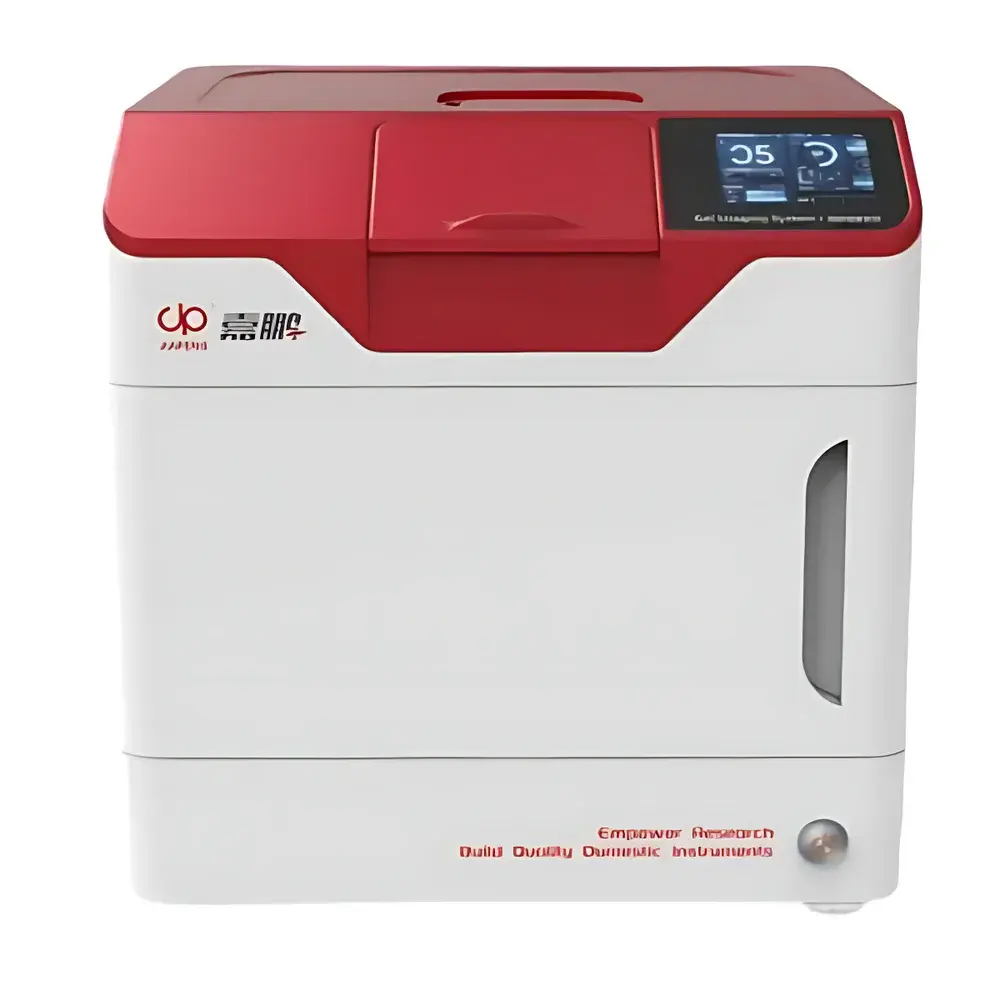
Jiapeng JP-UV2 Dual-Wavelength UV Transilluminator and Gel Documentation System
| Brand | Jiapeng |
|---|---|
| Origin | Shanghai, China |
| Model | JP-UV2 |
| Instrument Type | Darkroom-style |
| Wavelengths | 254 nm, 302 nm (transmission), 365 nm (reflection) |
| Filter Thickness | 5 mm amber short-pass filter |
| UV Lamp Count | 10 × 8 W tubes |
| Transmission Area | 260 × 210 mm |
| Filter Dimensions | 200 × 80 mm (reflection), 260 × 210 mm (transmission) |
| Power Input | AC 220 V, 50/60 Hz |
| UV Intensity at 20 cm | ≥20 µW/cm² |
| White Light Source | 10 W, 5500 K LED |
| Touchscreen | 4.3-inch capacitive LCD |
| Weight | 5.3 kg |
| Dimensions (L×W×H) | 440 × 338 × 270 mm |
| Compliance | JJF 1936–2021 (National Verification Regulation for UV Analyzers), Patented Design (ZL2012205175136, ZL201920792756.2) |
Overview
The Jiapeng JP-UV2 Dual-Wavelength UV Transilluminator and Gel Documentation System is an engineered solution for nucleic acid and protein visualization in molecular biology laboratories. It operates on the principle of ultraviolet-induced fluorescence—where ethidium bromide, SYBR Safe, GelRed, or other nucleic acid intercalating dyes absorb UV photons and emit visible light upon excitation. The system integrates both transmission (302 nm) and dual-band reflection (254 nm and 365 nm) UV illumination within a light-tight darkroom enclosure, enabling high-contrast detection of DNA/RNA bands in agarose and polyacrylamide gels, as well as fluorescently labeled proteins on membranes or TLC plates. Its optical architecture conforms to JJF 1936–2021—the national metrological verification regulation for UV analyzers in China—ensuring traceable intensity stability and uniform irradiance across the active transillumination area (260 × 210 mm). The inclusion of a 5 mm amber short-pass filter suppresses stray visible light while transmitting optimal UV excitation energy, enhancing signal-to-noise ratio during imaging.
Key Features
- Triple-wavelength UV illumination: 302 nm transmission for standard gel documentation; 254 nm and 365 nm reflection modes for alternative fluorophore excitation and surface-based assays (e.g., thin-layer chromatography or Western blot screening).
- 4.3-inch capacitive touchscreen interface with real-time UV intensity display (0–1000 µW/cm², optional sensor required), allowing precise exposure time calibration and protocol reproducibility.
- Dedicated camera mounting port and adjustable support frame compatible with DSLR and mirrorless systems (Canon EOS, Nikon DSLR, Sony α series), facilitating high-resolution gel photography without optical distortion.
- Integrated 10 W, 5500 K white LED reflector for post-UV documentation under visible light—enabling side-by-side comparison of stained vs. unstained regions or Coomassie/silver-stained protein gels.
- Front-facing anti-UV observation window with >99% UV attenuation (254–365 nm), permitting safe real-time sample assessment without opening the darkroom door.
- Ergonomic dual-side access ports with flexible glove-compatible openings for direct gel handling and precision excision using the included stainless-steel gel cutter (1 blade + 4 replaceable tips).
Sample Compatibility & Compliance
The JP-UV2 supports routine analysis of nucleic acids (DNA, RNA, PCR amplicons, restriction digests), fluorescently labeled proteins (e.g., GFP fusions), and small molecules resolved by paper chromatography or silica-based TLC plates. Its uniform 302 nm transillumination field meets the minimum irradiance requirement (≥20 µW/cm² at 20 cm) specified in JJF 1936–2021 for Class II UV analyzers. While not certified to ISO/IEC 17025 or FDA 21 CFR Part 11 out-of-the-box, the system’s stable output and documented wavelength accuracy make it suitable for GLP-aligned workflows where instrument performance qualification (IQ/OQ) is performed per laboratory SOP. All UV lamps are CE-marked and comply with IEC 62471 photobiological safety standards for UV hazard classification (Risk Group 2).
Software & Data Management
The JP-UV2 operates as a hardware platform requiring external imaging software (e.g., ImageLab, Quantity One, Fiji/ImageJ, or LabChart Gel Analysis Module) for band quantification, molecular weight estimation, and densitometric profiling. No proprietary firmware or cloud connectivity is embedded—ensuring full data sovereignty and compatibility with institutional IT security policies. Optional UV intensity logging (via external calibrated radiometer) enables audit-ready records for internal quality reviews. The touchscreen stores up to 10 user-defined illumination presets, supporting repeatable exposure conditions across shifts or operators.
Applications
- Nucleic acid gel documentation: Visualization and imaging of ethidium bromide- or SYBR-stained DNA fragments from standard agarose electrophoresis.
- PCR product validation: Rapid confirmation of amplification specificity and size fidelity prior to sequencing or cloning.
- DNA fingerprinting and RFLP analysis: High-resolution band pattern capture for forensic or population genetics studies.
- Protein detection on nitrocellulose/PVDF membranes: 254 nm reflection mode enhances sensitivity for UV-absorbing tags or intrinsic tryptophan fluorescence.
- Thin-layer chromatography (TLC) and paper chromatography: 365 nm excitation facilitates visualization of UV-active compounds (e.g., alkaloids, flavonoids, antibiotics) without derivatization.
- Gel excision and downstream processing: Integrated cutout ports and ergonomic lighting reduce UV exposure time during band isolation for extraction or mass spectrometry submission.
FAQ
What safety certifications does the JP-UV2 hold?
The unit complies with IEC 62471 for photobiological safety and adheres to JJF 1936–2021 metrological requirements. It carries CE marking for electromagnetic compatibility (EMC) and low-voltage directive compliance.
Is the UV intensity calibrated and traceable?
Yes—intensity uniformity and spectral output are verified against national standards during manufacturing. Optional NIST-traceable radiometer integration enables lab-level recalibration per ISO/IEC 17025 procedures.
Can the JP-UV2 be used for UV crosslinking?
No. It is designed exclusively for fluorescence excitation and visualization—not for nucleic acid crosslinking, which requires higher-intensity 254 nm sources (>1000 µW/cm²) and controlled dosimetry.
Does the system support time-lapse imaging?
Not natively. Time-resolved acquisition requires external camera control via USB or TTL trigger; the JP-UV2 provides stable illumination only.
What maintenance is required for long-term UV output stability?
UV lamps should be replaced every 1,000–1,500 operating hours to maintain ≥90% nominal irradiance. Filter surfaces must be cleaned weekly with lint-free wipes and isopropanol to prevent fluorescence quenching from residue buildup.





