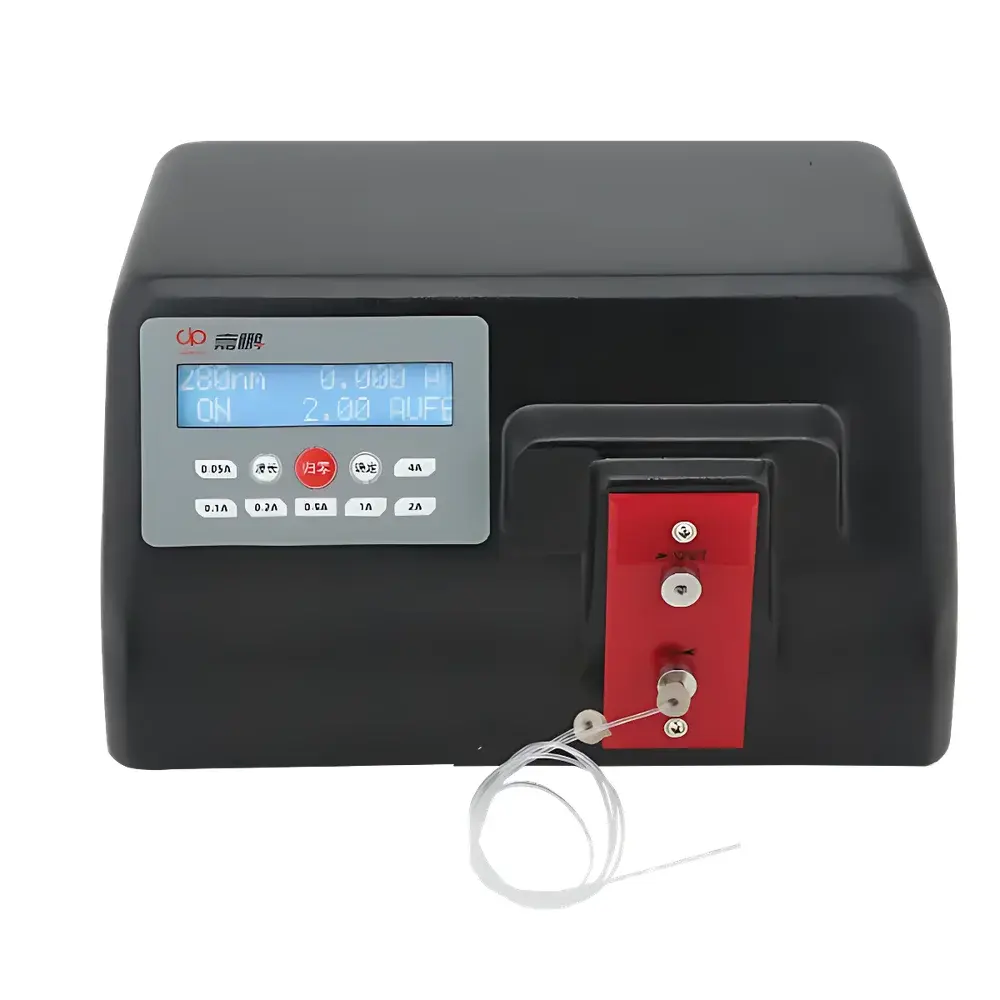
Jiapeng JP-2000 Dual-Beam Nucleic Acid & Protein Detector
| Brand | Jiapeng |
|---|---|
| Origin | Shanghai, China |
| Model | JP-2000 |
| Purification Principle | Ion Exchange Chromatography (IEX) |
| Gradient Type | Linear Gradient |
| Detection Wavelengths | 260 nm, 280 nm, 295 nm, 310 nm |
| Maximum System Pressure | 3 MPa |
| Light Source | LED (Lifespan > 50,000 h) |
| Optical Path Length | 2 mm |
| Sample Cell Volume | 10–120 µL |
| Baseline Noise | < 0.0001 A |
| Drift | ≤ 0.002 A/s |
| Sensitivity Range | 0.05–4 A (adjustable in 7 steps) |
| Zeroing | Dual-beam one-touch auto-zero |
| Display | High-definition blue-membrane LCD |
| Power Supply | AC 220 V, 50/60 Hz |
| Dimensions (W×D×H) | 205 × 300 × 180 mm |
| Weight | 2.6 kg |
Overview
The Jiapeng JP-2000 Dual-Beam Nucleic Acid & Protein Detector is a benchtop UV-Vis absorbance detector engineered for real-time monitoring of biomolecular elution profiles during liquid chromatography purification workflows. It operates on the principle of dual-beam photometry—where one beam passes through a reference flow cell and the other through the sample flow cell—enabling continuous baseline correction and high signal stability without pre-warmup time. Designed specifically for ion exchange chromatography (IEX), the instrument supports linear gradient elution and delivers quantitative absorbance measurements at four fixed wavelengths critical for biomacromolecule characterization: 260 nm (nucleic acid backbone), 280 nm (aromatic amino acids), 295 nm (tryptophan-specific), and 310 nm (background correction or denatured protein assessment). Its 2 mm optical path length and low-volume flow cell (10–120 µL) optimize sensitivity for small-scale purification runs typical in academic labs, QC facilities, and early-stage bioprocess development.
Key Features
- Dual-beam optical architecture with simultaneous reference and sample beam detection—eliminates lamp drift and solvent absorption artifacts
- LED-based cold light source with >50,000-hour operational lifetime and negligible thermal load on sensitive biological samples
- Seven-step adjustable sensitivity (0.05–4 A full scale) to accommodate wide dynamic range—from crude lysates to highly purified fractions
- One-touch dual-beam zeroing function ensures rapid recalibration between runs without manual alignment or hardware intervention
- High-stability analog electronics yielding baseline noise < 0.0001 A and drift ≤ 0.002 A/s—meeting performance thresholds required for reproducible peak integration in regulatory-compliant environments
- Compact footprint (205 × 300 × 180 mm) and lightweight design (2.6 kg) facilitate integration into laminar flow hoods, glove boxes, or modular purification rigs
- Native compatibility with GE Healthcare chromatography columns and AKTA systems via standardized Luer-lock or 1/16″ PEEK tubing interfaces
Sample Compatibility & Compliance
The JP-2000 is validated for use with aqueous mobile phases common in IEX purification—including Tris-HCl, sodium acetate, and phosphate buffers across pH 3–10. Its flow cell construction resists corrosion from low-concentration chaotropic agents (e.g., up to 1 M NaCl, 0.5 M ammonium sulfate) and mild organic modifiers (<5% v/v ethanol or isopropanol). While not certified to ISO 13485 or FDA 21 CFR Part 11 out-of-the-box, its hardware architecture supports audit-trail-capable data acquisition when paired with Blupad Chromatography Workstation (software copyright registered: 2019SR0680657). The system meets general laboratory safety standards per IEC 61010-1 and electromagnetic compatibility requirements per EN 61326-1. For GLP/GMP applications, users may implement procedural controls—including electronic logbooks, user access levels, and raw data archiving—to satisfy internal validation protocols.
Software & Data Management
The optional Blupad Chromatography Workstation provides real-time chromatogram visualization, peak detection, area integration, and retention time annotation. Data export is supported in CSV, TXT, and native .blup formats; JPEG snapshot capture (one-click save) enables rapid documentation for lab notebooks or regulatory submissions. The software implements timestamped event logging (system startup, wavelength change, zeroing, gradient start/stop) and allows manual annotation of fraction collection triggers. While the base unit operates standalone via its integrated LCD interface, USB 2.0 connectivity enables firmware updates and configuration backup. All acquired absorbance traces are stored with metadata including date/time stamp, wavelength setting, sensitivity level, and operator ID (when entered manually)—supporting traceability under ISO/IEC 17025 clause 7.7.
Applications
- Monitoring elution profiles during IEX purification of monoclonal antibodies, recombinant enzymes, and histidine-tagged proteins
- Quantitative tracking of nucleic acid yield in plasmid or mRNA purification workflows
- Assessing protein folding state via 295/280 nm absorbance ratio shifts in buffer exchange experiments
- Validating column equilibration and gradient formation in method development for biologics manufacturing
- Supporting educational chromatography labs where robustness, ease of operation, and cost-effectiveness are prioritized over ultra-high resolution
- Field-deployable quality control in agricultural biotech settings for rapid screening of plant-derived therapeutic peptides
FAQ
What chromatography techniques is the JP-2000 optimized for?
It is specifically designed for ion exchange chromatography (IEX) with linear gradients, though it can be used with hydrophobic interaction (HIC) or size exclusion (SEC) methods if compatible solvents and flow rates are maintained.
Can the JP-2000 be connected to third-party fraction collectors or pumps?
Yes—its analog output (0–1 V or 0–5 V, selectable) and TTL-compatible trigger input support synchronization with most commercial fraction collectors and syringe or HPLC pumps.
Is the flow cell replaceable, and what materials is it constructed from?
The standard flow cell is fused silica with stainless steel end fittings and is field-replaceable; alternative quartz or sapphire cells are available upon request for aggressive solvent compatibility.
Does the instrument support wavelength scanning or only fixed-wavelength detection?
The JP-2000 uses fixed-wavelength LED sources at 260, 280, 295, and 310 nm—no scanning capability is implemented, ensuring maximal photometric stability and signal-to-noise ratio at these biologically relevant bands.
How is calibration performed, and is NIST-traceable verification possible?
Calibration is performed using neutral density filters and certified holmium oxide solution (for wavelength verification); while the instrument does not include factory NIST-traceable certification, its optical design permits third-party metrological validation per ASTM E275 and USP <857>.