
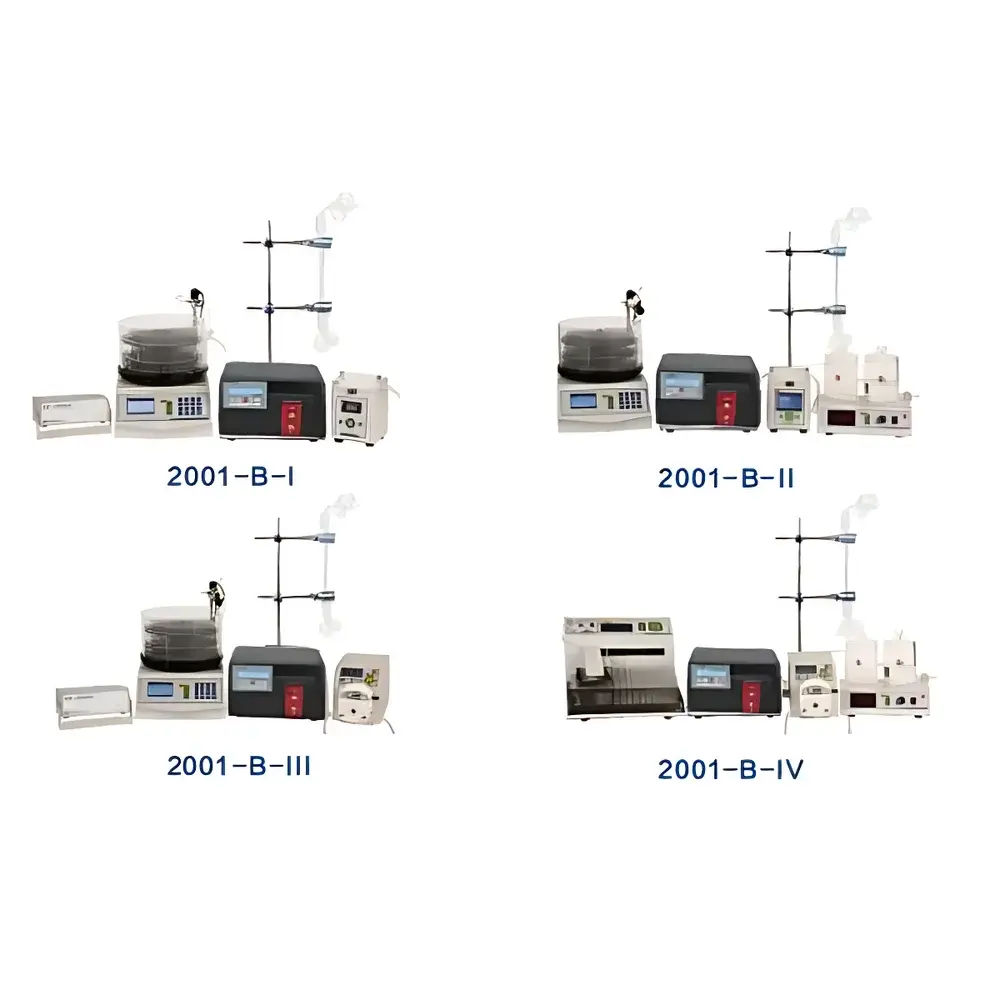
Jiapeng 2001-B Series Automated Low-Pressure Liquid Chromatography System
| Brand | Jiapeng |
|---|---|
| Origin | Shanghai, China |
| Model | 2001-B Series |
| Instrument Type | Low-Pressure Liquid Chromatograph (LPLC) |
| Flow Rate Range | 0.5–900 mL/h (dual-channel), up to 14,500 mL/h (single-channel) |
| UV Detection Wavelengths | 260 nm & 280 nm (standard) |
| optional | 310 nm & 405 nm |
| Detector | JP-3000 Dual-Beam Nucleic Acid/Protein UV Detector |
| Fraction Collector | DBS-100 / CBS-B / BSZ-100 (configurable, 100-tube capacity, max 12 mL/tube) |
| Collection Modes | Time-based, Drop-counting, Peak-triggered (0–100 mV or 0–250 mV threshold), Programmable tube numbering |
| Gradient Mixing | TH-500A Gradient Mixer (1000 mL capacity) |
| Column Compatibility | GE-compatible interfaces (e.g., for pre-purification on AKTA systems) |
| Display | High-contrast blue-membrane LCD with real-time dual-beam zero calibration |
| LED Light Source Lifetime | >50,000 hours |
| Data Acquisition | Real-time logging of time, UV absorbance, gradient profile, fraction index, and optional conductivity/temperature inputs |
Overview
The Jiapeng 2001-B Series Automated Low-Pressure Liquid Chromatography System is an engineered solution for preparative and analytical-scale chromatographic separations under ambient pressure conditions. Designed around the principles of classical column chromatography—where solute partitioning between a stationary phase and a mobile phase drives resolution—the system supports isocratic and linear gradient elution across a broad flow range (0.5–900 mL/h per channel). Its architecture integrates modular fluidic components—including precision peristaltic or constant-flow pumps, a dual-beam UV detector optimized for biomolecular absorbance at 260 nm (nucleic acids) and 280 nm (proteins), and a programmable fraction collector—enabling reproducible separation of macromolecules, natural products, and small-molecule compounds. Unlike high-performance liquid chromatography (HPLC) platforms, this LPLC system operates at pressures ≤ 5 bar, minimizing hardware complexity while maintaining compatibility with standard glass or polypropylene columns (e.g., 1.0 × 50 cm, 1.0 × 70 cm, 2.6 × 50 cm) and GE-style fittings for seamless integration into upstream/downstream workflows, including AKTA-based purification pipelines.
Key Features
- Dual-beam UV detection with real-time auto-zero functionality ensures baseline stability and minimizes drift during extended runs.
- Modular pump configuration supports flexible flow control: HL-2F, DHL-B, BT-100SD, and other peristaltic/constant-flow variants accommodate diverse solvent viscosities and column backpressures.
- Programmable fraction collector (DBS-100/CBS-B/BSZ-100) enables precise collection via four independent modes—time, drop count (1–9999 drops), peak threshold (0–250 mV analog input), and user-defined tube numbering—ensuring unambiguous sample tracking.
- TH-500A gradient mixer provides linear two-solvent blending (up to 1000 mL total volume), supporting method development for ion exchange, gel filtration, and affinity chromatography.
- Blue-membrane LCD interface delivers high-contrast visualization of real-time parameters: elapsed time, UV signal, gradient slope, active tube index, and system status—all accessible without external software.
- GE-compatible column adapters allow direct use of commercially available prepacked columns (e.g., Sephadex, HiTrap), facilitating method transfer and scalability validation.
Sample Compatibility & Compliance
The 2001-B Series accommodates aqueous and organic-aqueous mobile phases commonly used in bioseparations (e.g., PBS, Tris-HCl, ammonium acetate, methanol/water gradients). It is routinely deployed for purifying recombinant proteins, plasmid DNA, polysaccharides, plant extracts, and synthetic intermediates. While not certified for Good Manufacturing Practice (GMP) environments, its design aligns with general laboratory best practices outlined in ISO/IEC 17025 for testing laboratories. Data integrity is supported through timestamped, non-editable fraction indexing and detector output logging—features consistent with GLP-compliant documentation requirements for academic and industrial R&D. The system does not include 21 CFR Part 11-compliant electronic signatures or audit trails; such functionality requires integration with validated third-party acquisition software.
Software & Data Management
The instrument includes embedded firmware for real-time acquisition and display of chromatographic data—including UV trace, gradient profile, and fraction assignment—but does not ship with proprietary PC-based control software. Raw analog outputs (e.g., 0–1 V UV signal, TTL pulse for drop counting) are provided for integration with external data acquisition systems (e.g., LabChart, MATLAB, or custom Python/NI LabVIEW applications). All displayed parameters—including run time, peak height, tube number, and collection trigger events—are retained in volatile memory during operation and may be manually recorded or exported via RS-232 or analog output interfaces. For long-term archiving, users typically pair the system with commercial chromatography data systems (CDS) that support analog input ingestion and comply with institutional data retention policies.
Applications
This system serves as a core platform in academic teaching labs, biotech process development groups, and quality control units requiring cost-effective, robust chromatographic separation. Typical use cases include: desalting and buffer exchange of protein samples prior to mass spectrometry; purification of monoclonal antibody fragments via size-exclusion chromatography; isolation of polyphenols from botanical matrices using reversed-phase or ion-exchange media; and rapid screening of enzyme reaction products in kinetic assays. Its low-pressure operation makes it particularly suitable for fragile biomolecules and labile natural products where high-shear stress or elevated temperatures must be avoided. The modular design also supports pedagogical demonstrations of chromatographic theory—including retention time prediction, resolution calculation (Rs), and column efficiency (N)—in undergraduate analytical chemistry curricula.
FAQ
Is the 2001-B Series compatible with HPLC columns?
No. It is designed exclusively for low-pressure applications (≤5 bar) and uses standard glass or plastic columns with internal diameters of 1.0–2.6 cm. HPLC columns (typically 4.6 mm ID, rated for >200 bar) are mechanically and hydraulically incompatible.
Can I connect the UV detector to third-party data acquisition software?
Yes. The JP-3000 detector provides analog voltage output (0–1 V full scale) and TTL-compatible trigger signals, enabling integration with most generic DAQ hardware and software platforms.
Does the system support pH or conductivity monitoring?
Not natively. However, analog inputs from external pH/conductivity meters can be routed into optional auxiliary channels on compatible data loggers when paired with the system’s analog output interface.
What is the maximum column length supported?
The standard configuration includes columns up to 70 cm in length (e.g., 1.0 × 70 cm). Longer columns may be used if flow rates and backpressure remain within pump specifications and system tubing limits.
Is method validation support included?
The system provides operational repeatability and basic parameter logging but lacks built-in tools for IQ/OQ/PQ documentation, calibration certificate generation, or electronic signature compliance. These elements require supplementary SOPs and external validation packages.
Related Products




